

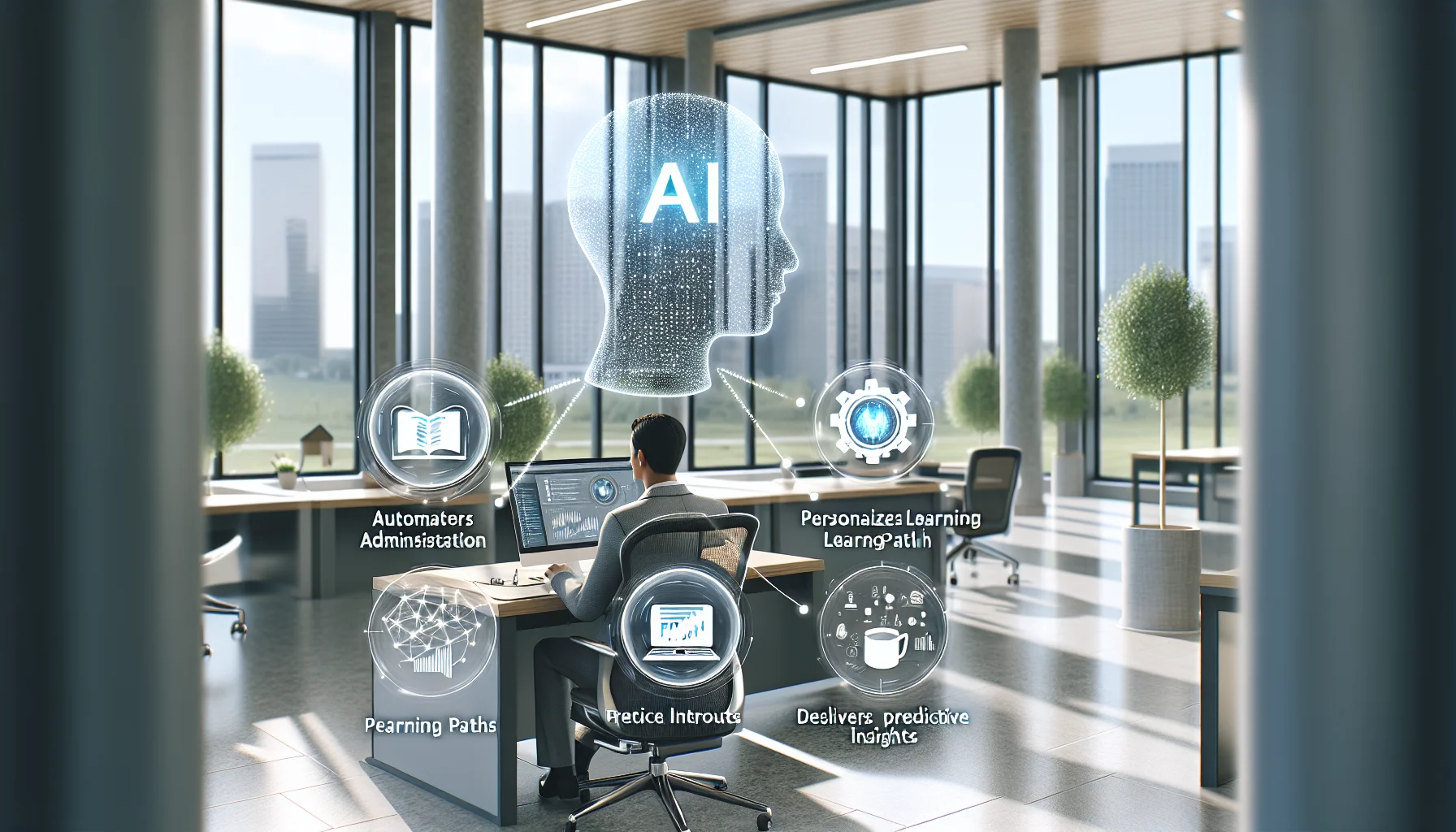
AI in LMS automates administration, personalizes learning paths, and delivers predictive insights to improve completion and skill transfer. This article explains adaptive learning mechanics, concrete AI features, a four-step implementation framework, measurement metrics, and governance practices to pilot safely and demonstrate ROI for learning programs.
AI in LMS is no longer a novelty—it's a force multiplier for learning programs. In our experience, successful learning teams move beyond pilot projects to embed artificial intelligence learning throughout course design, delivery, and analytics. This article explains the practical roles AI plays in modern LMS platforms, gives real examples, and provides a step-by-step approach you can use to evaluate and implement AI capabilities safely and effectively.
Readers will get concrete answers to questions people ask about implementation, measurement, and the kind of features that deliver measurable outcomes. We focus on personalized learning LMS approaches, adaptive learning mechanics, and how to surface value quickly for stakeholders.
At a high level, AI in LMS serves three interlocking roles: automating routine tasks, enhancing personalization, and delivering predictive insights. These roles reduce administrative friction and make learning more relevant to individual performance gaps.
We've found organizations benefit most when AI is used to free subject matter experts for high-value activities instead of focusing on content assembly or manual reporting. The two immediate gains are efficiency and relevance.
Learning programs face budget pressure and demand for measurable impact. AI in LMS can compress learning cycles and increase skill transfer rates, which directly affects business KPIs like productivity and retention.
Industry research shows adaptive and personalized approaches improve completion and application rates; in our experience, programs that combine automation with human coaching show the best outcomes.
Adaptive learning is one of the most tangible benefits of using AI in LMS. Instead of forcing every learner through the same sequence, adaptive systems continuously assess mastery and adjust content, practice, and assessment in real time.
Adaptive engines use item response data, time-on-task, and behavior signals to build a learner model. That model feeds content selection and spacing algorithms to optimize retention and reduce cognitive overload.
When we ask "how ai personalizes lms learning paths," the answer is a layered process:
In practice, this reduces irrelevant content exposure and accelerates readiness. A pattern we've noticed is that learners who receive adaptive sequences reach functional proficiency 20–40% faster compared with linear modules.
When evaluating platforms, look for concrete feature sets that show how AI in LMS translates to learner impact. Below are practical examples that move beyond buzzwords.
These are the features that consistently produce measurable improvements in completion, engagement, and skill adoption.
Two concise examples illustrate impact. First, a sales onboarding program that uses recommendation engines to prioritize practice scenarios based on early role-play results saw a 30% lift in quota attainment among new hires.
Second, a compliance training initiative used automated assessments and micro-remediation to reduce repeat failures by 45% and lowered administrative review time by 60%.
Implementing AI in LMS requires pragmatic sequencing. In our experience, teams that pilot with focused use cases and clear KPIs move faster and scale safely.
Start with low-risk, high-impact features, validate with real data, and then broaden the scope. Below is a simple four-step framework we use with clients.
The turning point for most teams isn’t just creating more content — it’s removing friction. Tools like Upscend help by making analytics and personalization part of the core process, turning raw usage data into prioritized interventions that learning teams can act on quickly.
When selecting vendors, evaluate data portability, model transparency, and governance capabilities rather than only feature checklists.
Measuring the effectiveness of AI in LMS is both straightforward and often neglected. The key is linking learning signals to business outcomes through a combination of proximal and distal metrics.
Proximal metrics measure learning behavior; distal metrics measure business value. You must track both to make a compelling case for continued investment.
Use a balanced set:
Common pitfalls we've seen include over-reliance on engagement metrics, ignoring data quality issues, and deploying opaque models that practitioners don't trust. Address these by establishing clear validation tests, data audits, and model explainability routines.
Looking ahead, AI in LMS will move from feature-based add-ons to infrastructure-level services that power orchestration across talent systems. Expect more federated learning models, stronger privacy-preserving techniques, and standards for competency interoperability.
Ethics and governance will be central. Guardrails should include explicit consent, bias testing, human oversight, and plans for remediation when AI-driven recommendations produce unintended consequences.
Industry practices we recommend:
How much data do you need before AI helps? Quality and relevance matter more than volume; even modest datasets can drive recommendation engines when paired with strong taxonomies.
Can small teams use AI effectively? Yes—by focusing on targeted pilots and leveraging platforms that provide model management and explainability out of the box.
AI in LMS has matured from experimentation to practical application. When applied correctly, it reduces administrative burden, increases the relevance of learning, and accelerates skill acquisition. The strongest results come from combining automated personalization with human coaching and clear outcome measurement.
To make progress, start with a focused use case, collect the right signals, and build a feedback loop that ties learning behavior to business outcomes. In our experience, this iterative approach leads to sustainable adoption and clear ROI.
If you're evaluating next steps, identify one business metric to influence, map the data you need, and run a short pilot to validate assumptions. That approach turns abstract promises about artificial intelligence learning into tangible improvements.
Ready to move from theory to practice? Choose a pilot that targets a measurable KPI, assemble a cross-functional team, and set a 90-day evaluation cadence to learn fast and scale responsibly.
The Upscend Team provides actionable insights on technology and business strategy.
Book a walkthrough and we'll show you how it applies to your own content.
 L&D
L&DDecember 21, 2025
This article explains how AI in LMS personalizes learning through content tagging, learner modeling, recommendation engines, and adaptive assessment. It provides a three‑phase rollout (pilot, scale, optimize), measurement tiers (micro/meso/macro), common pitfalls, and a practical 90-day pilot plan for L&D teams to validate and scale personalization.
 Lms
LmsDecember 23, 2025
AI-driven adaptive learning in LMS platforms personalizes content by combining diagnostics, predictive models, and business rules to recommend microlearning, quizzes, or coaching. Teams see faster proficiency, higher engagement, and data-driven insights. Start with a narrow 90-day pilot, ensure data hygiene, and maintain human oversight for high-stakes decisions.
 Lms
LmsDecember 23, 2025
This article explains how ai personalization lms uses adaptive learning algorithms and recommendation engines to tailor content, increase engagement, and shorten time-to-competency. It outlines practical design steps, implementation checklists, common pitfalls with mitigations, and a measurement framework. Readers get immediate actions—pilot, tagging standard, and a KPI-linked dashboard—to start testing.
 Lms
LmsDecember 24, 2025
AI LMS platforms combine adaptive learning, learning analytics AI, and workflow integration to deliver personalized eLearning that reduces ramp time, improves retention, and aligns training to business outcomes. Implement via discovery, pilot, scale, and optimize—prioritize KPIs, data readiness, governance, and a focused 90-day pilot to validate impact.