

 Embedded Learning in the Workday
January 11, 2026
Small automated learning nudges can erode trust and create legal risk unless L&D applies explicit consent, transparency and data minimization. Use layered consent, short contextual privacy notices, cross‑functional governance and quarterly audits. Pilot nudges, measure completion and employee sentiment, and include easy opt‑outs to preserve privacy while keeping learning impact.
 Embedded Learning in the Workday
January 11, 2026
This article provides a reproducible nudge pilot program template L&D teams can run in 4–8 weeks. It covers defining a single measurable objective, picking a 50–200 user cohort, designing 2–3 messaging variants and a calendar, and pre-registering metrics and success criteria to test notification nudges and decide whether to scale.
 Embedded Learning in the Workday
January 11, 2026
This article explains how compensation learning alignment — via skill-based pay, pay-for-certification, or promotion-linked learning — can increase internal mobility and cut voluntary turnover. It offers a six-step implementation, compliance checklist, sample costing scenarios, and communication templates to pilot and scale programs while protecting equity and managing payroll impact.
 Embedded Learning in the Workday
January 11, 2026
This article shows practical, low-risk ways to design content incentives employees will actually use. It explains four incentive models, quality controls to prevent gaming, a decision matrix by company size, sample reward structures, and a 90-day pilot with measurable gains. Use the guidance to pilot balanced incentives tied to impact.
 Embedded Learning in the Workday
January 11, 2026
This article provides a step-by-step, modular employee content training curriculum that converts subject-matter experts into frequent content creators without pulling them from day-to-day work. It includes sample lesson plans, rubrics, operational timelines (one-day and 8-week), measurement metrics, and mitigations for time, fear, and quality issues.
 Embedded Learning in the Workday
January 11, 2026
Employee advocacy analytics and systematic A/B testing turn ad‑hoc employee sharing into a repeatable channel. This article outlines priority experiments (post format, CTAs, timing), a four‑step analytics framework, measurement tiers, statistical basics for small samples, and two week‑long test plans with decision rules to scale winners.
 Embedded Learning in the Workday
January 11, 2026
This article explains how to create internal content governance and employee content policy templates, approval workflows, and a decision tree to triage risky posts. It includes a global compliance checklist and practical tips to automate routing, ensure disclosures, and maintain audit trails so organizations can scale peer-generated content safely.
 Embedded Learning in the Workday
January 11, 2026
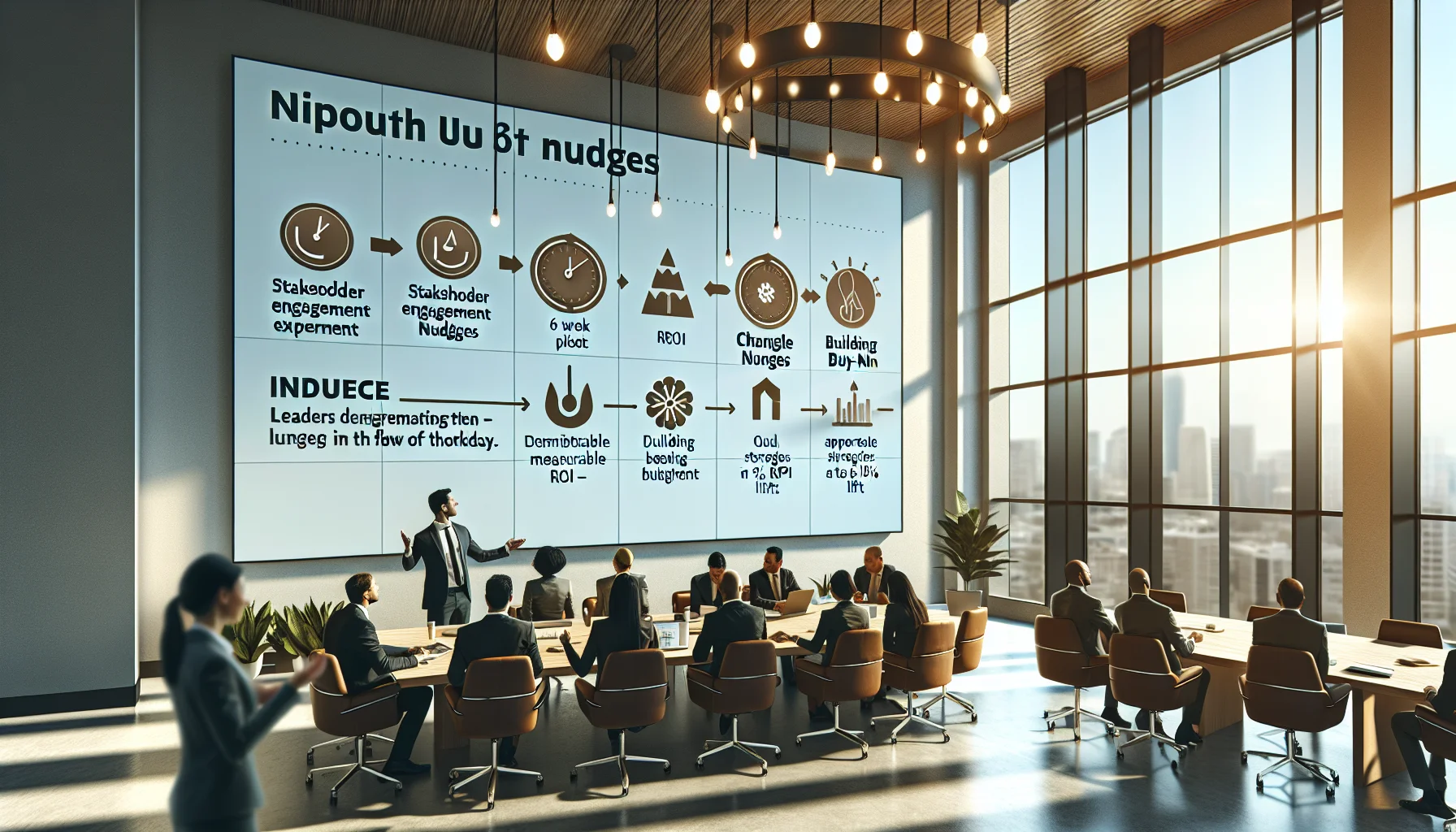
Leaders can build buy-in nudges by aligning nudges to one or two KPIs, running time-boxed 6-week pilots, and measuring rapid outcomes. Use tailored messages for executives, managers, and learners, simple pilot templates, ROI calculations, and objection scripts. A 90-day engagement plan and manager enablement accelerate adoption and scaling.
 Embedded Learning in the Workday
January 11, 2026
This article explains why leadership buy-in employee advocacy determines whether peer-generated content pilots scale. It outlines common executive objections and a five-step persuasion plan—define goals, run a low-risk pilot, present executive-ready metrics and a one-page business case—and shows how to report outcomes to secure sustained C-suite sponsorship.
 Embedded Learning in the Workday
January 11, 2026
This article explains how leaders model a 'forever learner' mindset to improve retention by making learning visible, protected, and practice-based. It provides concrete leader actions, program design tips, two leader profiles, and a checklist managers can use immediately to embed learning into day-to-day work.
 Embedded Learning in the Workday
January 11, 2026
This article explains how to combine LMS, LXP, microlearning, knowledge bases, mentorship, and analytics to sustain employee learning for 10+ years. It provides evaluation criteria, a simple 1–5 scoring rubric, vendor-sizing examples, a decision matrix, and a 90-day pilot checklist to measure retention, engagement, and business outcomes.
 Embedded Learning in the Workday
January 11, 2026
The article shows how lifelong learning improves learning ROI retention by lowering turnover, raising productivity, and enabling internal mobility. It provides three ROI models, a spreadsheet-ready template, sensitivity scenarios, and executive metrics (ROI, payback, NPV) to help L&D leaders quantify value and build a defensible business case.
 Embedded Learning in the Workday
January 11, 2026
This article lists the primary and secondary nudge metrics L&D teams should track—open rate, CTR, completion, time-to-completion, retention, behavior change, and ROI—plus formulas, sample SQL, attribution approaches, and dashboard guidance. Start by instrumenting delivery and completion events, run A/B tests, and add operational metrics to prove impact.
 Embedded Learning in the Workday
January 11, 2026
This article defines nudge fatigue, lists early warning metrics (opt-outs, CTR drops, latency), and offers tactical mitigations: frequency caps, smart throttling, contextual relevance, opt-in tiers, and message bundling. It includes a decision flowchart, case studies, and an implementation checklist to run 30–90 day pilots and restore sustainable engagement.
 Embedded Learning in the Workday
January 11, 2026
This article explains how to align peer-generated content with employer brand and recruitment goals using templates, channel tactics, measurement, and governance. It covers spotlights and day-in-the-life formats, A/B testing tied to applicant quality and time-to-hire, and a phased 7-step rollout to scale authentic employee content.
 Embedded Learning in the Workday
January 11, 2026
This article provides a tactical, step-by-step checklist to launch peer-generated product campaigns with employees. It covers pre-launch alignment, role-based content briefs, short compliance training, scheduling windows, daily measurement loops, and a post-launch scaling playbook. Use the sample briefs and approval workflow to run a controlled pilot and measure reach, CTR and conversions.
 Embedded Learning in the Workday
January 11, 2026
This article explains how to sustain a remote learning culture in remote and hybrid teams through asynchronous microlearning, virtual cohorts, buddy systems, manager check-ins, and short learning rituals. It provides a phased 90-day blueprint, platform capabilities to prioritize, and solutions for engagement and time‑zone challenges with two short case examples.
 Embedded Learning in the Workday
January 11, 2026
This article gives a practical, low-cost playbook for small business learning programs: prioritize 6–8 high-impact skills, use blended 70/20/10 delivery, run 4–8 week learning sprints, and implement lightweight tracking and manager accountability. It includes a 6–12 month pilot plan, a budget estimator for ~50 employees, and a small-vendor shortlist.
 Embedded Learning in the Workday
January 11, 2026
Employee advocacy mistakes—like poor governance, unclear goals, and no measurement—often derail peer-generated content programs. This article lists the top 10 pitfalls, provides a pre-launch checklist, a remediation playbook, and KPI categories. Use the two-week audit and provided templates to prioritize fixes and restore momentum quickly.
 Embedded Learning in the Workday
January 11, 2026
This article presents a five-stage L&D framework—needs analysis, design, delivery, reinforcement and evaluation—to produce measurable lifelong learning. It recommends KPIs (skill attainment, internal moves, retention), blended in‑flow delivery, and technology for longitudinal measurement. Leaders should start with a 90-day pilot, baseline data and matched cohorts to test impact.