


Organizations should not automatically replace LMS platforms with LXPs. Evaluate Cost, Integrations, Content readiness and Change capacity (CICC) before migrating; many contexts, especially compliance-heavy or budget-constrained environments, benefit from interim optimizations like modularizing content and lightweight recommendation engines that preserve continuity and improve outcomes.
In many conversations with L&D leaders we've heard a near-mantra: don't replace LMS platforms the moment LXPs appear. That advice isn't conservative for its own sake — it's pragmatic. In this article we unpack the practical reasons to pause before performing a wholesale swap, outline when not to upgrade, and provide a simple decision framework to protect compliance, budget, and learning continuity.
Our aim is to help teams decide deliberately, not reactively. We'll cover compliance-heavy scenarios, cost and integration realities, typical LXP limitations, and tactical optimizations that extend the life and value of a well-configured LMS.
There is a strong vendor push for migration: LXPs promise modern UX, AI-driven recommendations, and social learning. That promise is compelling, but it creates a market narrative that upgrading is always the right move. In our experience, that narrative overlooks three realities: sunk costs in content, the maturity of integrations, and the operational needs of regulated environments.
Claiming a new platform will fix every problem is risky. Many organizations discover post-migration that essential reports are missing, mandatory workflows break, or compliance evidence does not map cleanly. Before you sign a new multi-year contract, validate those assumptions.
Industry benchmarks show adoption gaps: studies indicate that 30–50% of features in new learning platforms go unused in the first year due to governance and change management issues.
There are clear situations where you should explicitly consider the reasons to keep using LMS rather than rushing to an LXP.
Each scenario reflects a trade-off: LXPs excel at discovery and engagement, but structured compliance workflows and formal reporting are a core strength of mature LMS solutions.
Ask these questions: Do you need auditable completion records? Is your content primarily mandatory e-learning? Do integrations with HR, payroll, or credentialing systems require strict uptime? If yes, this is clear guidance for when an LXP is not the right choice.
Rushing to replace an LMS introduces tangible risks. Three stand out: operational disruption, compliance exposure, and wasted spend. Operational disruption can impact onboarding and customer-facing training.
Case example: a mid-sized healthcare payer migrated to a flashy LXP and lost seven weeks of reporting continuity during a benefits enrollment period — a measurable compliance breach. That organization later paused full rollout and maintained the LMS for mandatory training, adopting the LXP only for optional learning paths.
Migration is not a technology event; it’s an organizational transformation. Treating it as the former is where most programs fail.
Use a pragmatic framework to decide. We suggest evaluating four dimensions with red/yellow/green status visuals: Cost, Integrations, Content readiness, and Change capacity (CICC).
Rate each dimension: Red = delay and optimize; Yellow = plan phased migration; Green = migrate with clear milestones. This structured approach avoids one-off decisions driven by vendor FOMO.
Give each dimension a 1–5 score and build a simple dashboard. A combined score below 12 suggests you don't replace LMS yet. Scores between 12–15 warrant a phased approach, and above 15 indicates migration readiness.
If your CICC assessment suggests delay, there are high-impact optimizations that extract more value from an LMS without replacing it. These fall into three buckets: technical, content, and governance.
Practical example: a global logistics firm deferred a big LXP purchase and instead invested in content modularization and a lightweight recommendation engine on their LMS. Completion rates rose 22% in six months and procurement cleared more budget for strategic pilots.
Some of the most efficient L&D teams we work with use platforms like Upscend to automate this entire workflow without sacrificing quality. That pattern — incremental automation layered on a stable LMS — often reduces the urgency to migrate while improving learner outcomes.
Before: A 90-minute compliance module, single-file SCORM package, hard-coded due dates, limited reporting. Learners skip content or fail audits.
After: The same compliance outcome delivered as four 12-minute micro-modules, automated reminders, and dashboard metrics mapped to audit requirements. Same LMS, better outcomes.
The right choice isn't binary: don't replace LMS is a strategic position when compliance, integrations, budget, or content readiness are at risk. We've found that teams who pause to evaluate often achieve better outcomes through phased adoption or targeted optimization rather than an all-in platform swap.
Next steps: run the CICC scoring, assemble a cross-functional migration steering group, and prioritize three low-cost optimizations you can deploy in 60–90 days. That approach preserves continuity, protects compliance, and builds the evidence base for a future migration if and when it becomes the clear, measurable next step.
Final note: Replace certainty with a plan. When you choose deliberate delay, you convert risk into an operational advantage and ensure any future move to an LXP is strategic, not reactive.
The Upscend Team provides actionable insights on technology and business strategy.
Book a walkthrough and we'll show you how it applies to your own content.
 General
December 14, 2025
Frustrated administrators and learners should evaluate best LMS alternatives with an outcomes-first framework: define performance goals, score vendors on UX/integrations/analytics, pilot, and plan phased migration. Prioritize modern LMS platforms that reduce admin hours, support SCORM/xAPI, and provide HR/SSO connectors to accelerate adoption and measurable ROI.
 General
December 22, 2025
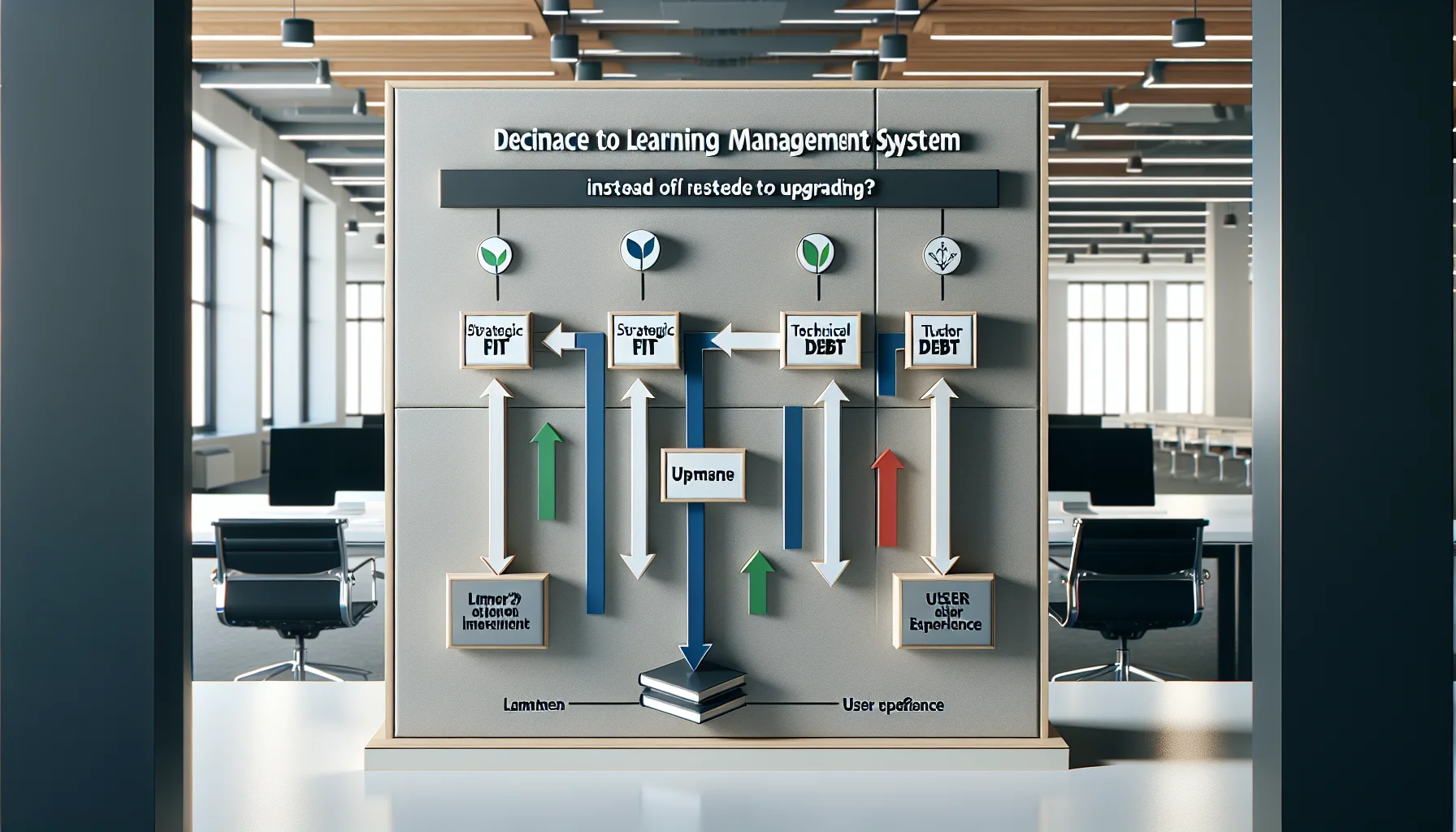
Use a three-axis framework—strategic fit, technical debt, and user experience—to decide whether to replace LMS or upgrade. Track migration signals (security, integrations, analytics), build a 3–5 year TCO, run a pilot migration, follow an eight-step playbook, and retain legacy records until compliance is verified.
 Business Strategy&Lms Tech
December 31, 2025
Moving from an LMS to an LXP shifts compliance from a single-system model to an ecosystem problem. Organizations must map authoritative event owners, enforce metadata and role-based publishing, implement tamper‑evident audit trails, and make certification provenance auditable. Use a governance layer and quarterly reconciliations to maintain regulatory training integrity.
 Business Strategy&Lms Tech
January 28, 2026
Traditional LMS rollouts often fail succession planning due to weak governance, poor UX, misaligned incentives, and missing competency models. The article highlights diagnostic signals (e.g., <20% logins in 90 days), prescribes competency-driven pilots, manager enablement, integration-first design, and a 90-day recovery playbook to restore promotion-readiness.