


Traditional LMS rollouts often fail succession planning due to weak governance, poor UX, misaligned incentives, and missing competency models. The article highlights diagnostic signals (e.g., <20% logins in 90 days), prescribes competency-driven pilots, manager enablement, integration-first design, and a 90-day recovery playbook to restore promotion-readiness.
LMS rollout failures are the first visible sign of a deeper organizational mismatch: wasted budget, stalled leadership pipelines, and pilots that never graduate. In our experience, these failures show consistent patterns across industries — not random glitches. This article diagnoses common symptoms, analyzes root causes, and prescribes practical alternatives so talent leaders can pivot from wasted spend to measurable succession outcomes.
Before a rollout collapses, symptoms emerge. Recognizing them early lets you take surgical action instead of wholesale replacement. We've found the same signs at multiple clients and vendors.
Symptoms to track:
These symptoms often precede full-scale breakdowns where succession pipelines stagnate. When you see these indicators, treat the rollout as a strategic problem, not purely a technology issue.
Drilling down, four root causes account for the majority of LMS rollout failures: weak governance, poor user experience, misaligned incentives, and absence of a robust competency model. A simple fishbone-style analysis clarifies where to intervene.
Governance failures mean no clear owner for succession outcomes. Without accountable owners, roadmaps slip and prioritization falters.
User experience shortcomings — confusing navigation, mobile-unfriendly design, and slow content discovery — kill adoption quickly. Studies show platforms with intuitive UX see engagement rates 2–3x higher.
In our experience, governance failures manifest as competing owners (HR, IT, L&D) with different success metrics. When incentives are misaligned, the platform becomes a checkbox. A strong governance model defines clear KPIs, escalation paths, and a cross-functional steering committee focused on leadership pipeline outcomes.
Lack of a valid competency model reduces the LMS to a library of courses instead of a strategic engine for promotion-ready talent. Fixing this requires mapping role-level competencies, tying content to behaviors, and measuring proficiency — not completions.
Why LMS projects fail is often a combination of predictable execution errors and cultural resistance. Common failure modes include treating the LMS as a product launch rather than a capability transformation, and neglecting the people side of change.
Typical causes observed:
Two pilot case examples illustrate the pattern. In one global manufacturer, a large LMS rollout produced low engagement because leaders received no guidance on how to use learning data in promotion conversations. In another firm, a carefully scoped pilot failed to expand because the governance committee dissolved after go-live.
“Pilots fail most often when success criteria are ambiguous and ownership is diffuse.”
These examples reinforce that technology without process and accountability yields predictable LMS rollout failures.
Fixing the problem requires changing how you design pilots, govern rollouts, and curate content. Below are practical alternatives we've used to reverse failing initiatives.
Pilot design: narrow the scope to a single leadership cohort, define success metrics tied to promotion readiness, and run the pilot for a full promotion cycle (6–12 months).
Change management: embed manager enablement and tie learning data to performance calibration. We've found manager nudges increase course completion and application by 40%.
Modern LMS platforms — Upscend is one example — are evolving to support AI-powered analytics and personalized learning journeys based on competency data, not just completions. These capabilities illustrate the emerging best practices around data-driven succession.
Implementing any one of these alternatives reduces the risk of repeating the same LMS rollout failures.
When a rollout is already failing, a staged recovery playbook helps restore momentum without a full rip-and-replace. This stepwise roadmap focuses on stabilizing outcomes and rebuilding trust.
Risk-mitigation checklist:
| Failure lane | Recovery lane |
|---|---|
| Checkbox compliance and course completions | Competency progress and promotion-readiness scores |
| Duplicated content and wasted spend | Curated competency-aligned microlearning |
| Diffuse ownership | Cross-functional governance with clear KPIs |
Use this table as a visual reference for moving from failure lanes to recovery lanes. Annotated fishbone diagrams of your own process can help prioritize interventions.
LMS rollout failures are rarely caused by a single factor. In our experience, the most durable fixes combine a competency-driven approach with clear governance, focused pilots, and manager-enabled change management. Treat the LMS as an organizational capability, not a product purchase.
Key takeaways: define success metrics tied to promotions, map content to competency outcomes, enforce cross-functional ownership, and measure progress in readiness — not just completions. A short recovery sprint (90 days) followed by phased expansion reduces risk and preserves investment.
Next step: run a 90-day diagnostic: inventory users and content, confirm a competency model, and launch a constrained pilot with manager involvement. This is the fastest, lowest-risk way to fix LMS rollout failures and restore momentum to your leadership pipelines.
The Upscend Team provides actionable insights on technology and business strategy.
Book a walkthrough and we'll show you how it applies to your own content.
 General
December 14, 2025
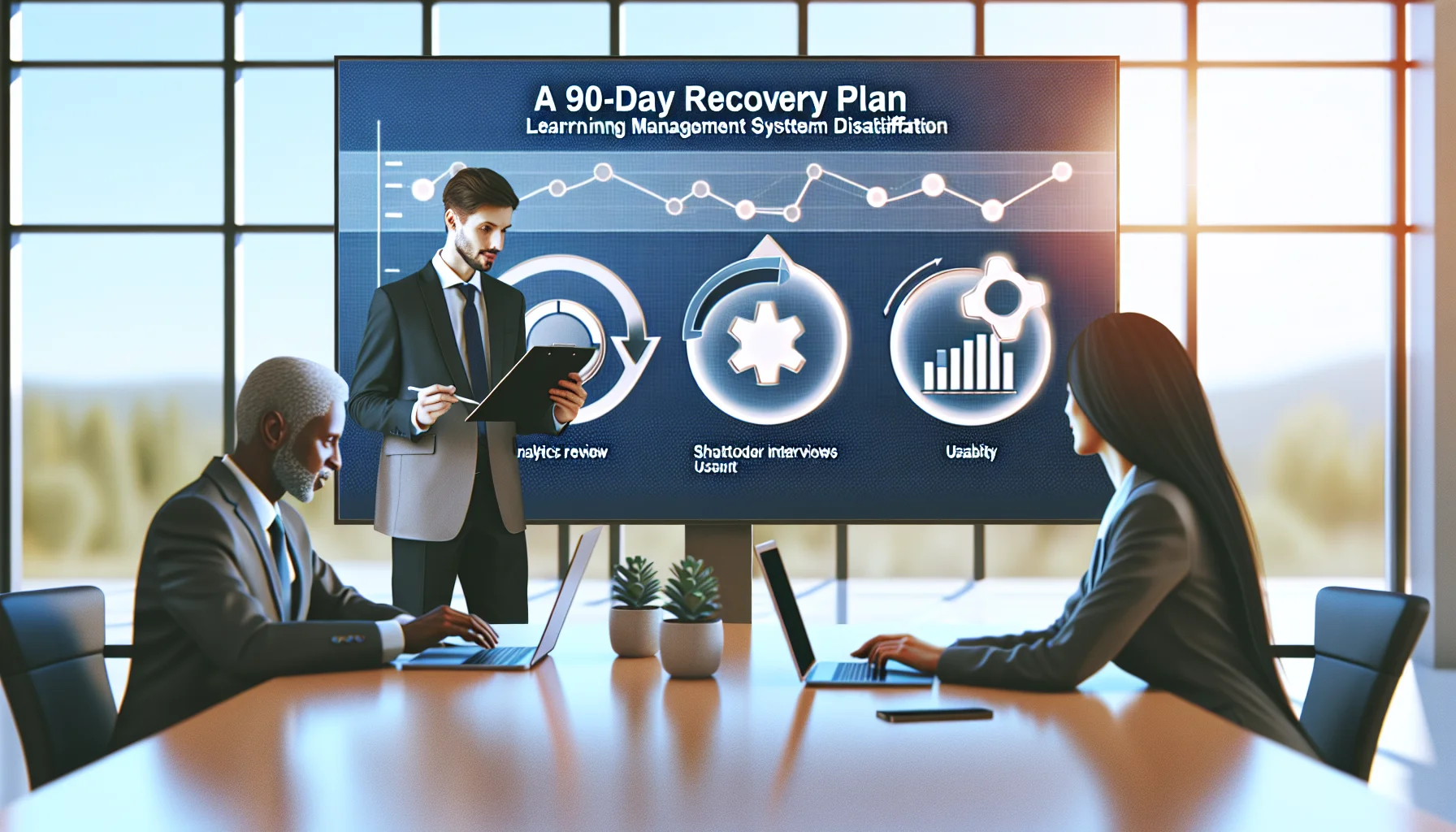
This article outlines a three-stage diagnostic—analytics review, stakeholder interviews, and usability testing—to identify LMS dissatisfaction drivers. It prioritizes quick wins (0–30 days), medium fixes (30–120 days), a 90-day recovery plan, and governance practices to measure and sustain LMS user adoption.
 L&D
L&DDecember 14, 2025
This article identifies five recurring problematic LMS features—clunky navigation, poor UX, slow performance, lack of mobile learning, and feature bloat—and gives diagnostic checklists and replacement plans. It recommends quick wins (navigation, mobile, performance), a 90-day roadmap, and governance steps to measure impact and scale improvements.
 L&D
L&DDecember 14, 2025
Employees resist LMS platforms due to low perceived value, poor UX, and weak managerial support. This article outlines quick 0–30 day wins, medium and long-term fixes, and a three-track approach—product, workflows, manager enablement—plus a checklist and KPIs to measure progress and reduce pushback during new LMS rollouts.
 Lms
LmsDecember 23, 2025
This article identifies common lms rollout pitfalls — strategy misalignment, technical surprises, user adoption gaps, and weak governance — and gives a phased framework: discovery, pilot, scale, sustain. It recommends sandboxed integrations, risk-based prioritization, microlearning, manager enablement, and governance with outcome-based KPIs to reduce time-to-value.