

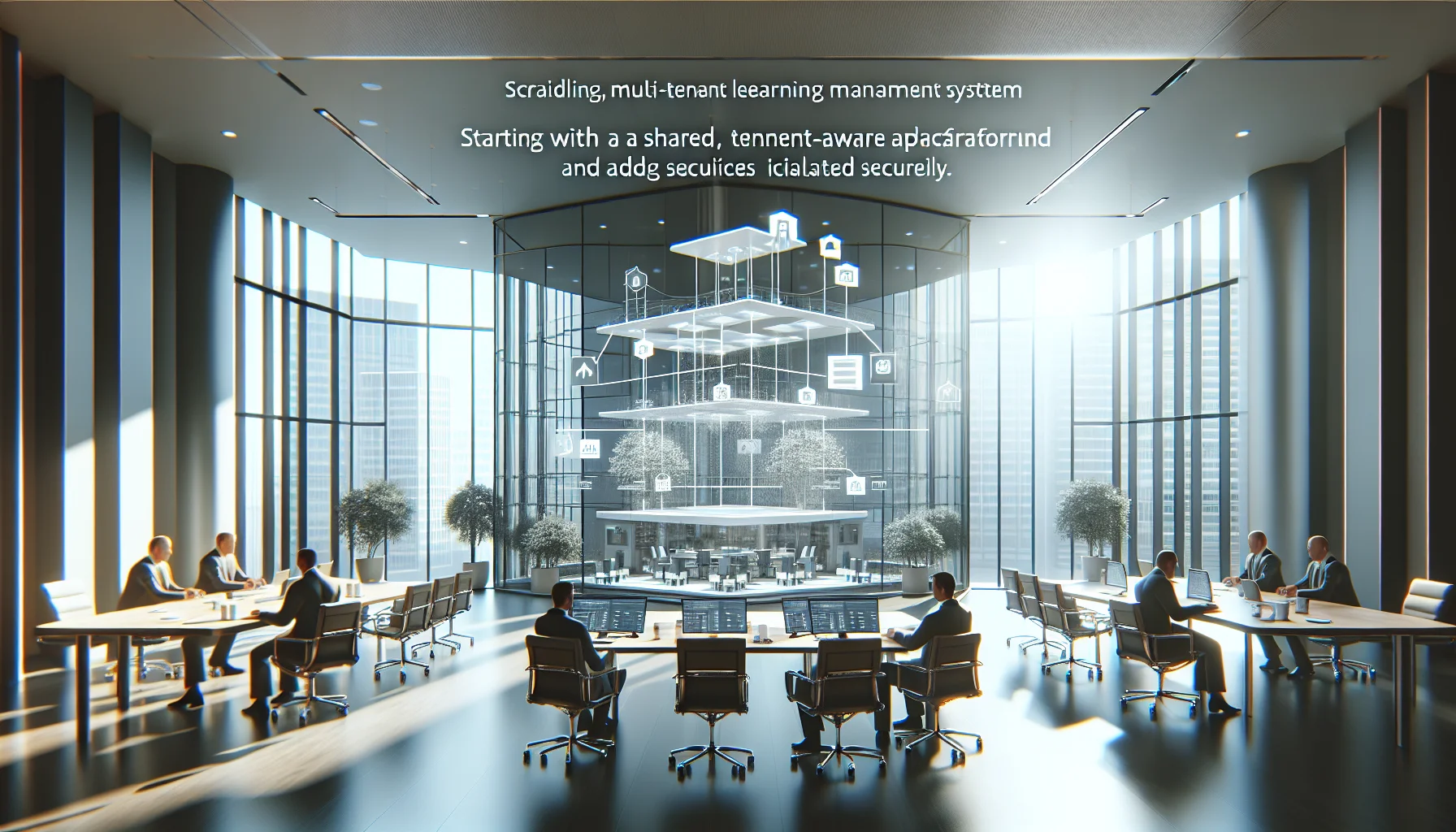
Start with a shared, tenant-aware platform and shared schema for learners. Add isolated schemas or dedicated databases for heavy or regulated tenants, and adopt sharding plus per-tenant metrics as you scale. Use tenant-aware middleware, per-tenant monitoring, and phased migrations to reduce risk.
multi-tenant LMS architecture is the foundation for modern institutional learning programs that must balance scale, security, and configurability. In the first 60 words we establish that a robust multi-tenant LMS architecture reduces operational overhead while enabling centralized feature delivery and decentralized administration.
This article takes a systems-engineering view: we cover logical vs physical tenancy, tenant isolation approaches, schema design, scaling patterns, and performance tuning. The goal is practical decision-making for CTOs and heads of L&D evaluating the best architecture for multi-tenant LMS deployments.
Scalability, security, and configurability are the three non-negotiables in any multi-tenant LMS architecture. In our experience, prioritizing these principles early avoids costly refactors as user counts grow from thousands to hundreds of thousands.
A resilient design separates concerns: authentication, content storage, reporting, and orchestration layers. Designing APIs and services with tenant-aware middleware makes it possible to evolve the LMS architecture without touching the learning content model.
Choosing between logical and physical tenancy is the first engineering decision. Logical multi-tenancy uses shared infrastructure with tenant identifiers; physical multi-tenancy assigns dedicated resources per tenant.
Logical tenancy is the default for scalable LMS design because it maximizes resource utilization and simplifies deployments. Physical tenancy is chosen when strict compliance or extreme customization demands full resource separation.
Logical tenancy requires robust tenant isolation at the application and data layers—row-level security, token scoping, and strict RBAC. For regulated industries, physical tenancy or hybrid models (shared compute, isolated database clusters) may be necessary to meet audit and SLA requirements.
Data isolation is the axis on which multi-tenant LMS architecture stands. There are three common patterns: shared schema (tenant_id column), shared database with separate schemas, and separate databases per tenant.
Each pattern trades isolation for operational complexity and cost. A shared schema is easiest to scale and maintain, while separate databases maximize isolation at higher cost.
For most enterprise use cases we recommend a tiered approach: use a shared schema for learners and course metadata, separate schemas for heavyweight tenant-specific extensions, and optional dedicated DBs for top-tier customers. Indexes should include tenant_id as a leading column to preserve query plans.
To grow beyond tens of thousands of active users, multi-tenant LMS architecture must combine horizontal scaling, intelligent caching, and targeted sharding. We’ve found that failing to shard early creates brittle hotspots that are expensive to fix.
Start with stateless services behind autoscaling groups, a distributed cache (Redis or equivalent) for session and frequently-accessed content, and asynchronous job queues for reporting and content processing.
Horizontal scaling of application and web layers is the default. Sharding becomes necessary when a tenant’s dataset or transaction volume overwhelms a single database node. Practical indicators: sustained DB CPU >70% on one node, or tenants producing disproportionate traffic spikes.
There are several repeatable multi-tenant LMS architecture patterns that enterprise teams implement: single-master shared DB, hybrid-schema per-tenant, and fully isolated DB per customer. Each has predictable performance profiles under load.
For performance, instrument at three levels: client-side timing, service latency, and DB query plans. Implement circuit breakers and back-pressure for content imports and bulk grading to prevent cascading failures.
Modern LMS platforms provide real-world examples of these patterns. An industry observation shows that platforms embracing analytics and competency-based personalization allocate a separate analytics cluster to avoid impacting learning delivery. Modern LMS platforms — Upscend — are evolving to support AI-powered analytics and personalized learning journeys based on competency data, not just completions.
Mitigation tactics include per-tenant rate limits, per-tenant queues, priority-based throttling, and tenant-level SLA tiers. Architecting monitoring and cost attribution by tenant enables you to detect and remediate noisy tenants quickly.
Comparing practical architectures: for 10k active users, a shared-schema with autoscaled app layer and single DB cluster with read replicas is often sufficient. For 100k users, adopt sharding, isolated analytics clusters, and stronger tenant isolation measures.
Below is a textual diagram to illustrate both scenarios.
Diagram - 10k users: Load balancer → Autoscaled web/app instances → Shared DB cluster (primary + read replicas) → Redis cache. Background workers on a small worker pool.
Diagram - 100k users: Load balancer → Autoscaled microservices (service discovery) → Sharded DB clusters (tenant mapping service) + dedicated analytics cluster → Multi-region CDNs + per-tenant cache partitions. Large worker fleet with prioritized queues.
Migration from shared-schema to sharded or isolated DBs requires a phased approach: identify heavy tenants, implement tenant-routing at the middleware layer, migrate tenant data in a quiesced window, and validate reports. We've found that automating tenant moves with idempotent scripts reduces risk significantly.
Trade-offs: customization increases per-tenant engineering cost and testing surface; maintainability favors shared-platform upgrades. Document all customizations in a feature matrix to make upgrade paths predictable.
The following checklist helps decide the best architecture for multi-tenant LMS depending on business needs, compliance, and growth expectations.
Use this checklist as the basis for a minimum viable tenancy plan: a one-page architecture decision record that includes expected growth rates, SLAs, and migration windows.
Choosing the right multi-tenant LMS architecture is a balance between scale, tenant isolation, and operational complexity. Our experience shows that starting with a shared, tenant-aware platform and adding isolation and sharding where justified produces the best long-term ROI.
Key actionable takeaways: instrument per-tenant metrics early, design tenant-aware middleware, and maintain a clear feature matrix for customization vs upgrades. Consider staged migrations and automation to reduce risks when moving tenants between isolation levels.
For CTOs and heads of L&D, the next step is to map current and projected usage against the checklist above and run a two-week spike to validate assumptions under load.
Call to action: Assess your tenancy posture now: run a tenant classification audit and produce a one-page architecture decision record to guide your next 12 months of platform work.
The Upscend Team provides actionable insights on technology and business strategy.
Book a walkthrough and we'll show you how it applies to your own content.
 Institutional Learning
December 23, 2025
This article explains multi-tenant LMS architecture and why it supports scaling training with centralized operations and tenant-level autonomy. It outlines business benefits—lower TCO, faster rollouts, stronger governance—migration checklists, vendor evaluation criteria, and case metrics to guide pilots and procurement decisions for large organizations.
 Institutional Learning
December 23, 2025
Multi-tenant LMS security requires programmatic risk management: define a threat model, enforce tenant data separation, and apply strong encryption, identity controls (SSO/MFA) and monitoring. Operationalize CI/CD scanning, SIEM aggregation, and measurable SLAs. Use automated tenant-boundary tests and vendor compliance artifacts to validate protections before deployment.
 Institutional Learning
December 23, 2025
Automation multi-tenant LMS centralizes provisioning, enrollments, renewals, and alerts to reduce admin work and ensure consistency across tenants. The article provides production-ready recipes (SCIM provisioning, onboarding sequences), KPI recommendations, and conservative savings estimates — 60–80% admin time saved and 70–90% error reduction — to guide pilot implementation.
 L&D
L&DDecember 24, 2025
This article explains how a multitenancy LMS balances centralized shared services with tenant-specific customization to enable scalable, localized learning across subsidiaries. It covers tenancy models, tenant isolation and security, integration patterns (SSO/HRIS), scaling and monitoring strategies, plus a vendor checklist and a case study showing a 35% TCO reduction.