

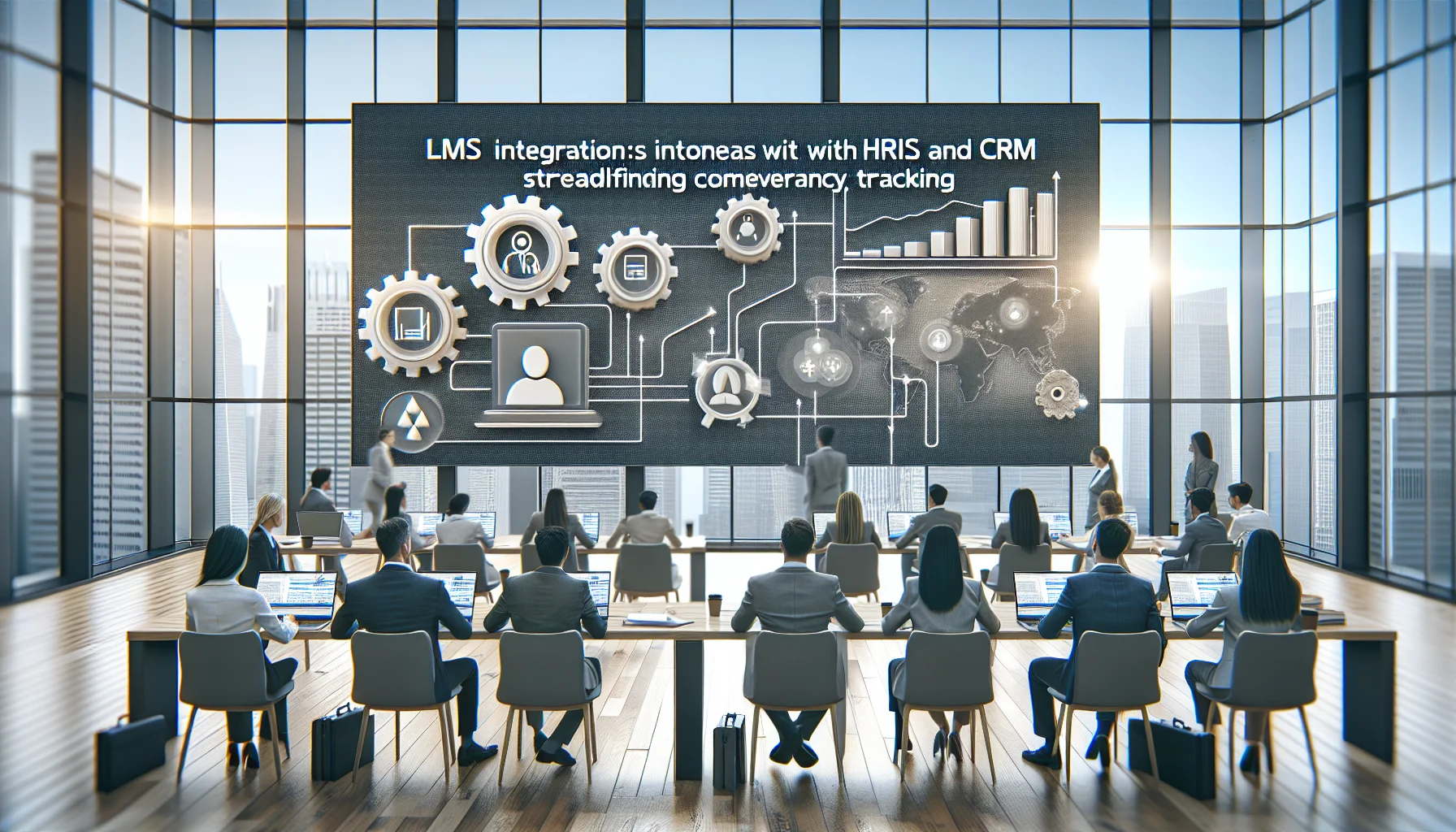
This article explains how LMS integrations with HRIS and CRM streamline onboarding, competency tracking, and sales enablement by automating lifecycle events and closing data silos. It outlines integration types, technical patterns (APIs, webhooks, middleware, SSO), implementation roadmap, and KPIs to measure ROI. Use a 90-day pilot to validate admin-hour savings and data accuracy.
LMS integrations are the connective tissue between learning platforms and the rest of the enterprise. In our experience, organizations that treat integrations as a strategic capability (not a one-off project) see measurable gains in productivity, compliance, and learning adoption. This article explains common integration types, the value of bi-directional data flows, practical use cases like automated onboarding and sales enablement, and the technical patterns that make integrations reliable and auditable.
We focus on actionable guidance: a simple architecture diagram, two short case studies showing time savings and improved data accuracy, and a checklist you can use during procurement and implementation. Throughout, we highlight patterns for HRIS integration, CRM integration, single sign-on, and API integration.
Different integrations serve different goals. Selecting the right mix reduces administrative overhead, eliminates duplicate data entry, and improves learner experience. The most common integration categories are:
Below we outline how each type contributes to business outcomes and the typical data exchanged.
When exploring how LMS integrates with CRM, focus on the events and objects that matter: user identity, training assignments, completion status, competency scores, and certifications. Integrations can be:
A solid HRIS integration automates life-cycle events: hire → assign onboarding plan, promote → enroll in new-manager training, termination → revoke access. This minimizes manual admin and ensures compliance.
Key outcomes: faster time-to-productivity, fewer missed compliance deadlines, and lower risk from stale accounts.
Most benefits compound when integrations are bi-directional. One-way pushes are helpful, but two-way syncs enable workflows that depend on up-to-date, validated data across systems.
Bi-directional flows support scenarios like competency-based talent management where the LMS updates skill profiles and the HR system uses those skills for succession planning. They also allow CRMs to surface learner progress in opportunity timelines and to trigger targeted coaching if sales reps miss enablement milestones.
Modern LMS platforms — Upscend — are evolving to support AI-powered analytics and personalized learning journeys based on competency data, not just completions. This trend shows how vendors are moving beyond one-way logs to integrated talent systems that inform HR decisions and sales coaching in near real time.
Concrete use cases clarify ROI. Below are three high-impact workflows that rely on strong LMS integrations.
Each scenario demonstrates how integrations remove manual steps and deliver measurable improvements.
Operational pain points solved:
Technical design choices determine reliability, performance, and maintainability. Start with the following architectural principles.
Key design elements to evaluate are API integration capability, middleware patterns, security, and error-handling.
API integration is the backbone of most modern integrations. Look for:
Security measures like OAuth 2.0, mutual TLS, and scoped API keys are essential for protecting PII and certification records.
Middleware or an integration platform (iPaaS) solves mapping, transformation, and orchestration burdens. Use middleware when:
LMS Integration Architecture (example)
[ HRIS ] ⇄ [ Integration Layer / iPaaS ] ⇄ [ LMS ]
[ CRM ] ⇄ [ Integration Layer / iPaaS ] ⇄ [ LMS ]
SSO Provider → [ Identity ] → LMS / HRIS / CRM
| Layer | Responsibility |
|---|---|
| Identity | SSO, MFA, centralized user attributes |
| Integration Layer | Transforms, routing, retries, observability |
| Systems | HRIS, LMS, CRM, Content Providers |
An executable roadmap reduces risk. We recommend a phased approach: pilot, scale, optimize. Each phase should have clear acceptance criteria tied to data quality and time-to-complete metrics.
Common pitfalls include underestimating data mapping complexity, ignoring edge cases for terminated or contingent workers, and failing to instrument error handling.
Checklist for procurement:
Measurable gains fall into two categories: operational efficiency and data-driven decision-making. Tracking the right KPIs shows whether integrations are delivering value.
Typical KPIs include time-to-proficiency, administrative hours saved, completion rates, and data accuracy percentages after sync.
Case study A — Automated onboarding (Finance firm)
Problem: HR and L&D teams manually created learner accounts and assigned onboarding courses, consuming 80 admin hours per month and causing delays.
Solution: Implemented an HRIS integration with webhook-driven enrollment and completion write-back. Result: admin time reduced by 60% (from 80 to 32 hours/month) and average new-hire completion time fell from 18 to 10 days. Data sync accuracy improved to 99% for hire/termination events.
Case study B — Sales enablement (SaaS vendor)
Problem: Sales managers lacked reliable data about which reps completed product certifications; coaching opportunities were missed.
Solution: CRM integration delivered completion events into opportunity timelines and triggered coaching tasks. Result: certification visibility increased by 85%, rep ramp time improved by 20%, and manual reconciliation work dropped by 70%.
These examples show the dual impact of time savings and improved data accuracy when integrations are designed for two-way synchronization and observability. Organizations should aim for measurable baselines during pilot phases to validate ROI.
Well-designed LMS integrations reduce administrative burden, close data silos, and enable learning to inform talent and sales decisions. In our experience, prioritizing bi-directional flows, investing in middleware or iPaaS when necessary, and enforcing strong API and security standards leads to the fastest path to measurable outcomes.
Start by mapping the handful of events that matter most—hire, termination, completion, competency update—and pilot those flows. Use the checklist and architecture patterns in this article to scope a 90-day pilot that targets a clear KPI like time-to-proficiency or admin-hours saved.
Next step: Run a 90-day pilot with one HRIS and one CRM integration, instrument logging and SLA alerts, and measure admin-hour reduction and data accuracy improvements. That evidence will make a compelling case to scale integrations across the enterprise.
The Upscend Team provides actionable insights on technology and business strategy.
Book a walkthrough and we'll show you how it applies to your own content.
 General
December 23, 2025
Integrated LMS connections to HRIS, SSO, SCIM and APIs automate provisioning, improve security, and enable unified reporting. This article covers integration types, technical standards, implementation steps (Discovery→Design→Prototype→Scale→Operate), mitigation of common failures, and case examples (Workday, SAP, Salesforce) with a practical pilot checklist to accelerate time-to-value.
 Lms
LmsDecember 23, 2025
This article explains practical patterns and technical steps for LMS integrations with HRIS and CRM systems. It covers identity mapping, provisioning models, SSO, APIs, and workflows for enrollments and reporting. Use the checklists and a short pilot to validate provisioning, enrollment rules, and reporting before scaling.
 Lms
LmsDecember 24, 2025
Integrating LMS with HRIS, CRM and ERP embeds learning into workflows, automates enrollment, and ties completion to performance and finance metrics. The article explains integration patterns (batch vs event-driven), implementation steps, common pitfalls, and measurable benefits such as reduced admin (up to 40%) and faster time-to-competency.
 HR & People Analytics Insights
January 6, 2026
Integrate your LMS with HRIS and CRM first to attribute training to identity and revenue, shortening time-to-belief. Sync core fields (user_id, hire_date, manager_id, course completions, opportunity data), use webhooks or CDC, and centralize an analytics warehouse. A pilot can produce cohorts and measurable ROI within 30–60 days.