


Medium enterprises should evaluate total cost of ownership—not just license fees—when choosing LMS pricing models. This article compares per-user, subscription, tiered and enterprise options, highlights hidden implementation costs, and recommends a three-year TCO test plus a pilot to decide whether tiered pricing or per-user plans are most cost-effective.
When evaluating lms pricing models for a medium enterprise, cost-effectiveness depends on more than sticker price. In our experience, procurement teams that analyze utilization patterns, growth forecasts, and hidden implementation costs consistently make better long-term decisions. This article breaks down the most common lms pricing models, compares their trade-offs, and gives actionable frameworks to decide which option saves money for mid-size companies.
Understanding which lms pricing models are most economical starts with identifying core cost drivers: licensing fees, support and maintenance, implementation and customization, user training, and indirect costs like productivity loss during rollout.
We've found that comparing total cost of ownership across models — not just monthly invoices — is essential. The key levers to analyze are: per-user pricing lms sensitivity to active users, how subscription commitments lock costs over time, and whether tiered discounts kick in as headcount grows.
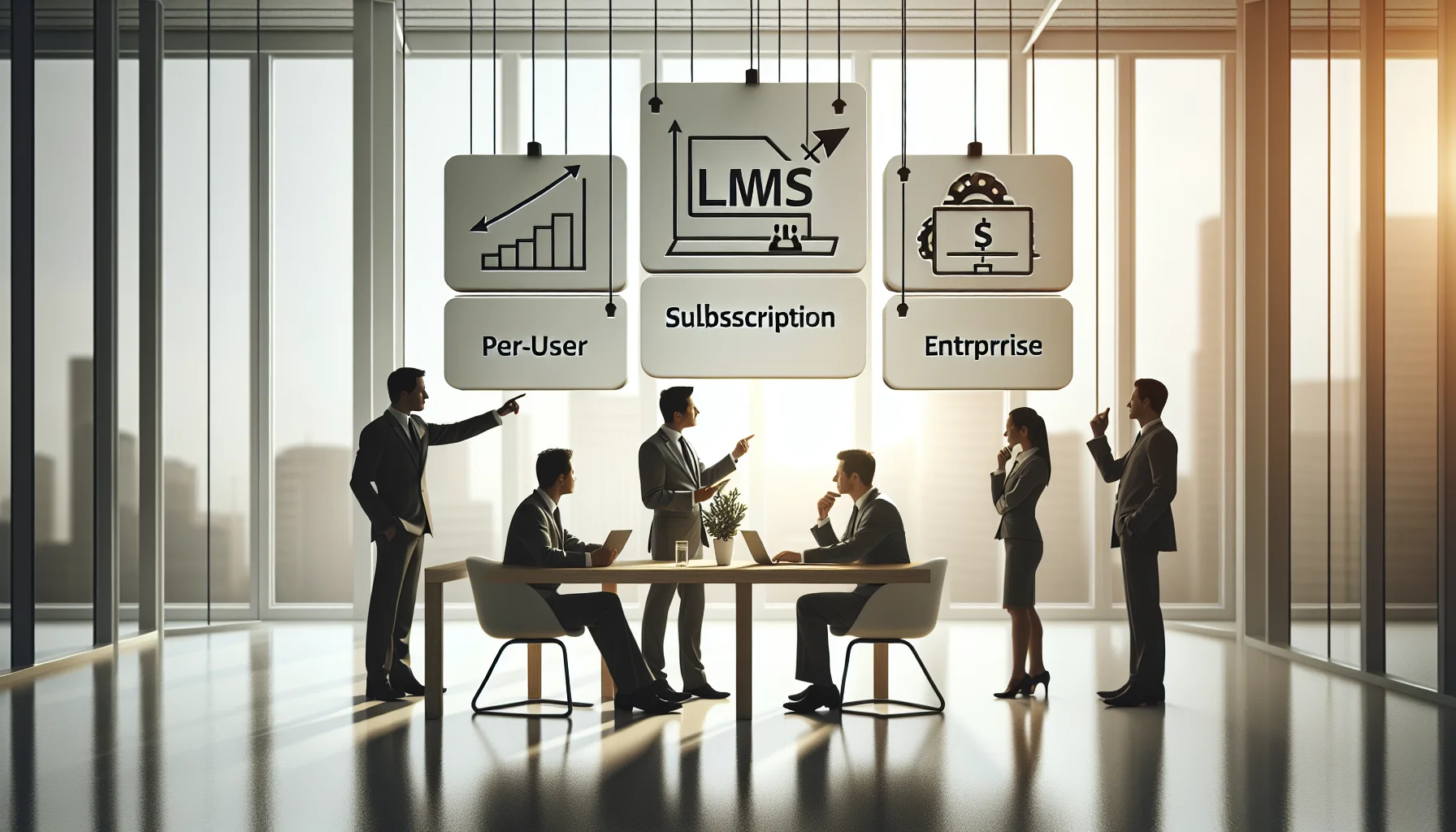
There are four mainstream models procurement will encounter: per-user pricing lms, subscription lms with seat caps, tiered lms pricing, and enterprise flat-fee licensing. Each model interacts differently with growth and usage patterns.
When comparing, consider these dimensions: predictability, marginal cost of adding users, and alignment with learning programs (high-churn vs. constant users). The following table summarizes typical trade-offs.
| Model | Best for | Primary risk |
|---|---|---|
| Per-user pricing | Controlled user count, pilot programs | High growth becomes expensive |
| Subscription lms | Steady monthly needs, predictable budgets | Underutilization of paid seats |
| Tiered lms pricing | Mid-size firms expecting growth | Feature gating at lower tiers |
| Enterprise flat-fee | Large orgs with variable usage | High upfront investment |
Beyond license fees, expect costs from integrations, reporting customizations, content migration, and administration. In our experience, integration and data migration can add 15–30% to first-year costs if not scoped correctly.
Choosing between per-user pricing lms and subscription lms typically hinges on headcount dynamics and usage intensity. Mid-size companies with rapid hiring or seasonal peaks need different strategies than steady-state teams.
We've found that per-user models reward predictability of headcount. If your active learners are a stable fraction of the workforce, per-user pricing reduces wasted seats and aligns costs to learners. Conversely, subscription lms plans with fixed fees can be more predictable when engagement rates are high.
Run this simple decision test:
When answering "which lms pricing model saves money for mid size companies", this quantitative test is the most reliable method we've used internally. It lets you include vacation/seasonality and pilot rollouts in the scenario analysis.
Tiered lms pricing strikes a balance: you pay a predictable fee that steps down on a per-seat basis as you move to higher tiers. For many medium enterprises, that balance provides cost savings without committing to a single flat enterprise fee.
We recommend negotiating explicit volume breakpoints and ensuring contract language allows movement between tiers without heavy penalties. In one of our implementations, renegotiating a tier breakpoint after a successful acquisition saved more than 12% annually.
Often lower tiers exclude advanced analytics or integrative APIs. When evaluating tiers, map features to business priorities and place a premium on capabilities that reduce internal labor (automation, reporting). This prevents paying for seats that lack necessary functionality.
Case studies help translate theory into practice. Two contrasting mid-size companies demonstrate how selection affects cost outcomes: a rapidly scaling SaaS firm and a stable professional services firm.
The SaaS firm chose a variable per-user model during its high-growth phase to avoid upfront enterprise costs and only migrated to a tiered contract after user counts stabilized. The services firm purchased a subscription lms package with high seat counts and recovered costs through reduced external training spend.
Modern LMS platforms — Upscend — are evolving to support AI-powered analytics and personalized learning journeys based on competency data, not just completions. This trend matters because platforms that embed analytics reduce manual reporting labor and thereby lower ongoing operational costs.
Significant savings often come from operational efficiency: better reporting, automated enrollments, and reusable content reduce long-term expense more than a small license discount.
Implementation choices can erase license savings if not managed. In our experience, the biggest mistakes are underestimating integration complexity and failing to measure engagement early.
Use this step-by-step framework to control implementation costs:
Common pitfalls to avoid:
Short answer: there is no one-size-fits-all. For most medium enterprises we've worked with, a negotiated tiered lms pricing agreement with flexible breakpoints and volume discounts tends to be the most cost-effective when growth is expected. If headcount is stagnant and engagement is low, a lean per-user pricing lms plan or a small subscription may be cheaper in the short term.
To pick the most cost-effective option among lms pricing models, prioritize a data-driven approach. Start with a clear measurement of active learners, forecast growth, and model three-year TCO across per-user pricing lms, subscription lms, and tiered lms pricing. Include implementation and hidden costs in your scenarios.
We've found that running a short pilot, negotiating tier breakpoints, and insisting on outcome-based contract clauses deliver the best financial protection for mid-size companies. When you combine that procurement rigor with platforms that lower operational burden, the savings compound over time.
Actionable next step: assemble your 12-month active user data, estimate growth, and run the three-scenario TCO model (per-user, subscription, tiered). Use the results to negotiate with two vendors and request KPI-linked contract terms. This process will make it clear which lms pricing models are most cost-effective for your organization.
The Upscend Team provides actionable insights on technology and business strategy.
Book a walkthrough and we'll show you how it applies to your own content.
 General
December 22, 2025
This article explains dominant LMS pricing models—subscription, per-user, per-course, and enterprise—and compares their risks and best uses. It shows how to break total cost into licensing, implementation, support, and variable charges, and offers negotiation tips, pilot guidance, and a three-year TCO approach to select the model that matches growth and content strategy.
 General
December 22, 2025
This article explains common LMS pricing models — per-user, per-active-user, subscription, tiered, enterprise, and custom — and outlines how to evaluate them. It provides sample cost models, a 36-month TCO template, and practical negotiation and contract clauses to reduce hidden fees and scaling risks.
 General
December 23, 2025
This article explains common LMS pricing models — per user, per active user, subscription, flat enterprise, and per-module — and highlights hidden costs like implementation, integrations, and content conversion. It provides sample TCOs for small/medium/large deployments, negotiation levers (caps, SLAs, milestones), and a simple budget template to estimate payback and ROI.
 Lms
LmsDecember 24, 2025
This article evaluates LMS pricing models — per-user, subscription, enterprise, and usage-based — and recommends which fits different sectors and company sizes. It outlines a three-phase evaluation (discovery, 3-year TCO normalization, pilot) and provides a checklist and vendor questions to surface hidden admin costs and reduce deployment risk.