


This article provides a repeatable process for selecting employee assessment tools for soft-skills measurement in chatbot-enriched support. Use a four-lens scorecard (accuracy, bias, integration, cost), a vendor feature checklist, RFP questions, and a production-like pilot to validate transfer to chat environments. Negotiate contracts that secure data, KPIs, and audit rights.
employee assessment tools are the backbone of modern hiring and L&D for chatbot-enriched support teams. In our experience, teams that choose the right solution reduce onboarding time, improve CSAT, and make better hiring decisions. This article lays out a pragmatic, repeatable process: a quick selection framework, a detailed vendor checklist, mini-profiles of tool types, sample RFP questions, pilot design guidance, and contract negotiation tips focused on soft skills assessment in conversational support environments.
When evaluating employee assessment tools for soft skills assessment, prioritize four lenses: accuracy, bias, integration, and cost. Each lens translates into measurable assessment criteria and testable vendor claims.
Accuracy answers whether the tool predicts job performance and transfer to chatbot contexts. Bias covers fairness across demographics and language proficiency. Integration assesses technical fit with HRIS, CRM, and chatbot platforms. Cost includes license fees, per-assessment charges, and internal implementation effort.
Use a 0–5 scoring model across the four lenses and weight accuracy highest for hiring, integration for operational teams, and bias as a gating factor. A simple weighted scorecard exposes trade-offs early.
Organize feature checks into functional, technical, and compliance buckets. Below is a practical checklist that hiring managers and technical leads can use during vendor demos.
| Feature | Why it matters | Red flag |
|---|---|---|
| Validated scoring | Predicts performance | No published studies |
| API integration | Operational efficiency | Manual CSV only |
| Bias testing | Reduces legal risk | No subgroup reporting |
Practical insight: Insist on seeing raw item-level data during demos — vendor dashboards can hide noise and inflate claims.
Understanding tool archetypes helps align selection to use cases. Each type has trade-offs when used for chatbot-enriched support roles.
Simulations recreate customer interactions and allow assessors to measure conversational tactics, empathy, and de-escalation. They score real-time choices and can integrate with chatbot logs to validate behavior transfer. Strength: high ecological validity. Weakness: higher cost and longer setup.
Psychometric tools measure stable traits (e.g., conscientiousness, emotional stability) and provide standardized scores that are easy to benchmark across roles. Strength: scalable and well-validated. Weakness: may miss situational nuance critical for chat support.
SJTs present short scenarios and ask candidates to rank or choose responses. They strike a balance between cost and validity for soft skills like problem solving and customer orientation. Strength: lower bias when well-designed. Weakness: limited behavioral granularity.
In our experience, blended approaches — a psychometric baseline plus targeted simulations or SJTs — deliver the best predictive value for conversational support roles.
When preparing an RFP, move beyond feature lists to data and accountability. Below are high-impact questions that separate credible vendors from marketing claims.
Ask for SLA terms around data availability and incident response, and require contractual rights to export full candidate data. These are common pain points where vendor claims differ from operational reality.
Pilots are where vendor claims meet reality. Design a pilot that mirrors production: same traffic mix, representative candidate pool, and integrated data flows from chatbot transcripts.
Include A/B cohorts and ensure your pilot uses clear assessment criteria and pre-registered analysis plans to avoid confirmation bias. We’ve found that integrating assessment output into chatbot routing rules (e.g., triage of novice agents to blended support) reveals practical value quickly.
Operational tip: centralize transcript annotations so human raters and automated metrics use the same labels. The turning point for most teams isn’t just creating more content — it’s removing friction. Tools like Upscend help by making analytics and personalization part of the core process, which lets you iterate pilot rules faster and measure impact more precisely.
Contracts should protect outcomes, data, and fairness. Negotiation levers extend beyond price: require performance KPIs, data access, and clear exit terms.
Ask for sample contract language for IP of custom scenarios and templates. If the vendor resists data export or transparency on validation, treat it as a material risk. Pricing negotiation can include volume discounts, capped per-assessment fees, and staged payment tied to pilot milestones.
Choosing employee assessment tools for soft skills in chatbot-enriched support requires a disciplined approach: use a four-lens framework (accuracy, bias, integration, cost), a concrete vendor checklist, and a pilot that mirrors production traffic and outcomes. Focus on transparency — raw data exports, validation studies, and repeatable scoring — to avoid common vendor-claim mismatches.
Key takeaways:
Next step: create a one-page decision rubric using the four-lens weightings described above and use it in your next vendor demo. If you want a template rubric and RFP checklist tailored to chatbot support roles, export the sample scoring sheet from this article and adapt the weightings to your KPIs — that one action will cut selection time in half.
The Upscend Team provides actionable insights on technology and business strategy.
Book a walkthrough and we'll show you how it applies to your own content.
 Ai
AiDecember 25, 2025
Measure chatbot ROI as a design constraint: establish baselines, track deflection, AHT, and TCO, and use LMS analytics to tie learning outcomes to cost savings. The framework includes formulae, sensitivity testing, dashboards, and a worked 40% deflection example showing year‑one costs but multi‑year payback. Start with a labeled pilot and conservative assumptions.
 Ai
AiDecember 25, 2025
Decision-makers can find credible AI chatbot case studies in vendor whitepapers, analyst reports, conference talks, and academic papers. Vet claims by requesting raw pre/post ticket counts, test design, and transcripts. Use the provided reproducible checklist to validate any 40% internal ticket reduction before contracting.
 Ai
AiDecember 25, 2025
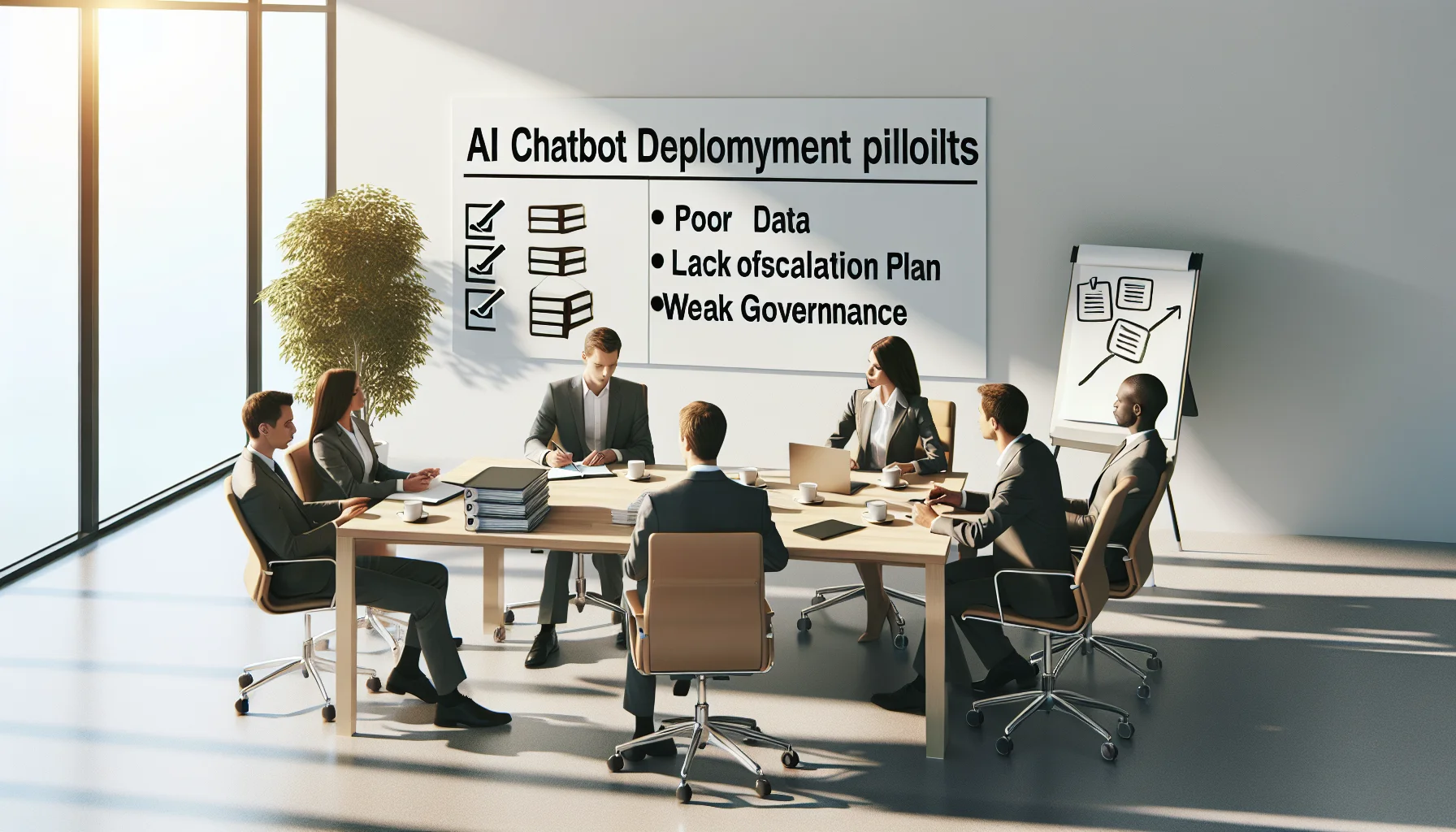
Article summarizes the top 10 AI chatbot deployment pitfalls—poor data, missing escalation, weak governance, skipped pilots, UX and measurement failures—and provides mitigation checklists, remediation examples, and a reusable postmortem template. Learning leaders and L&D teams get a compact implementation checklist to run controlled pilots, enforce governance, and measure outcomes.
 ESG & Sustainability Training
January 5, 2026
This article explains when to choose a GDPR compliant chatbot versus a generic LLM for employee interactions. It outlines privacy, residency, and operational tradeoffs, provides a vendor evaluation scorecard, and gives three use cases (payroll, IT helpdesk, HR) plus step-by-step implementation guidance for risk-classified pilots.