


This article explains when to choose a GDPR compliant chatbot versus a generic LLM for employee interactions. It outlines privacy, residency, and operational tradeoffs, provides a vendor evaluation scorecard, and gives three use cases (payroll, IT helpdesk, HR) plus step-by-step implementation guidance for risk-classified pilots.
GDPR compliant chatbot options are not a one-size-fits-all choice. In our experience, the decision hinges on risk profile, data sensitivity, speed-to-deploy, and long-term governance. This guide helps compliance, security, and product teams decide when to choose a GDPR compliant chatbot for employee interactions versus adopting a generic LLM and layering controls. You’ll get a practical decision framework, a vendor evaluation scorecard you can copy into a spreadsheet, and three real-world use cases (payroll queries, IT helpdesk, HR advice) to illustrate tradeoffs between privacy and agility.
Start by asking: will the application routinely process personal data, special categories of data, or employee identifiers? If yes, a GDPR compliant chatbot is often the safer default. A pattern we've noticed is that organizations with regulated data flows or high compliance risk choose vendor-provided GDPR solutions to avoid inadvertent breaches and to simplify auditability.
Conversely, teams prioritizing rapid experimentation, advanced customization, and cutting-edge LLM capabilities may prefer a generic LLM plus controls. That route demands a governance program and technical investment to ensure LLM chatbot compliance in practice.
We compare chatbot GDPR capabilities vs the layered approach for generic LLMs across privacy features, cost, speed, customization, and control over training data. You’ll find a reproducible vendor evaluation scorecard and clear decision points for when to choose a GDPR compliant chatbot for employee interactions.
The heart of this decision is control over data and model training. A GDPR compliant chatbot solution—typically offered on-premises or via a private cloud with contractual safeguards—gives direct control of data residency, retention policies, and deletion mechanics. That simplifies obligations under Article 5 and Article 32 of the GDPR because you can document where personal data is stored and how it is secured.
Generic LLMs often run in vendor-controlled environments. You can mitigate risk with encryption, tokenization, and API-level filtering, but residual risk remains around vendor access and unseen model training usage. This is the single biggest privacy difference between the two approaches.
Choosing a GDPR compliant chatbot usually increases time-to-deploy and initial cost. On-prem or private-cloud stacks require integration, security reviews, and occasionally hardware. However, they save time later by reducing legal review cycles and compliance overhead for sensitive workflows.
Generic LLM deployments are attractive for speed: APIs and managed services let teams ship prototypes in days. But expect ongoing costs for monitoring, custom prompt engineering, and governance. A pattern we've found is that initial time savings can be eroded by months of compliance remediation if the scope of personal data was underestimated.
Industry examples show mixed outcomes: some organizations reduce total cost of ownership with a private solution because compliance operations are streamlined; others accept higher governance spend to keep product velocity. For teams balancing both needs, hybrid approaches—an on-prem store for sensitive content and a generic LLM for public knowledge—often work well (real-time feedback tooling is available in platforms like Upscend to help manage and monitor mixed deployments).
Use this scorecard to compare vendor claims and to structure procurement questions. Copy this table into a spreadsheet to score vendors 1–5 per row; total the score for a comparative rank. The scorecard emphasizes the features that matter for enterprise chatbot privacy and compliance.
| Criteria | Why it matters | Vendor response / Notes | Score (1-5) |
|---|---|---|---|
| Data residency | Controls jurisdiction for storage and processing | ||
| Training data isolation | Prevents your data from being used in public models | ||
| Right to erasure | Speed and proof of deletion | ||
| Access controls & audit logs | Supports audits and separation of duties | ||
| Encryption & key management | Protects data at rest and in transit | ||
| SLAs & breach handling | Defines vendor obligations on incidents | ||
| Operational cost | Total cost to run and maintain | ||
| Customization & extensibility | Ability to fine-tune, integrate enterprise data |
Downloadable scorecard: Copy the rows above into a spreadsheet to create a procurement-ready evaluation tool. Use weighted scoring if compliance is more important than speed for your organization.
These concrete examples help you evaluate tradeoffs between a GDPR compliant chatbot and a generic LLM in real workflows.
Payroll data contains highly sensitive personal information and often needs to be retained for regulatory reasons. For payroll queries, a GDPR compliant chatbot that stores and processes interactions in a controlled, auditable environment is usually the right choice. It simplifies deletion requests and reduces legal risk when salary information or identifiers are involved.
IT helpdesk chats may include machine names, asset tags, and occasionally personal identifiers. If the majority of queries are system-level and non-personal, a generic LLM with strong data-filtering and ephemeral logs can be efficient. However, if tickets often include personal data, we advise an enterprise chatbot privacy approach: store logs in a controlled vault and apply role-based access.
HR advice often touches on employee performance, grievances, and health-related data. A GDPR compliant chatbot is the conservative option here: on-prem processing, explicit consent flows, and strong retention rules reduce compliance friction. For less-sensitive HR FAQs, a hybrid model can route sensitive questions to secure channels and use a generic LLM for public policy answers.
Successful deployments follow a clear governance path. We recommend a phased approach to balance speed and control while addressing the tradeoffs between GDPR compliant chatbot options and generic LLMs.
Important point: operationalizing privacy is as much about process and governance as it is about technical controls.
Deciding between a GDPR compliant chatbot and a generic LLM is a risk-based judgment. Choose an enterprise-grade GDPR-compliant solution when personal or sensitive data is central to the workflow, when you need provable deletion and residency guarantees, or when auditability is non-negotiable. Opt for a generic LLM with layered controls when speed, advanced model capabilities, and experimentation are primary concerns, and when you can afford the governance lift.
Use the vendor evaluation scorecard above to compare options, and run a risk-classified pilot before full rollout. If you need a practical starting point, begin by cataloging the top 20 queries your bot will handle and classifying them by sensitivity—this single exercise often clarifies whether a GDPR-focused deployment is required.
Call to action: Download the scorecard by copying the table into a spreadsheet and run a 30-day pilot with one high-risk and one low-risk use case to observe operational costs and compliance overhead.
The Upscend Team provides actionable insights on technology and business strategy.
Book a walkthrough and we'll show you how it applies to your own content.
 Ai
AiDecember 25, 2025
This article provides a practical decision framework to choose between a pre-built vs custom chatbot for training, covering pros/cons, a five-factor scorecard, sample timelines, and a three-year TCO comparison. It recommends a 4–8 week pilot with measurable KPIs to validate accuracy, ticket reduction, and vendor exportability before scaling.
 Ai
AiDecember 25, 2025
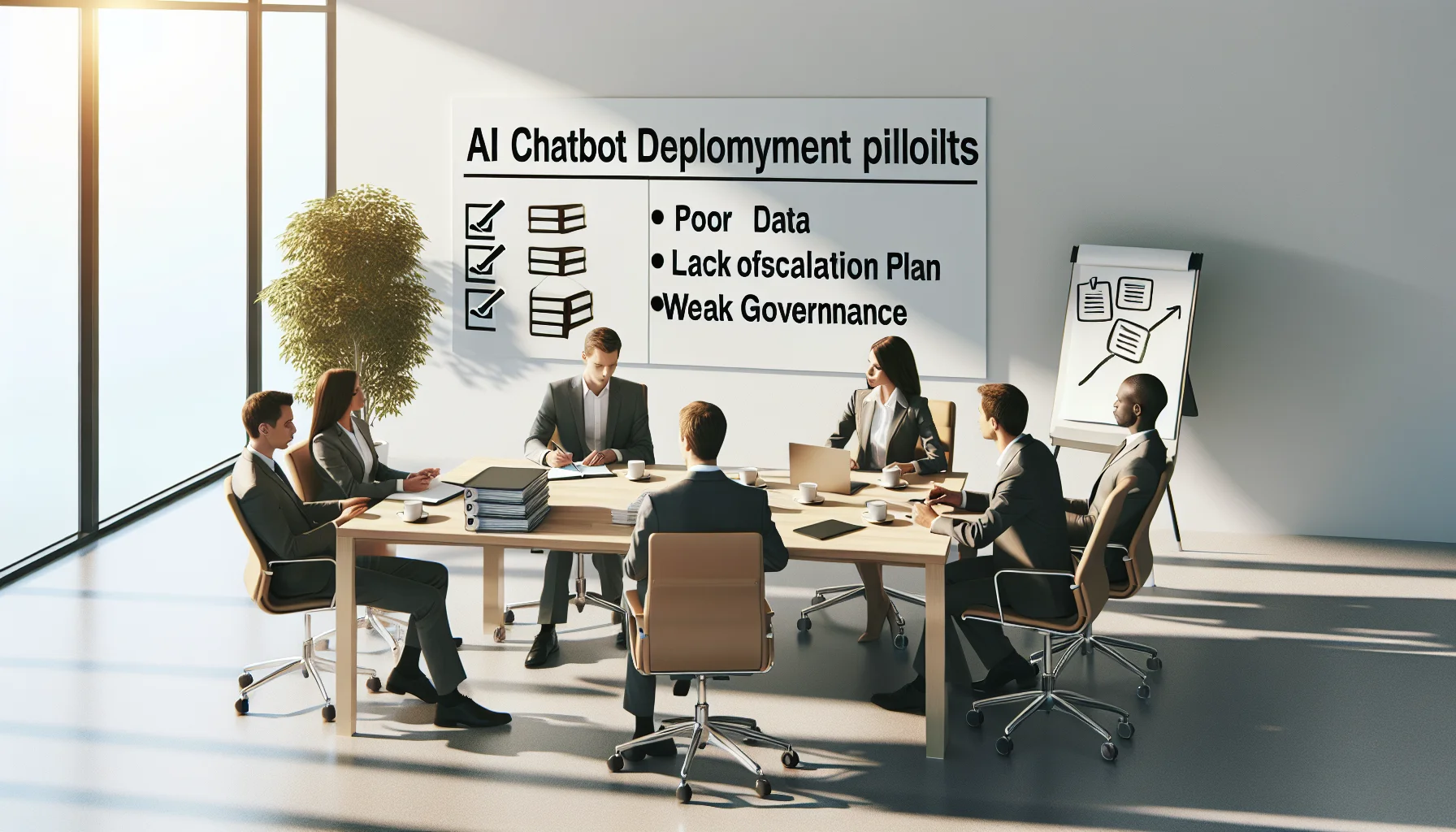
Article summarizes the top 10 AI chatbot deployment pitfalls—poor data, missing escalation, weak governance, skipped pilots, UX and measurement failures—and provides mitigation checklists, remediation examples, and a reusable postmortem template. Learning leaders and L&D teams get a compact implementation checklist to run controlled pilots, enforce governance, and measure outcomes.
 Business Strategy&Lms Tech
January 26, 2026
This article compares adaptive tutors vs chatbots across pedagogy, scalability, cost, analytics and compliance, offering a sector-specific decision matrix for K–12, higher ed, and corporate training. It recommends combining adaptive cores with conversational layers where appropriate and provides procurement rules and pilot criteria to measure ROI and adoption.
 Business Strategy&Lms Tech
January 26, 2026
Districts should evaluate AI chatbot tutors by pedagogy, standards alignment, moderation, privacy compliance, and cost. Run a 6–8 week pilot with defined cohorts, SSO, and exportable analytics. Use vendor scorecards to compare real-time moderation, teacher controls, pricing models and require SLAs and data-deletion clauses before contracting.