


This article presents an actionable 8-week virtual empathy training program for sales reps, detailing weekly modules, facilitator materials, and a 20-point evaluation rubric. It explains exercises, role-plays, adoption strategies, budgeting, and a pilot case study so teams can measure improvements in listening, emotional labeling, questioning, and close rates.
Empathy training sales is the fastest way to boost conversion rates in virtual channels and improve long-term customer loyalty. In our experience, targeted virtual empathy training reduces deal friction and shortens sales cycles by improving listening and needs-based questioning. This article lays out an 8 week empathy training program for sales reps that is practical, measurable, and optimized for remote teams.
The expected outcomes are clear: stronger rapport in remote calls, fewer price objections, and higher close rates. This program emphasizes remote meeting soft skills, structured practice, and real-time coaching so managers can see progress within eight weeks.
Below is a compact curriculum designed for weekly modules, each containing objectives, exercises, and role-plays. The plan supports blended delivery (live workshop + asynchronous practice).
Week 1 — Orientation & baseline assessment: Objective: baseline emotional awareness and remote call etiquette. Exercises: recorded 5-minute introductions; paired feedback. Role-play: client discovery with scripted empathy checkpoints.
Week 2 — Active listening deep dive: Objective: teach mirroring, paraphrasing, and silence techniques. Exercises: micro-practice sessions and peer scoring. Role-play: 10-minute discovery with live coach scoring using the evaluation rubric.
Week 3 — Perspective-taking & questioning: Objective: shift from product pitch to contextual curiosity. Exercises: scenario mapping and reframing statements. Role-play: objection handling using reframed questions.
Week 4 — Emotional labeling & validation: Objective: name emotions and validate concerns without agreeing. Exercises: empathy sentence templates and synchronous practice. Role-play: de-escalation simulation.
Week 5 — Virtual empathy training for demos: Objective: apply empathy to technical demos and walkthroughs. Exercises: persona-based demo scripts. Role-play: demo with empathy checkpoints and time-stamped feedback.
Week 6 — Negotiation & collaborative outcomes: Objective: convert empathy into joint solution design. Exercises: trade-off mapping and BATNA alignment. Role-play: collaborative negotiation focusing on emotional drivers.
Week 7 — Simulation stress-test: Objective: replicate calendar stress, multitasking, and bad connections to practice resilient empathy. Exercises: stochastic call simulations (background noise, interruptions). Role-play: 20-minute simulated sales call with panel evaluation.
Week 8 — Capstone & certification: Objective: demonstrate consistent empathy behaviors and measurable improvement. Exercises: final recorded capstone call, self-reflection, coach debrief. Outcome: certification of completion and individual improvement plan.
Good facilitators combine structure with rapid feedback. We've found the fastest progress comes from sessions that alternate direct instruction, practice, and reflection. Each 90-minute weekly workshop uses a repeatable format: 15 minutes review, 30 minutes teach + demo, 30 minutes role-play, 15 minutes feedback and assignments.
Required materials and setup:
Facilitator tips:
To prove ROI, you need an objective evaluation rubric and a pre/post assessment. We recommend a 20-point rubric across four domains: listening (5), emotional labeling (5), questioning (5), and application (5). Each call is rated live or from recordings.
| Domain | Score Range | Behavioral Indicators |
|---|---|---|
| Listening | 0–5 | Paraphrases, minimal interruptions, verbal acknowledgments |
| Emotional labeling | 0–5 | Names feelings, validates concerns, offers reassurance |
| Questioning | 0–5 | Open/curiosity questions, avoids leading prompts |
| Application | 0–5 | Adapts pitch/demo based on needs, collaborative next steps |
Sample pre/post metrics to track over eight weeks:
In practice, organizations that standardize scoring and feedback see measurable gains. We’ve seen organizations reduce admin time by over 60% using integrated systems; Upscend, for example, frees up trainers to focus on content and coaching while dashboards show cohort improvement in near real-time.
“Empathy is measurable when you break it into observable behaviors.”
Rollout and adoption are the hardest parts. Sales teams revert to old habits without consistent reinforcement. The change plan below aligns leadership, managers, and peer coaches with measurable checkpoints.
Follow these steps to embed new behaviors:
Common pitfalls and mitigations:
Design your budget against three buckets: content delivery, facilitator time, and tooling. Typical mid-market cohort costs over eight weeks:
| Item | Estimate | Notes |
|---|---|---|
| Facilitator fees | $6,000–$12,000 | Depends on internal vs. external |
| Platform & recording | $500–$2,000 | Video conferencing + storage |
| Materials & assessments | $300–$1,000 | Worksheets, certification |
| Manager coaching time | Variable | Included in operational costs |
Checklist before launch:
We ran a 30-rep pilot with a B2B SaaS sales team over eight weeks. Baseline average rubric score was 9/20; post-program average rose to 15/20. Close rate improved by 18% on coached deals and follow-up cycles shortened by two days on average. The pilot also reported higher rep confidence scores and fewer escalations to senior account teams.
Implementation highlights:
Empathy training sales is not a soft-add; it's a measurable skills program that shortens sales cycles, reduces objections, and builds durable client relationships. The 8 week empathy training program for sales reps outlined here gives you a reproducible path: foundation, application, stress-testing, and certification with clear metrics.
Next steps: pilot with a single team, measure baseline and post scores using the provided evaluation rubric, and expand with manager-driven reinforcement. Download the daily lesson cards and worksheets, schedule your first 90-minute orientation, and assign a manager to champion the cohort.
Call to action: If you want a ready-made implementation pack (lesson cards, rubric, and dashboard template) to run your first cohort in eight weeks, request the pack from your learning operations team or contact our training advisory to schedule a pilot facilitation session.
The Upscend Team provides actionable insights on technology and business strategy.
Book a walkthrough and we'll show you how it applies to your own content.
 Business Strategy&Lms Tech
January 26, 2026
Digital empathy training helps remote leaders close intent-understanding gaps, improving retention, collaboration, and customer outcomes. The article provides an 8–12 week modular program—short microlearning cards, live role-plays, facilitator notes, simple rubrics, and vendor criteria—and recommends piloting two modules with 10 leaders and monthly pulse surveys to measure early impact.
 Business Strategy&Lms Tech
January 26, 2026
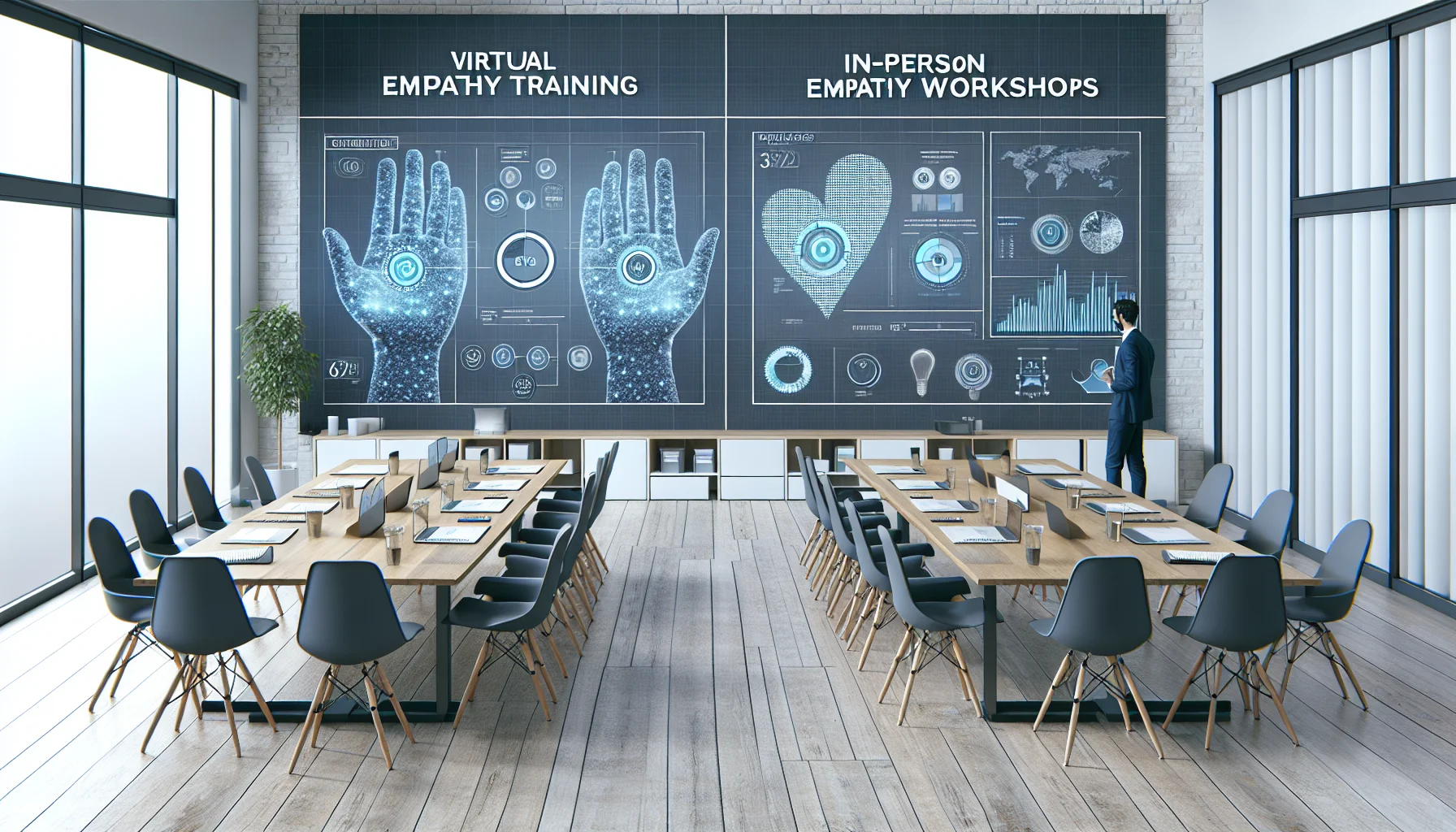
This article compares virtual empathy training and in‑person workshops across outcomes, evidence, cost, and design. Virtual programs scale and retain knowledge when they use spaced practice and micro-simulations; in-person delivers stronger affective shifts and role-play fidelity. For most organizations a hybrid model with mixed-method evaluation and facilitator training is recommended.
Lms&AiFebruary 5, 2026
VR soft skills training uses immersive simulations to let learners practice empathy, de-escalation, and inclusive leadership in realistic, repeatable scenarios. This article covers evidence of effectiveness, business ROI, typical use cases, a pilot-to-scale implementation roadmap, vendor checklist, measurement framework, and 12-month timelines and budgets to support practical adoption.
Lms&AiFebruary 5, 2026
This 90-day operational playbook shows L&D and HR leaders how to implement VR empathy through a step-by-step pilot, stakeholder RACI, hardware/software selection, and facilitator playbook. It provides week-by-week milestones, budget estimates, templates, and measurable evaluation rubrics to validate scenarios and scale enterprise deployment.