

This article compares virtual empathy training and in‑person workshops across outcomes, evidence, cost, and design. Virtual programs scale and retain knowledge when they use spaced practice and micro-simulations; in-person delivers stronger affective shifts and role-play fidelity. For most organizations a hybrid model with mixed-method evaluation and facilitator training is recommended.
Virtual empathy training is often the first phrase teams search when they want scalable, measurable social awareness development across distributed workforces. In this article we compare virtual empathy training and in-person workshops head-to-head, define the outcomes organizations should measure, review evidence and pilot data, and offer practical design patterns and scripts you can implement immediately.
Empathy is a composite skill: cognitive perspective-taking, affective resonance, and behavioral response. Effective social awareness training targets all three and translates them into workplace outcomes: improved conflict resolution, higher psychological safety, and better customer interactions.
Outcomes to measure include:
When evaluating any program—virtual or in-person—use mixed measures: self-report scales, behavioral observation, and objective performance metrics such as resolution time or customer satisfaction. These are essential for rigorous social awareness training.
Research on online empathy workshops and traditional workshops shows mixed but instructive results. Studies of digital interventions find that well-designed virtual empathy training can produce significant gains in cognitive empathy and knowledge retention, while in-person settings often yield stronger affective shifts.
Key metrics reported in studies include:
According to industry research, randomized pilots that include asynchronous reflection and structured role-play produce the largest effects in remote settings. We’ve found that programs labeled empathy training virtual that combine micro-learning, feedback loops, and real-world practice show sustained improvement at three-month follow-up.
Meta-analyses indicate knowledge retention favors virtual formats when spaced repetition is used; emotional resonance favors in-person formats by a modest margin. This suggests a hybrid model often captures the best of both worlds.
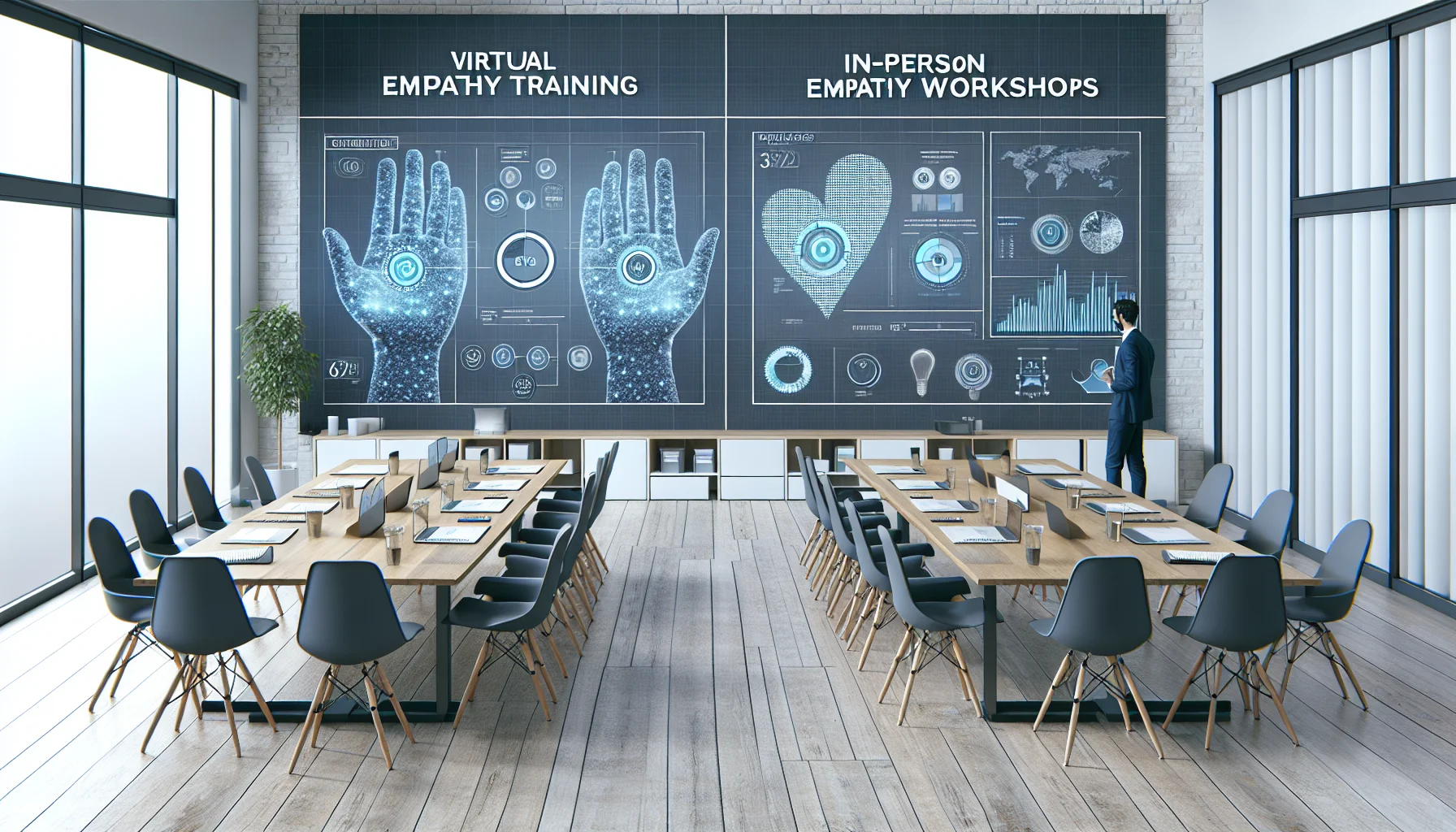
Below is a practical comparison showing where virtual empathy training wins and where in-person workshops maintain advantages. Visual teams often prefer split-screen presentations—side-by-side photos of virtual platforms versus in-person sessions—to communicate these trade-offs to stakeholders.
| Dimension | Virtual Empathy Training | In-Person Workshops |
|---|---|---|
| Scalability | High; repeatable across regions | Limited by facilitator availability |
| Role-play fidelity | Variable; depends on design and tech | High; richer nonverbal cues |
| Cost | Lower per capita | Higher fixed costs |
| Engagement | Susceptible to participant fatigue | Stronger emotional bonding |
| Measurement | Easy to instrument and analyze | Harder to scale measurement |
Common pain points include role-play authenticity, facilitator skill variance, and participant fatigue—each requires targeted mitigation strategies.
Active facilitation and scenario realism are the two biggest levers that determine whether virtual empathy training translates to genuine behavior change.
Design compensations shift virtual weakness into strengths. Below are proven patterns that reduce fatigue and improve authenticity in remote empathy exercises.
Implementation tips:
It’s the platforms that combine ease-of-use with smart automation — like Upscend — that tend to outperform legacy systems in terms of user adoption and ROI. These platforms make it practical to run remote empathy exercises, automate scoring of observer rubrics, and deliver personalized reflection prompts at scale.
Authenticity improves when scenarios are contextualized, observers provide immediate behavioral feedback, and facilitators model vulnerability. Use multi-modal cues (audio, closed captions, simulated interruptions) to mimic real interactions.
Below is a concise matrix to choose modality based on audience size, budget, and desired outcomes. Use it as a decision rule, not a prescription.
| Audience & Budget | Recommended Modality | Rationale |
|---|---|---|
| Small team (≤25), high budget | In-person workshop | Maximizes emotional bonding and high-fidelity role-play |
| Mid-size (25–200), moderate budget | Hybrid (kickoff in-person + virtual practice) | Balances affective shift and scalable practice |
| Large distributed (200+), low budget | Virtual empathy training | Cost-effective, measurable, repeatable |
Checklist before choosing:
Below are compact, actionable scripts you can adapt. Each script is a 45–60 minute module designed to target a specific empathy skill.
Key artifacts: observer checklist, one-minute video clips, automated poll for emotional labeling.
Key artifacts: live observer ratings, role-play scripts with context, facilitator-led modeling of affective language.
Case overview: A consumer services company piloted two cohorts: Cohort A (virtual empathy training, n=120) and Cohort B (in-person workshop, n=30). Both cohorts used identical scenario bank and the same facilitator rubric.
Pre/post measures: We used a 20-item empathy inventory (self-report), observer-rated role-play fidelity (0–5), and a six-week behavioral transfer check (customer satisfaction delta).
| Measure | Cohort A (virtual) | Cohort B (in-person) |
|---|---|---|
| Self-report empathy increase (mean pts) | +6.2 | +7.8 |
| Observer role-play fidelity (avg) | 3.9 | 4.4 |
| Customer satisfaction (6-week delta) | +4.1% | +5.6% |
Interpretation: Both modalities produced meaningful gains. The in-person cohort showed slightly higher affective shifts and fidelity, but the virtual cohort reached four times as many employees and delivered stronger cost-per-point improvement. The primary limiting factor in the virtual cohort was inconsistent facilitator experience, reinforcing the importance of facilitator training.
Summary: Virtual empathy training is a robust option for organizations that need scale, measurement, and cost efficiency; in-person workshops still lead in affective immersion and role-play fidelity. The optimal path for most organizations is hybrid: use in-person sessions to establish emotional baseline and a carefully designed virtual curriculum for distributed practice and measurement.
Key takeaways:
Next step: Pilot a 6-week hybrid module with clear pre/post metrics and a facilitator calibration session. If you’d like, start with the virtual script above for a low-cost proof of concept and follow with an in-person or live virtual calibration day.
Call to action: Choose one program to pilot this quarter—virtual, in-person, or hybrid—and collect baseline empathy and behavioral metrics; use those data to iterate after six weeks.
The Upscend Team provides actionable insights on technology and business strategy.
Book a walkthrough and we'll show you how it applies to your own content.
 Business Strategy&Lms Tech
January 25, 2026
This article compares VR vs in-person roleplay for high-stakes layoffs across realism, emotional safety, facilitator control, scalability, and TCO. It recommends paired pilots (VR and in-person), a decision matrix, and facilitator training. Use VR for repeatable, data-driven baseline practice and in-person for legally sensitive, high-emotion calibrations; hybrid programs often perform best.
 Talent & Development
January 28, 2026
This article compares virtual simulations and case-based workshops across pedagogy, scalability, cost, and transfer-to-work. It shows simulations excel at repeated practice and measurable decision data while workshops drive deliberation and normative reasoning; the best programs use hybrids, piloting both and matching format to objectives, audience maturity, and scale.
 Ai
AiJanuary 28, 2026
This article compares virtual mentors vs human coaches across cost, scalability, personalization, empathy and compliance, and presents decision frameworks for onboarding, performance, and career development. It recommends a three-tier hybrid model—automated baseline, human intervention triggers, continuous measurement—and a staged pilot approach with KPIs to operationalize hybrid human-AI coaching.
 Lms&Ai
February 5, 2026
VR soft skills training uses immersive simulations to let learners practice empathy, de-escalation, and inclusive leadership in realistic, repeatable scenarios. This article covers evidence of effectiveness, business ROI, typical use cases, a pilot-to-scale implementation roadmap, vendor checklist, measurement framework, and 12-month timelines and budgets to support practical adoption.