

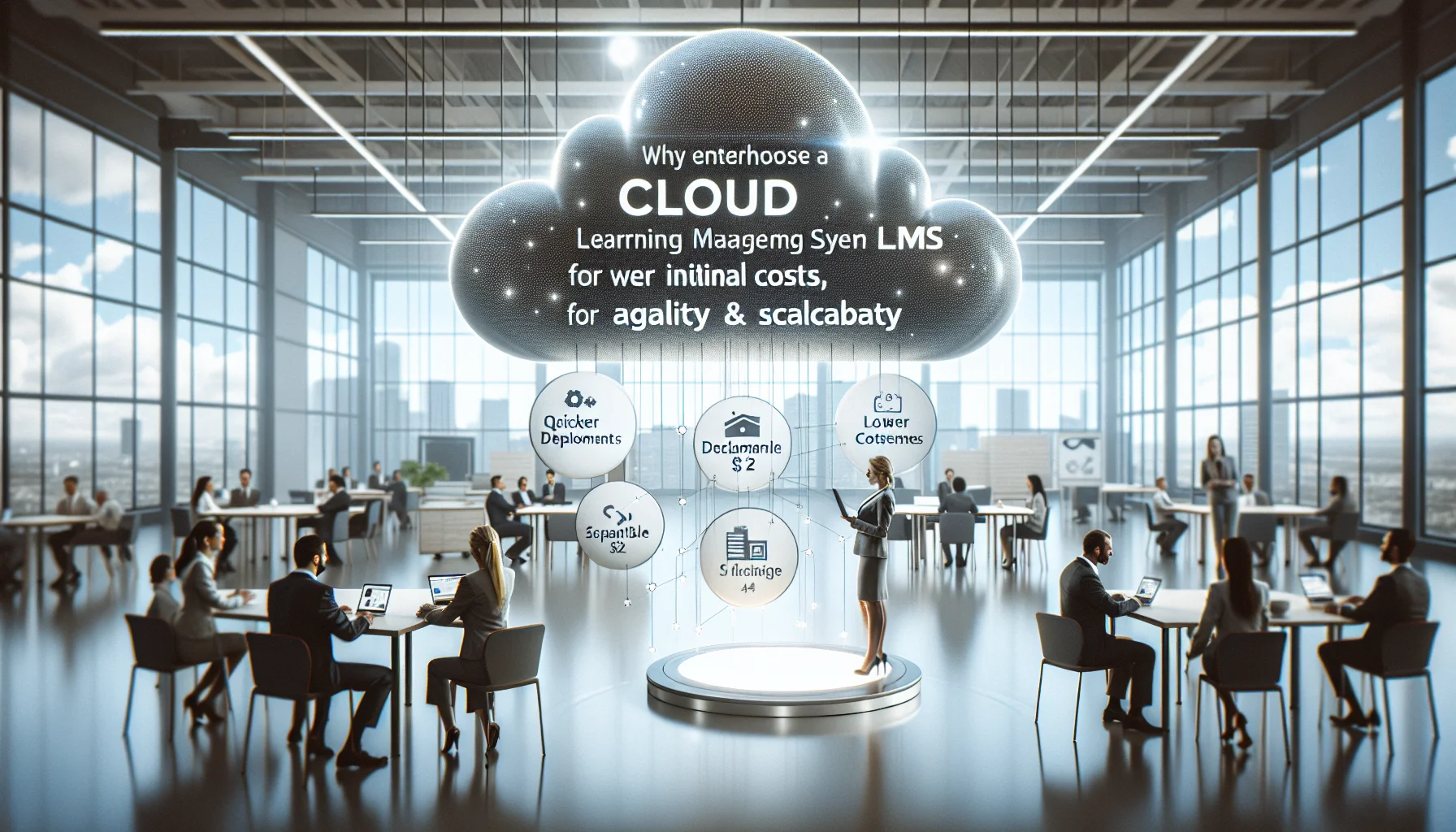
Enterprises benefit from cloud LMS platforms through faster deployments, lower upfront costs, elastic scalability, and centralized analytics that enable talent measurement. This article compares cloud LMS vs on-premise, outlines integrations, security checks, and a phased migration checklist (discovery, pilot, data migration, integration, rollout, optimize) to guide enterprise migrations.
A cloud LMS is rapidly becoming the default architecture for enterprise learning because it addresses modern demands for agility, scale, and measurement that on-premise deployments struggle to deliver. In our experience, organizations that switch from legacy systems to a cloud based LMS see faster rollout cycles, lower upfront costs, and more reliable uptime.
This article explains the practical reasons enterprises should evaluate a cloud LMS, compares it to traditional on-premise systems, and provides an implementation roadmap and warning signs to watch for. Expect actionable checklists, comparison tables, and real-world insights drawn from deployments and industry benchmarks.
Enterprises choose a cloud LMS because it aligns learning strategy with business agility. When teams need to respond quickly—new product launches, compliance updates, or M&A integrations—a hosted model reduces the friction of software updates and infrastructure provisioning.
We've found that the most compelling drivers are improved time-to-value and centralized analytics. A modern cloud based LMS aggregates learning data across departments, enabling talent analytics and performance correlation that on-premise silos rarely support.
Operational benefits are tangible and measurable:
These advantages translate into reduced total cost of ownership and higher adoption rates across global teams because the environment is consistently available and up to date.
When comparing cloud LMS vs on premise, decision-makers must weigh predictable operational expenses against capital expenditure and control. A hosted approach typically shifts costs from capex to opex, which can be favorable for budgeting and rapid scaling.
Below is a concise comparison that highlights the critical trade-offs organizations face.
| Dimension | Cloud LMS | On-premise LMS |
|---|---|---|
| Upfront Cost | Lower (subscription) | Higher (hardware + licenses) |
| Scalability | High (elastic) | Limited by hardware |
| Maintenance | Vendor-managed | Internal IT |
| Customization | Configurable via APIs | Deep customization possible |
ROI for a cloud LMS is driven by three levers: faster rollout, higher completion rates, and lower operating costs. Studies show that centralized, cloud-based learning functions can reduce per-learner costs by up to 30% compared to fragmented on-premise deployments when factoring staffing and maintenance.
When calculating ROI, include integration, training content migration, and change management—these are often underestimated.
Enterprises need a cloud LMS that integrates with HRIS, SSO, CRM, and analytics platforms. The ability to share learning objects and track xAPI/Tin Can data across systems is increasingly critical for workforce intelligence.
Cloud training software that supports API-first design, microlearning, mobile access, and offline sync will drive higher learner engagement and easier content governance.
Priority integrations typically include HRIS for user provisioning, SSO for seamless login, analytics platforms for measuring learning impact, and content libraries for rapid course assembly. A hosted learning platform that supports these integrations reduces the administrative overhead of syncing user records and reporting.
Some of the most efficient L&D teams we work with use platforms like Upscend to automate enrollment, compliance workflows, and completion reporting without sacrificing quality.
Security is a top concern when evaluating a cloud LMS. Enterprises should verify vendor certifications, data residency options, encryption standards, and incident response SLAs. A hosted model can provide stronger baseline security because vendors invest heavily in compliance and infrastructure redundancy.
In our practice, we've seen that the right security posture includes layered defenses, regular penetration testing, and contractual commitments for data handling.
Legal and security teams should request:
These checks ensure the hosted learning platform meets regulatory obligations and internal governance standards while leveraging cloud-native protections.
Successful migrations follow a repeatable sequence: discovery, pilot, migration, optimization. A phased approach reduces risk and creates quick wins to build momentum.
Below is a practical, step-by-step checklist to guide an enterprise migration to a cloud based LMS.
Small pilots can be live in weeks; enterprise-wide migrations typically take 3–9 months depending on integrations and legacy data complexity. Plan for parallel-run periods to preserve reporting continuity and compliance evidence.
Key success factors include executive sponsorship, a dedicated migration manager, and clear training for administrators and instructors.
Even with the advantages of a cloud LMS, enterprises encounter recurring pitfalls: underestimating change management, neglecting data quality, and choosing systems that overpromise customization.
We've compiled specific avoidance strategies that deliver faster adoption and minimize rework.
Adoption improves when learning is contextual, measurable, and rewarded. Connect learning outcomes to performance reviews, enable managers with dashboards, and design short, modular learning paths. Use A/B testing on content formats to learn what drives completion and performance.
A bias toward iteration—deploying minimum viable learning experiences and improving with analytics—is often more effective than attempting a perfect one-off launch.
For enterprises, a cloud LMS represents a strategic platform: it reduces operational burden, scales with the business, and unlocks data-driven learning insights. When you evaluate options, weigh integration capabilities, security posture, and the vendor's roadmap for analytics and automation.
Adopt a phased migration plan, prioritize integrations with HR and analytics, and measure impact with clear KPIs (time-to-proficiency, completion rates, and business outcomes). With the right approach, the benefits of cloud based LMS for enterprises include lower total cost of ownership, faster innovation, and better alignment between learning and business goals.
Next step: Map your current learning landscape against the migration checklist above, run a focused pilot, and use the results to build a prioritized enterprise rollout plan.
The Upscend Team provides actionable insights on technology and business strategy.
Book a walkthrough and we'll show you how it applies to your own content.
 General
December 22, 2025
This article compares cloud-based LMS and on-premise systems across TCO, deployment speed, scalability, security, and integrations. It shows SaaS LMS often lowers three‑year TCO, accelerates rollouts, and reduces ops overhead while meeting compliance via SOC2/ISO27001. Use a migration checklist, pilot migrations, and clear data export terms when evaluating vendors.
 General
December 23, 2025
Deciding between a cloud LMS and an on‑premises LMS requires weighing TCO, control, security, integrations, and migration effort. Cloud LMS often lowers ops cost, scales and simplifies updates; on‑premises suits strict data residency or deep customization. Use the article's checklist and pilot approach to quantify 5‑year costs and risks.
 Lms
LmsDecember 24, 2025
This article explains how to evaluate and select an enterprise LMS for global, large-scale deployment. It outlines core scalable LMS features—APIs, skills mapping, localization—plus validation tests, governance checklists, and a phased 90-day pilot roadmap to measure onboarding, compliance, and upskilling outcomes.
 Business Strategy&Lms Tech
January 27, 2026
This article compares cloud vs on-premise LMS deployments for multinational organizations across scalability, compliance, TCO, customization, latency and integrations. It recommends a weighted decision matrix, mapping regional risks, and phased hybrid migrations with a two-vendor pilot to validate latency, integrations and five-year costs before global rollout.