

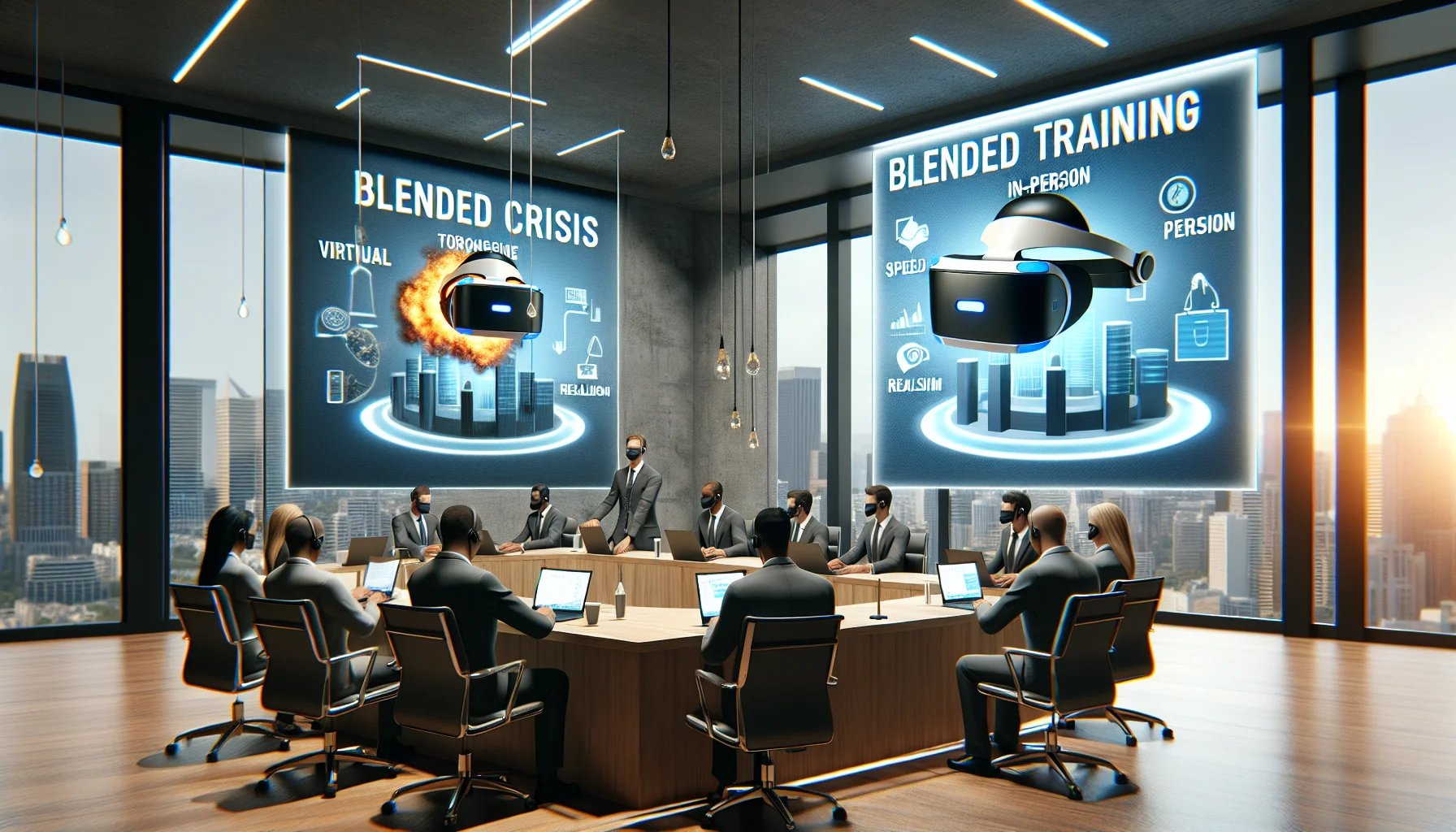
This article compares virtual, in-person and blended crisis training across speed, realism, reach, cost and assessment fidelity, and concludes blended crisis training is the pragmatic default when speed and fidelity matter. It includes a decision matrix, role-based mixes, sample schedules, cost/time trade-offs, and a 6–8 week pilot checklist with metrics.
Blended crisis training offers a practical middle ground when seconds count and coordination matters. In the first minutes of an emerging incident, the delivery mix you choose affects speed, realism, reach, cost and the fidelity of assessments. This article compares virtual vs in-person training and hybrid learning models to answer which training delivery mix is best for crisis preparedness and gives a decision matrix, sample schedules, cost/time trade-offs and a pilot approach you can implement this quarter.
In our experience, teams that plan with realistic constraints (budget, travel limits, workforce distribution) and measure outcomes iteratively get faster, more reliable responses. Below is a structured guide to choose and pilot the right mix.
Choosing between virtual vs in-person training and blended crisis training hinges on five practical criteria: speed, realism, reach, cost and assessment fidelity. Below we summarize strengths and limitations so you can align modality to the organizational constraint most likely to limit response time.
We've found that no single modality dominates across all criteria; the optimal mix depends on the dimension you prioritize. The comparison below reflects real program trade-offs from multi-national drills and municipal emergency response exercises.
Virtual delivery wins on rapid scale-up. A scheduled webinar or scenario-driven simulation can reach distributed staff in hours. In-person drills require coordination and travel time; they are slower to convene but often produce deeper behavioral change. Blended crisis training lets you launch a virtual primer immediately while reserving in-person simulation for later, compressing total program time without sacrificing depth.
High-fidelity tactile or equipment-based drills require in-person presence. Virtual simulations have improved (immersive branching, role-play breakout rooms), but tactile realism is limited. Blended approaches pair virtual scenario sequencing with focused in-person simulations to preserve realism while lowering cost and travel.
When teams are geographically dispersed or travel-limited, virtual and hybrid learning models provide broad coverage. Blended crisis training enables core audiences to receive essential content virtually while targeted cohorts get hands-on practice locally.
In-person is most expensive (venues, travel, staff time). Virtual is cheapest per head but may require investment in platforms and facilitation skills. Blended crisis training optimizes cost by concentrating in-person resources where they create the most incremental value.
Assessment in virtual settings can capture decision timing and communication logs, while in-person drills enable observation of non-verbal behavior and equipment handling. A blended approach provides multi-source evidence for better competency validation.
Below is a compact decision tool to map your primary constraint to the recommended delivery mix. Use it as a rule-of-thumb to answer which training delivery mix is best for crisis preparedness in different scenarios.
Apply the matrix against your program goals and budget to select an initial pilot design.
| Primary Constraint | Recommended Mix | Why |
|---|---|---|
| Need fastest organization-wide reach | Primarily virtual, add micro-sim labs | Virtual scales quickly; micro in-person labs cover critical hands-on tasks |
| High realism required (equipment/process) | In-person core + virtual prep | Hands-on fidelity with cost savings via virtual pre-work |
| Budget constraints & travel limits | Blended crisis training with regional hubs | Local, small-group simulations cut travel and per-person cost |
| Assessment & certification needs | Blended with mixed-mode assessment | Leverages virtual logs and in-person observation for robust validity |
If you must pick one short answer: when speed and fidelity both matter, blended crisis training is the pragmatic default. It lets you start fast (virtual) and validate deeper skills later (in-person).
Different roles demand different balances of speed, context and practice. Below are recommended delivery mixes we use when designing programs for corporate and municipal clients.
We recommend labeling every program with an objective, primary audience, and a single performance metric (time-to-decision, error rate, or communication latency) before choosing the mix.
Recommended: 70% virtual (scenario walkthroughs, dashboards), 30% in-person tabletop. Executives benefit from concise virtual briefings and facilitated tabletop sessions for cross-functional alignment. Blended crisis training provides just-in-time simulations followed by focused in-person rehearsals to fast-track strategic decisions.
Recommended: 50% virtual prep, 50% in-person simulation. Operational roles need tactile practice and coordination drills. Use virtual modules for checklists, systems walkthroughs and initial assessments, then validate skills in small-scale in-person labs.
Recommended: 60% virtual role-plays, 40% in-person media drills. Communication latency and message consistency are measurable virtually; in-person exercises simulate press conferences and stakeholder presence.
A pattern we've noticed: the turning point for most teams isn’t just creating more content — it’s removing friction. Tools like Upscend help by making analytics and personalization part of the core process. This reduces redundancy in training design and accelerates targeted follow-ups after blended sessions.
Below are three sample schedules (one-week mini-programs) that show how blended crisis training compresses time and reduces cost while preserving outcomes.
Each sample shows estimated time, travel exposure and cost direction (low/medium/high). Estimates assume a 200-person distributed org with three regional hubs.
Cost: Medium. Travel exposure: Low. Outcome: Alignment and time-to-decision reduction.
Cost: Medium-High. Travel exposure: Medium. Outcome: Equipment handling and coordination metrics.
Cost: Low-Medium. Travel exposure: Low. Outcome: Message consistency and response cadence.
Cost/time trade-offs quick guide:
Run a rapid pilot to validate assumptions before large rollouts. A structured pilot avoids wasted travel budgets and demonstrates impact to stakeholders.
We've found that a 6–8 week pilot with clear metrics provides reliable evidence to scale or pivot.
Common pitfalls to avoid:
Industry research and our practitioner networks show three trends driving successful crisis programs: personalization at scale, modular micro-sims, and integrated assessment. Hybrid learning design that stitches virtual analytics to in-person validation is becoming the de facto standard.
Best practices we recommend:
In summary, blended crisis training is the most defensible choice when you need both speed and fidelity under budget or travel constraints. Virtual vs in-person training is a false binary for most organizations—hybrid learning tied to clear performance metrics gives the best balance of reach, realism and cost control.
Use the decision matrix to map constraints to a recommended mix, run a short pilot with control and blended cohorts, and measure outcomes before scaling. A measured approach reduces travel spend, resolves budget concerns, and delivers faster, evidence-based improvements to response readiness.
Ready to test a blended pilot? Start with a one-month hypothesis-driven pilot: define the metric, select cohorts, and schedule a regional micro-sim. Track results and you’ll have the evidence to justify the right training delivery mix for your organization.
The Upscend Team provides actionable insights on technology and business strategy.
Book a walkthrough and we'll show you how it applies to your own content.
 L&D
L&DDecember 14, 2025
This article compares incident-based vs scheduled training and recommends a hybrid approach: scheduled modules for baseline compliance and incident-triggered microlearning for remediation. It outlines a five-step incident workflow, risk-to-cadence guidance (3–6 months for high risk), and key KPIs like time-to-training and recurrence rate to measure impact.
 ESG & Sustainability Training
January 5, 2026
This article shows procurement teams how to locate turnkey crisis training vendors quickly, construct a lean training vendor RFP, and apply a weighted procurement checklist and scoring rubric to evaluate offers. It outlines sourcing channels, must-have contract clauses, and practical steps to avoid vendor lock-in while running a rapid two-week pilot.
 ESG & Sustainability Training
January 5, 2026
Advanced crisis leadership training shifts executives from task-focused response to systemic stewardship, teaching systems thinking, stakeholder alignment, media strategy and legal integration. Leadership modules use simulations, decision rubrics and longitudinal metrics—stakeholder alignment score, reputational delta, and decision traceability—to measure multi-dimensional outcomes versus binary operational metrics.
Workplace Culture&Soft SkillsFebruary 4, 2026
Practical roadmap for decision makers to build and measure soft skills for crisis. The guide outlines five core competencies—communication, decision-making, emotional intelligence, adaptability, psychological safety—and a three-tier assessment approach, modular training (microlearning, simulations, coaching), process embeds, KPIs, and a sample 90‑day implementation plan to drive measurable improvement.