

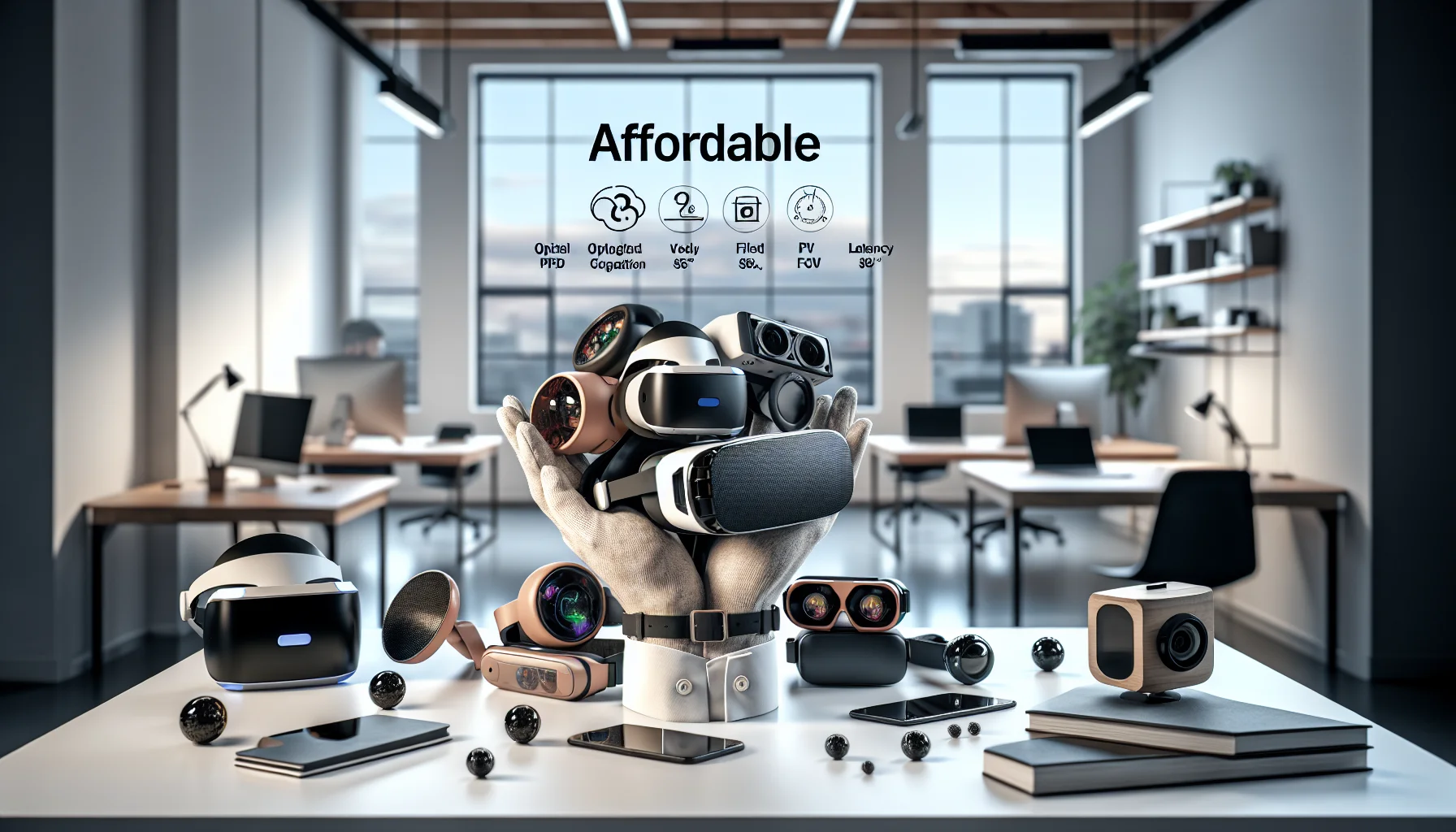
Assess affordable VR headsets for training by scoring optical fidelity (PPD), FOV and latency, plus ergonomics and enterprise tools. Pilot 10–20 units with real content, measure PPD/FOV in-context, and factor sanitation, warranties, and TCO. Match headsets to fine-motor or spatial training profiles before scaling.
When teams need immersive, scalable training without breaking the budget, affordable VR headsets are the starting point. In our experience, the right headset balances optical fidelity, comfort for long sessions, and enterprise-ready management. This buyer's guide compares the top options, benchmarks critical visual metrics, and gives procurement and sanitation tips so training programs can keep realism high while controlling total cost.
Below you'll find a practical comparison of 6 headsets tuned to training use, guidance on when to prioritize pixel density versus field of view, and short user-case blurbs from manufacturing and healthcare to show real-world fit.
To recommend affordable VR headsets for training, we score devices across three pillars: optical fidelity, ergonomics for long sessions, and enterprise readiness. Optical fidelity includes measured pixel density, lens quality, and subpixel layout; ergonomics covers weight, straps, and heat; enterprise readiness examines MDM/console support, security, and warranty options.
We've found that training needs cluster into two clear profiles: fine-motor and procedural training (where resolution and low latency matter) and spatial/orientation training (where FOV and tracking stability are paramount). Matching headset strengths to these profiles avoids paying extra for features you don't use.
For visuals we prioritize three metrics: pixels per degree (PPD) or pixel density, field of view (FOV), and system latency. High PPD improves legibility of gauges and fine textures; wide FOV supports situational awareness. For training, aim for at least moderate PPD and 90°+ FOV for balanced results.
Other factors: lens godrays, software upscaling (foveated or fixed), and display type (LCD vs OLED) all change perceived realism even at similar pixel counts.
Below we compare six affordable VR headsets that offer strong visual fidelity relative to price and are commonly used in enterprise training programs. Each entry shows headline specs, real-world suitability, and pros/cons for training.
Key specs: near-eye dual LCD panels, per-eye resolution in the high thousands (manufacturer-rated), ~110° FOV, inside-out tracking. Excellent for standalone headsets for training where wireless freedom matters.
Real-world fit: Ideal for mixed procedural and soft-skills training. Its upscaling and passthrough clarity help spatial tasks and object interaction.
Key specs: slightly lower resolution than newer units but extremely cost-effective; ~90°–100° FOV. Lightweight and widely supported.
Real-world fit: Good for orientation, basic procedural training, and large pilot programs where unit cost matters most.
Key specs: high-resolution panels and close-to-Quest 3 FOV; competitive pixel density and built-in ergonomic design. Available in consumer and enterprise variants.
Real-world fit: A strong choice for teams that want a high-resolution VR headset feel without PC tethering; commonly chosen for product assembly and quality-inspection training.
Key specs: per-eye high-resolution LCD, eye tracking, enterprise provisioning. Eye tracking enables analytics and foveated rendering to boost perceived clarity.
Real-world fit: For training that benefits from gaze analytics and reduced rendering load—fine-motor tasks and assessment scenarios perform well.
Key specs: stable tracking, enterprise configurations, competitive pixel density in newer Focus models. Good MDM and warranty choices.
Real-world fit: Training programs that require centralized device management, long warranties, and ruggedized accessories often pick this family.
Key specs: pairing a budget desktop or laptop GPU with an entry headset (refurbished high-res models) can outperform standalone visually while remaining affordable in TCO for small cohorts.
Real-world fit: Best when absolute visual fidelity for minute inspection is essential and the environment supports tethered setups and maintenance.
Benchmarks should inform procurement. When comparing cheap VR headsets for training, focus on three measurable values:
We recommend running a test matrix that measures each candidate headset on these metrics using sample training scenes. In our experience, lab-measured PPD often differs from perceived clarity because of lens artifacts and software scaling—so always validate with the actual training content.
Create a short, repeatable checklist and scorecards. Include:
Run sessions with a representative group of trainees and capture qualitative feedback—visual metrics alone don’t tell the whole story.
Cost-of-ownership for affordable VR headsets is heavily influenced by provisioning, MDM, and warranty. In our deployments we've learned to prioritize devices with unified consoles and clear bulk-pricing tiers.
Look for the following when buying:
For analytics and session management, many teams combine headset vendors’ tooling with third-party platforms that track engagement and performance (this process benefits from real-time feedback integration (available in platforms like Upscend) to help identify disengagement early). Use these tools to close the loop between training outcomes and headset choice.
When calculating TCO, include device cost, case/charger accessory cost, staffing for maintenance, content licensing, and expected lifespan. Negotiation tips:
Shared headsets must be durable and easy to sanitize. Our experience shows the biggest pain points are degrading facial interfaces, cracked straps, and lens contamination.
Sanitation best practices:
Durability tips: choose headsets with modular face pads and readily available spare parts. A modest increase in unit price for enterprise variants often saves 12–24% in replacement costs over a 3-year program.
Manufacturing: A mid-sized assembler used affordable VR headsets (standalone units with high PPD) to train wiring harness assembly. The team prioritized headsets with good near-field clarity and eye tracking for performance assessment. Results: 30% reduction in onboarding time and fewer assembly defects after a 6-week rollout.
Healthcare: A community hospital deployed a mixed fleet: higher-resolution standalone headsets for suturing modules and cheaper units for spatial orientation simulations. Sanitation protocols and replaceable facial interfaces were critical; they favored enterprise warranties and advance replacements to keep training schedules on track.
Teams often make three recurring mistakes: buying solely on spec sheets, under-budgeting for accessories and maintenance, and ignoring user comfort. To avoid these, always pilot with representative content, include accessory and sanitation line items in procurement, and prioritize ergonomics for hour-long sessions.
Choosing the right affordable VR headsets for training requires balancing pixel density, FOV, and enterprise tooling against budget constraints. In our experience, the best approach is iterative: pilot with 10–20 units, measure visual suitability against actual training tasks, and scale with vendor enterprise agreements that include warranties and spare parts.
Actionable next steps:
Ready to choose the right headset? Start a pilot with one or two of the recommended models and use the checklist above to score visual fidelity, comfort, and admin overhead. That empirical data will make procurement decisions defensible and keep training realistic without unnecessary cost.
The Upscend Team provides actionable insights on technology and business strategy.
Book a walkthrough and we'll show you how it applies to your own content.
 The Agentic Ai & Technical Frontier
January 4, 2026
This article lays out minimum specs and procurement ranges for budget VR training hardware, comparing standalone VR headsets and tethered PC VR requirements. It covers controllers, tracking, audio/haptics, lifecycle expectations, IT support needs, a decision flow, and a pilot checklist so teams can run small pilots and scale based on measured outcomes.
 The Agentic Ai & Technical Frontier
January 4, 2026
This article explains minimum specs for VR training hardware on a budget, comparing standalone VR headsets and tethered PC VR requirements. It outlines component priorities, cost bands, lifecycle expectations, procurement tips, a decision flow for matching fidelity to objectives, and a low-cost pilot checklist to validate assumptions before scaling.
 The Agentic Ai & Technical Frontier
January 4, 2026
Choose affordable VR headsets by matching training goals to measurable optics: prioritize pixel density and optics for fine-motor work and FOV/tracking for spatial drills. We compare six practical models (Meta Quest 3, Pico 4, HP Reverb G2, Vive Pro 2, Quest 2) and give benchmarking, enterprise, and procurement guidance. Run pilots before scaling.
Business Strategy&Lms TechJanuary 25, 2026
This article explains how HR teams should select and procure MR/VR headsets for onboarding, compliance, and soft-skill training. It compares common models and price tiers, outlines procurement channels, device-management best practices, warranty needs, and three pilot configurations (small, mid, enterprise) to reduce rollout risk and operational overhead.