


This article gives procurement teams a practical checklist and weighted rubric to evaluate LMS gamification features. It explains realistic outcomes for badges, leaderboards, branching scenarios, micro-quests, and analytics, lists integration and security checks, and provides RFP questions and pilot guidance to measure retention and total cost of ownership.
When procuring a learning platform, procurement teams increasingly ask for LMS gamification features in requirements documents. In our experience, the phrase appears early in RFPs but often translates into a mismatched procurement outcome: flashy demos but weak integrations, or gamification tools that only reward completion rather than change behavior.
This article provides a pragmatic procurement-oriented guide: a concise feature checklist, a realistic analysis of what each feature delivers, an evidence-based evaluation rubric, integration and security guidance, and practical RFP language. Use this to avoid vendor overpromise, identify hidden costs, and choose gamification that drives measurable learning impact.
Start RFPs with a clear checklist. Ask vendors to demonstrate each item in a realistic workflow rather than in isolated widgets. Key items to require include:
Insist on demonstration of these items using your content and at least one compliance scenario. For compliance-focused programs, include the secondary keyword best LMS gamification features for compliance training in the evaluation criteria to make expectations explicit.
Expect some items to be best delivered by embedded functionality (badges, micro-quests) while analytics and advanced scenario-building can be supported through connectors to specialist tools. A balanced procurement view treats the platform as an orchestration layer: native UI components for learner-facing features, and open APIs for deeper analytics and content generation.
Vendors often describe an LED-lit list of capabilities. Ask: does the feature drive behavior, or just UI affordances? Below are realistic outcomes for high-priority features and the common vendor claims to challenge.
| Feature | Common vendor claim | What it actually delivers (realistic) |
|---|---|---|
| Badges | "Increases motivation instantly" | Provides social proof and micro-credentials when tied to clear competencies and expiry rules. |
| Leaderboards | "Boosts completion rates" | Drives short-term engagement for competitive cohorts but can demotivate low-performers; needs segmentation controls. |
| Branching scenarios | "Simulates complex job tasks" | Good for decision training if scenario state persists and scoring maps to competencies; poor if linear or superficial. |
| Micro-quests | "Makes learning fun" | Encourages habit formation when quests are linked to job tasks and manager approvals; ineffective if cosmetic. |
| Analytics integration | "Provides ROI dashboards" | Delivers measurable insights only when xAPI and competency models are implemented and linked to business KPIs. |
Clear design and alignment to competencies determine whether a feature is meaningful or merely decorative.
Practical tip: require vendors to present two live case studies that show pre/post metrics for at least one of the features you value most—this exposes both capability and reporting fidelity.
For compliance, the best LMS gamification features for compliance training are those that improve knowledge retention and auditability: branching scenarios with evidence capture, badge metadata that links to competencies and expiration, and analytics that feed into compliance reporting. Cosmetic badges without competency tags deliver little audit value.
Procurement needs objective scoring. We've found a simple weighted rubric reduces bias and reveals hidden costs. Core dimensions:
Use a 1–5 scale per criterion and calculate weighted scores. Below is a compact scoring template you can paste into a spreadsheet:
| Criterion | Weight | Vendor A | Vendor B | Notes |
|---|---|---|---|---|
| Functionality | 30% | 4 | 3 | Badges standard; branching limited |
| Integration | 20% | 3 | 5 | Vendor B has robust API |
| Analytics & Reporting | 20% | 4 | 2 | Export to BI available |
| Authoring & Usability | 15% | 5 | 3 | No-code micro-quest builder |
| Total cost of ownership | 15% | 3 | 4 | Higher services fees for A |
Two practical evaluation rules we've used: 1) award points only for demonstrated workflows using your content, and 2) require vendors to disclose average implementation timelines and professional services rates for gamification projects.
Technical integration and security are where vendor overpromise often becomes an operational headache. Your checklist must include standards-level integrations (SCORM/xAPI/xLS, LRS, SSO), data residency, encryption, and role-based access for gamification administration.
Modern LMS platforms — Upscend is an example — are evolving to support AI-powered analytics and personalized learning journeys based on competency data, not just completions. That industry trend matters because it changes the integration requirements: you need event-level learning data (xAPI), competency models, and an LRS or BI pipeline to turn gamified actions into business insights.
Key technical checks:
Security caveat: gamification creates new data types (behavioral signals). Treat them as sensitive: include data retention and deletion clauses in contracts, and require SOC2 or equivalent security attestation.
Short-list vendors that can demonstrate three things: enterprise integration, measurable outcomes, and a no-code authoring path. When you run pilot evaluations, include at least one compliance and one performance improvement use case.
Example RFP questions focused on gamification:
Do not accept canned demo content. Negotiate trial workloads that use your real learners and measure retention at 30 and 90 days. Be explicit about hidden costs: setup fees, content conversion, badge verification services, and ongoing maintenance for scenario trees.
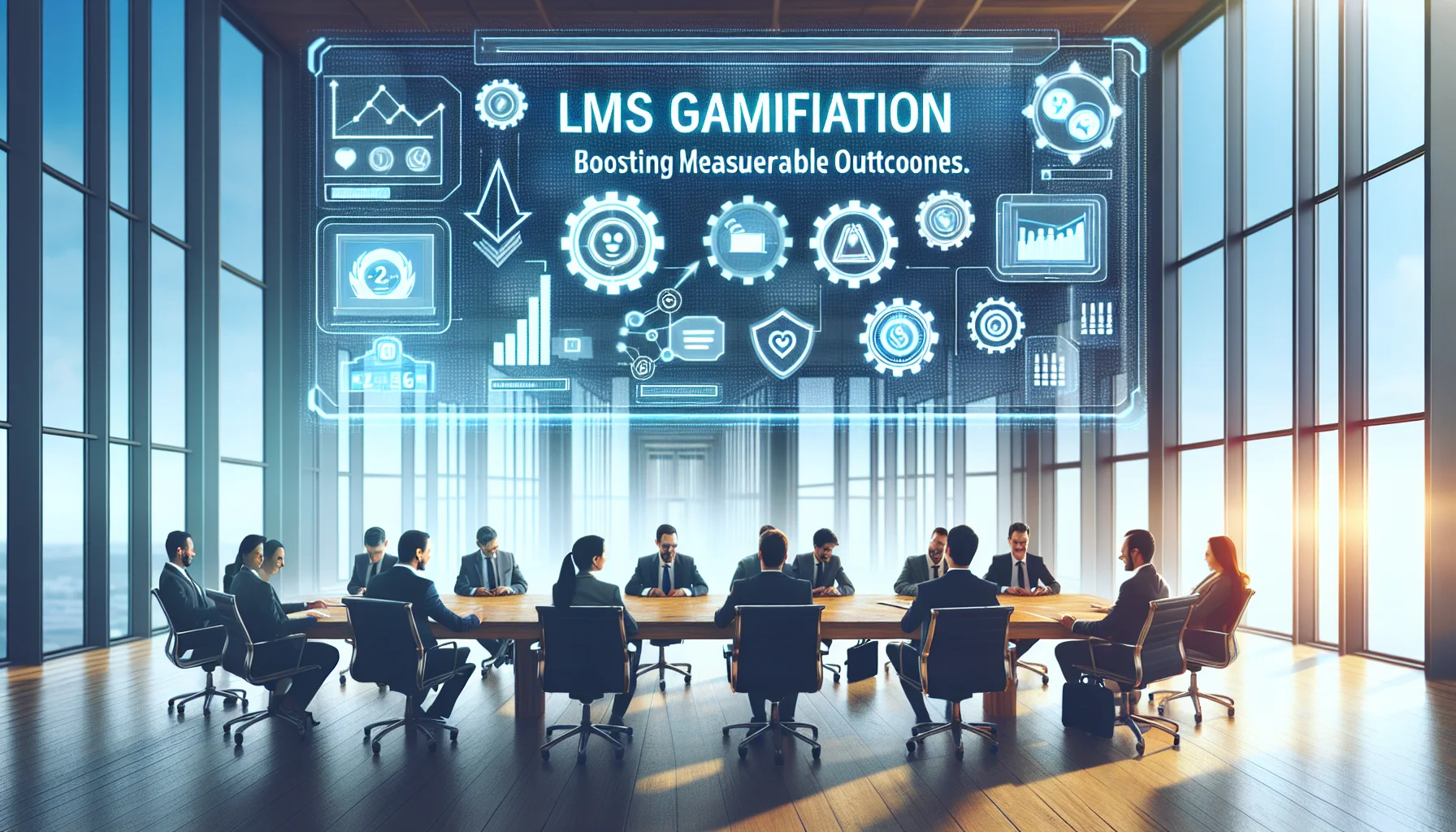
The visual angle helps stakeholder alignment. Build a two-panel vendor-evaluation dashboard:
Include annotated product UI thumbnails in your procurement binder with short benefit stickers: "audit-ready badges", "persistent branching", "xAPI export". These artifacts reduce misinterpretation during demos and make post-selection handoffs to IT and L&D smoother.
Example annotation set:
When assessing LMS gamification features, shift the conversation from UI bells-and-whistles to measurable outcomes, integrations, and total cost of ownership. In our experience, the platforms that win procurement evaluations are those that: 1) supply standards-based telemetry (xAPI/LRS), 2) support competency-linked badges and scenario persistence, and 3) provide no-code authoring so L&D can iterate without vendor reliance.
Next steps for procurement teams: run an evidence-based pilot using your compliance content, apply the weighted evaluation rubric here, and demand implementation timelines and service rates up front. Avoid vendors that promise instant behavior change; prioritize those that demonstrate sustained impact with data.
Call to action: Use the provided checklist and rubric to design a 60–90 day pilot RFP, require event-level xAPI exports, and score vendors with the weighted template before any procurement decision.
The Upscend Team provides actionable insights on technology and business strategy.
Book a walkthrough and we'll show you how it applies to your own content.
 L&D
L&DDecember 21, 2025
This article lists the essential LMS features to evaluate when selecting a platform, explaining core capabilities, learner experience, automation, analytics, and scalability. It recommends scoring features by business impact, running scripted pilots with real data and integrations, and requiring evidence for security and performance before procurement.
 L&D
L&DDecember 21, 2025
This article explains how LMS gamification uses mechanics like badges, progress bars, and optional leaderboards to increase engagement, completion, and job performance. It provides a four-phase pilot roadmap—define objectives, prototype, pilot, scale—plus design patterns, platform tips, pitfalls, and measurement strategies to tie gamified learning to business outcomes.
 General
December 22, 2025
This LMS procurement checklist provides decision-makers a concise RFP question bank, technical acceptance tests, security and legal clauses, pricing comparators, and SLA scoring templates. Use the weighted scoring and real-world example to shorten procurement cycles, validate vendor claims with test tenants, and reduce implementation risks.
 ESG & Sustainability Training
January 5, 2026
Gamification vendor training applies badges, progress bars, leaderboards and scenario-based challenges to raise supplier engagement and completion in LMSs. Start with micro-modules, visible progress and opt-in social features; measure completion and assessment scores, pilot a representative cohort, then scale while using guardrails to avoid fatigue.