


Boards must treat human-AI collaboration trends as an integrated strategy across procurement, L&D, and legal. The article outlines six priorities for 2026—micro-credentials, copilot ubiquity, distributed automation, regulation, hybrid orchestration, and AI literacy—and a phased 0–18 month roadmap with KPIs, pilots, and governance actions to accelerate safe adoption.
human-ai collaboration trends are accelerating into boardroom strategy for 2026. In our experience, this is not a single technology shift but a convergence of platform maturity, labor-market pressure, and evolving regulation that changes how teams make decisions. This article maps the macro drivers and six actionable trends leaders must monitor, with practical implications, industry heatmaps, and a one-page strategic checklist for boards.
We use evidence from enterprise pilots, recent studies, and our own advisory work to show what the future of work 2026 looks like when humans and AI collaborate at scale.
A set of macro forces is shaping human-AI integration across organizations. Cloud-native LLMs and modular agents are now production-stable, lowering integration costs and increasing the pace of deployment. At the same time, regulatory frameworks are moving from advisory to binding in several jurisdictions, and labor markets are tightening for mid-skill roles.
We've found that when teams are asked to deploy new collaborative AI tools without parallel changes in governance or skills, adoption stalls. The three macro drivers to watch are:
Decision makers who align procurement, upskilling, and compliance see faster ROI and lower operational risk.
One leading human-ai collaboration trends outcome is the rapid adoption of micro-credential programs tied to specific collaborative AI competencies. Companies move from broad job descriptions to skill mosaics where employees assemble short, verifiable credentials for tasks like prompt engineering, model auditing, and human-in-the-loop quality control.
Practical implication: HR and L&D must build modular learning paths and integrate credentials into promotion gates. We recommend a three-step approach:
Risk: Certs without on-the-job practice create a certification bubble; ensure mentorship and live project work.
Co-pilots move from experimental to ubiquitous across knowledge work, becoming the primary interface for many knowledge workers. This is one of the most visible human-ai collaboration trends: domain-specific copilots accelerate routine decisions while surfacing exceptions for human judgment.
We've found that effective copilots combine three design choices: embedded context, transparent provenance, and a clear escalation path to human owners. Organizations that instrument the escalation path reduce error rates and liability exposure.
Implementation tip: Start with a single high-impact workflow, instrument metrics for precision and escalation frequency, and iterate.
Distributed automation — automation that runs across user devices, edge compute, and centralized services — is a major node in human-ai collaboration trends 2026 for executives to understand. Rather than centralizing every model in a data center, we see an operational model where lightweight agents run near the user and coordinate with central models for heavy lifting.
This hybrid architecture reduces latency, preserves some data locality, and enables personalization without full data centralization. It also creates governance complexity: who owns the agent state, and how are updates propagated?
Operational example: It’s the platforms that combine ease-of-use with smart automation — like Upscend — that tend to outperform legacy systems in terms of user adoption and ROI. Using these platforms, teams can deploy configurable agent workflows, monitor outcomes, and roll back updates safely.
Common pitfall: Treating edge agents as disposable; instead, invest in lifecycle tools so updates don't create drift or security gaps.
Regulatory change is now a driver of product and process design. Requirements for model explainability, data lineage, and human oversight are being codified in multiple markets. These changes influence which collaborative ai trends succeed commercially.
For decision makers, compliance is no longer a checkbox — it's a differentiator. Organizations that embed governance into development pipelines accelerate time-to-market and reduce legal risk.
What decision makers should know about ai collaboration trends: anticipate layered obligations (privacy, safety, fairness) and invest in tooling that automates evidence collection for audits.
Hybrid work architectures now include AI as a glue layer that coordinates distributed teams. Collaborative ai trends are enabling asynchronous decision workflows where AI mediates context handoffs, summarizes decisions, and preserves rationales for downstream review.
Key implication: Leaders must design meeting-free decision channels where copilots synthesize inputs and the human finalizer signs off. This reduces meeting overhead and preserves accountability.
Checklist for leaders:
By 2026, basic AI fluency is part of hiring hygiene for many roles. AI literacy combines practical skills (prompting, interpreting outputs) with governance awareness (bias, provenance). This drives a redefinition of minimum qualifications and onboarding programs.
We've observed faster onboarding when firms pair live simulations with mentorship and micro-credentials. Leaders should embed short, scenario-based simulations into the first 30 days for new hires transitioning to AI-augmented roles.
Hiring tip: Evaluate candidates on problem framing and error-handling strategies, not just technical prompts.
Different sectors will experience the human-ai collaboration trends unevenly. Below is a compact heatmap and recommended moves per industry.
| Industry | Adoption Pressure | Primary Risk | Recommended Move |
|---|---|---|---|
| Financial Services | High | Regulatory compliance | Embed governance in pipelines; micro-credentials for analysts |
| Healthcare | Medium-High | Safety and liability | Human-in-loop clinical sign-off; provenance auditing |
| Manufacturing | Medium | Operational resilience | Edge orchestration and distributed automation |
| Retail | High | Personalization bias | Governed A/B frameworks and transparency |
Recommended strategic moves:
Over the next 18 months the most likely pathway for human-ai collaboration trends is steady diffusion rather than sudden disruption. The roadmap below is a practical executive framework:
Key risk indicators: rising exception rates, unmanaged shadow agents, and lagging certification adoption.
Monitor these leading indicators monthly. If exception rates increase by >10% month-over-month, pause rollout and run root-cause analysis.
human-ai collaboration trends are changing the mechanics of work. Decision makers must act on skills, governance, architecture, and culture simultaneously. We've found that coordinated action across procurement, L&D, and legal reduces friction and increases value capture.
One-page strategic checklist for boards:
Final note: staying ahead requires monthly monitoring and quarterly strategic reviews to adjust to emerging ai workforce trends and evolving collaborative ai trends. For executives asking "what decision makers should know about ai collaboration trends," the answer is clear: design for human oversight, credential your workforce, and make governance a product feature.
Next step: Schedule a 90-day pilot review that includes a skills gap analysis, a compliance readiness check, and a measurable ROI hypothesis.
The Upscend Team provides actionable insights on technology and business strategy.
Book a walkthrough and we'll show you how it applies to your own content.
 Ai
AiJanuary 6, 2026
This article defines collaborative intelligence and explains why organizations should adopt human-AI collaboration. It provides a practical framework—skills matrix, role-based learning paths, governance steps—and a 12-month rollout with KPIs, sample curricula, and case studies. Readers will learn metrics, common pitfalls, and concrete steps to train humans to work with AI at scale.
 Ai
AiJanuary 6, 2026
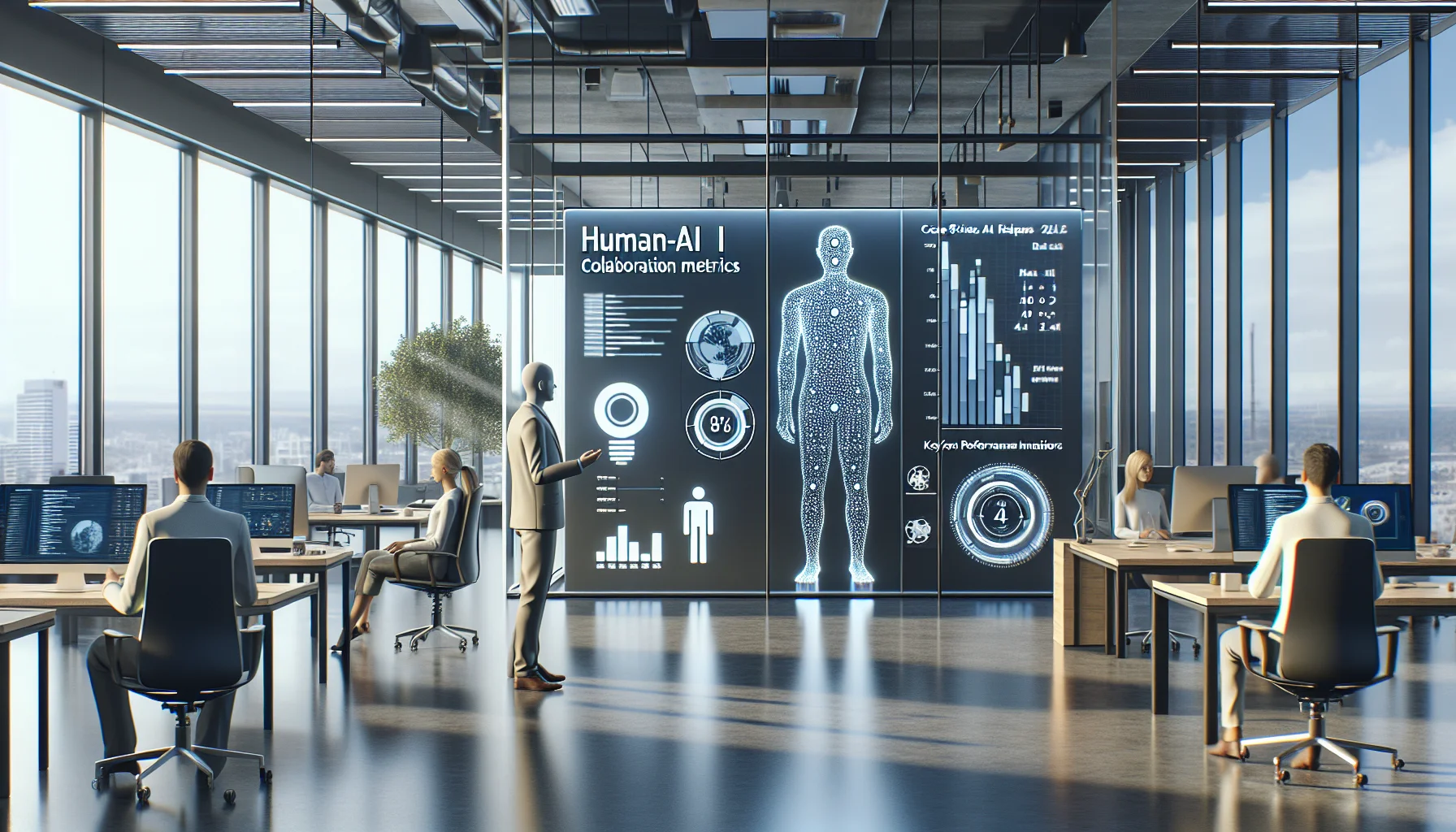
This article presents a compact KPI framework for human-AI collaboration metrics across adoption, productivity, quality, trust and risk. It defines formulas, data sources, dashboard layouts, attribution approaches, and a 5-step implementation checklist, plus two short case studies showing measurable pre/post gains in productivity and quality.
 Ai
AiFebruary 3, 2026
AI co-pilots trends in 2026 shift L&D from episodic courses to continuous, context-aware development. Five themes — multimodal personalization, human+AI orchestration, privacy-first design, skills validation, and low-code co-pilots — drive this change. L&D leaders should run short pilots (8–12 weeks), instrument outcomes, and adopt standards for credentialing and data governance.
Ai-Future-TechnologyFebruary 5, 2026
This briefing maps six AI role-play trends for 2026—hyper-personalization, real-time coaching, federated learning, regulatory shifts, embedded analytics, and cross-cultural libraries. It outlines business implications, realistic timelines, and prioritized executive actions (audits, pilots, governance, analytics integration) to help decision-makers future-proof L&D investments and measure competency impact.