


Treat training as a control: map courses to risk registers, assign single-point owners, enforce versioned audit trails, and measure outcomes. This article gives governance principles, a recommended org structure, role definitions, a training RACI model, policy language, audit-trail requirements, and a 6-step rollout checklist to implement risk-aligned training.
training governance model is the backbone that links learning, compliance, and risk controls. In our experience, designing a governance layer that treats training as a risk control reduces repeat incidents, clarifies accountability, and accelerates audit readiness. This article provides an actionable blueprint: governance principles, recommended org structure, clear role definitions, a sample training RACI model, policy language, and audit-trail standards you can implement immediately.
Effective governance for training under risk and compliance is not an add-on; it's a control. We follow five core principles when building a training governance model that stands up to audits and operational reality:
We've found that enforcing a small set of core principles early prevents scope creep and role ambiguity later. Make these principles part of your policy preamble so they are visible to stakeholders and auditors.
A practical training governance model needs a compact, cross-functional structure that balances central oversight with local execution. Typical structure we've used in enterprise environments:
In our experience, a board-level sponsor plus a designated Risk Owner for training cuts decision time by 40% and reduces role ambiguity. Use charters to define meeting cadence, decision rights, and escalation paths.
Ambiguity over who "owns" training is a common pain point. Below are concise role definitions to embed into job descriptions and the governance policy.
The Risk Owner is accountable for treating training as a risk control. Responsibilities:
Risk Owner must be a line manager or function head with the authority to enforce consequences tied to control performance.
The Content SME crafts, reviews, and updates learning materials. Responsibilities:
We've found pairing each SME with a reviewer from Risk ensures content meets control objectives before release.
The Delivery Owner manages execution: enrollment rules, LMS configuration, reporting, and evidence retention. Responsibilities:
Clear separation between Content SME and Delivery Owner prevents last-mile failures where correct content exists but delivery doesn't meet risk requirements.
Implement a training RACI model to make responsibilities explicit. Below is a compact RACI table for a typical compliance course. Replace role names with your org's titles.
| Activity | Risk Owner | Content SME | Delivery Owner | L&D Ops | Legal |
|---|---|---|---|---|---|
| Define training requirement | R | A | C | I | C |
| Create/approve content | C | A | C | I | C |
| Configure LMS & enroll | I | A | R | I | |
| Monitor completions | A | I | R | C | I |
For cross-functional clarity, provide a visual chart to stakeholders and publish the RACI in the governance portal. A common pitfall is overlapping "Accountable" assignments—ensure only one A per activity.
While traditional LMS implementations require manual rule setup for each role, we've observed modern platforms streamline role-based sequencing. For example, while traditional systems require constant manual setup for learning paths, some modern tools (like Upscend) are built with dynamic, role-based sequencing in mind. That pattern reduces operational overhead and improves compliance reporting when paired with a strong governance model.
A tight policy reduces interpretation variance. Below is sample policy text you can adapt. Use strong, enforceable language and embed references to risk registers and sanctions.
Sample policy text (extract):
Policy Title: Training Governance Policy — Risk Controls
Purpose: To ensure mandatory training functions as an auditable control mapped to enterprise risks and that ownership, delivery, and evidence retention support regulatory and internal audit requirements.
Scope: Applies to all employees, contractors, and third parties assigned control responsibilities in the enterprise risk register.
Accountabilities: Risk Owners are accountable for control objectives; Content SMEs are accountable for content accuracy and versioning; Delivery Owners are accountable for enrollment, completion evidence, and reporting.
Non-compliance: Failure to complete mandatory training triggers automated remediation workflows; persistent non-compliance escalates to the Risk Owner and HR per the escalation matrix.
Next, define precise audit trail requirements. We require the following minimum artifacts be retained for each mandatory course:
Store artifacts in an immutable repository or configure the LMS to produce exportable, tamper-evident logs. Auditors look for linkage between the risk register, the policy decision, and the completion evidence—make that linkage explicit in reports.
Below is a practical rollout checklist to move from concept to operational control. We've used this sequence across regulated industries with success.
Include these checkpoints in your project plan and validate each step with the Governance Board before progressing. Accountability gates reduce drift and ensure training remains a functioning control.
Escalation mechanisms solve one of the biggest pain points: accountability for non-compliance. A concise flow we've used:
Document this flow in policy and automate steps where possible to reduce manual chase.
Building a training governance model under Risk Management requires both governance design and operational rigor. A few closing lessons we've learned:
Start with the 6-step rollout checklist, adopt the sample policy language, and publish the RACI templates. Expect the first 90 days to focus on mapping and tooling; the next 6–12 months will be continuous refinement driven by audit findings and incident data.
Next step: Assemble your Governance Board, assign Risk Owners for the top 10 risks, and run the pilot for one high-risk training pathway. That pilot will produce the artifacts auditors want and demonstrate measurable risk reduction within one reporting cycle.
The Upscend Team provides actionable insights on technology and business strategy.
Book a walkthrough and we'll show you how it applies to your own content.
 L&D
L&DDecember 14, 2025
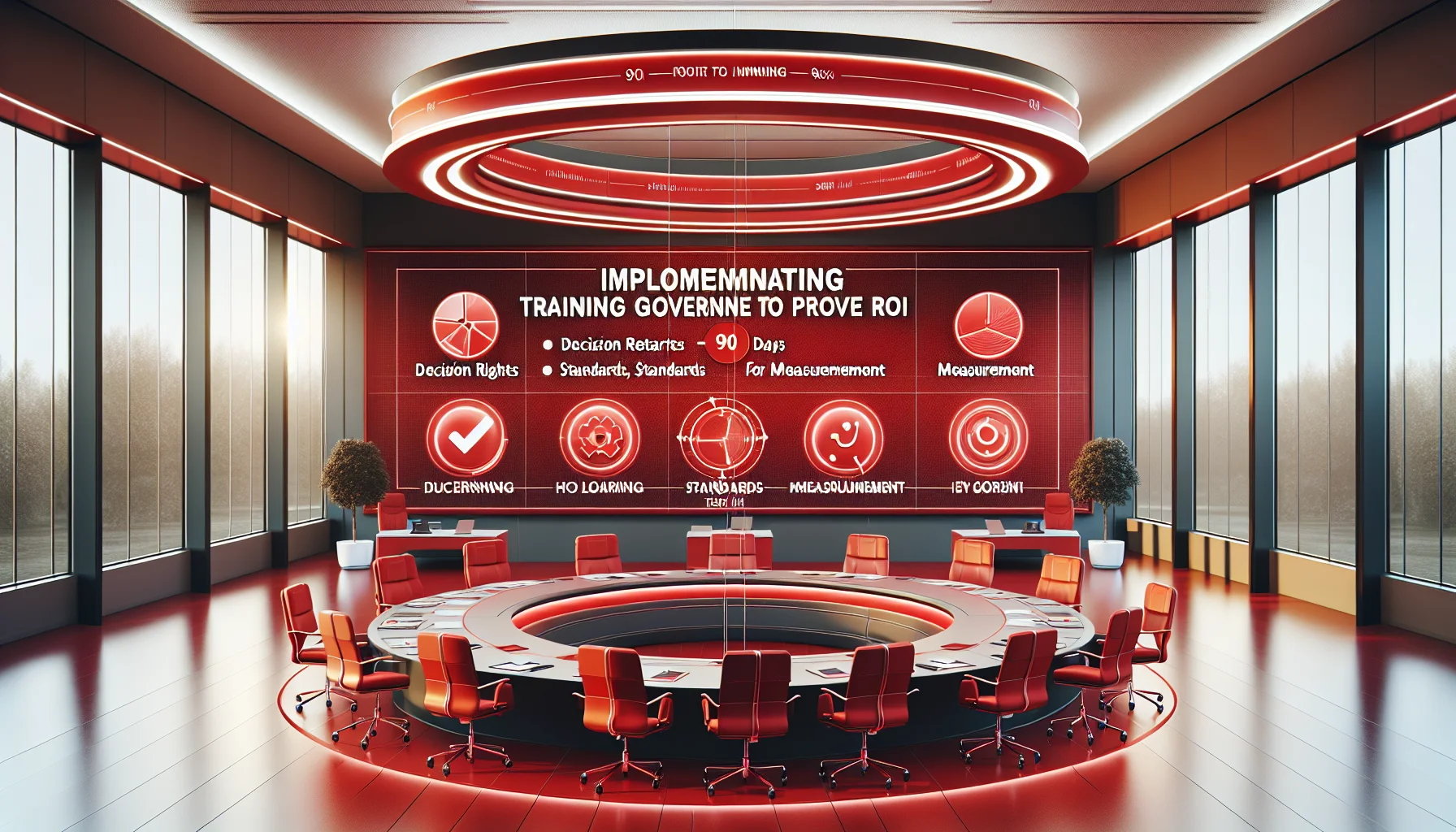
Training governance defines decision rights, standards, and measurement for learning programs to reduce duplication, manage vendor spend, and demonstrate value. Use a three-tier governance model (steering committee, operational council, delivery owners) and start with a 90-day pilot that sets roles, minimal standards, and measurable KPIs. Link outcomes to business metrics to calculate ROI.
 L&D
L&DDecember 14, 2025
This article explains how to design a training governance framework that clarifies policy, roles, workflows, and metrics. It outlines step-by-step implementation—assess current state, draft policies, pilot high-risk domains, and scale—plus templates, KPIs, and common pitfalls. Emphasizes competency outcomes, automation, and iterative reviews for enterprise adoption.
 L&D
L&DDecember 14, 2025
This article explains how to align learning programs with legal and regulatory obligations using a risk‑aligned governance framework. It outlines step‑by‑step design, implementation and measurement tactics — from role mapping and audit‑ready records to reporting cadence — and recommends a 90‑day pilot to validate controls and metrics.
 L&D
L&DDecember 14, 2025
Article explains practical options for training governance tools, covering LMS governance tools, training workflow software, and training audit trail software. It gives vendor comparison criteria, a weighted scorecard, and a three-week proof-of-value checklist to implement auditable workflows, evidence schemas, and retention policies for defensible compliance.