

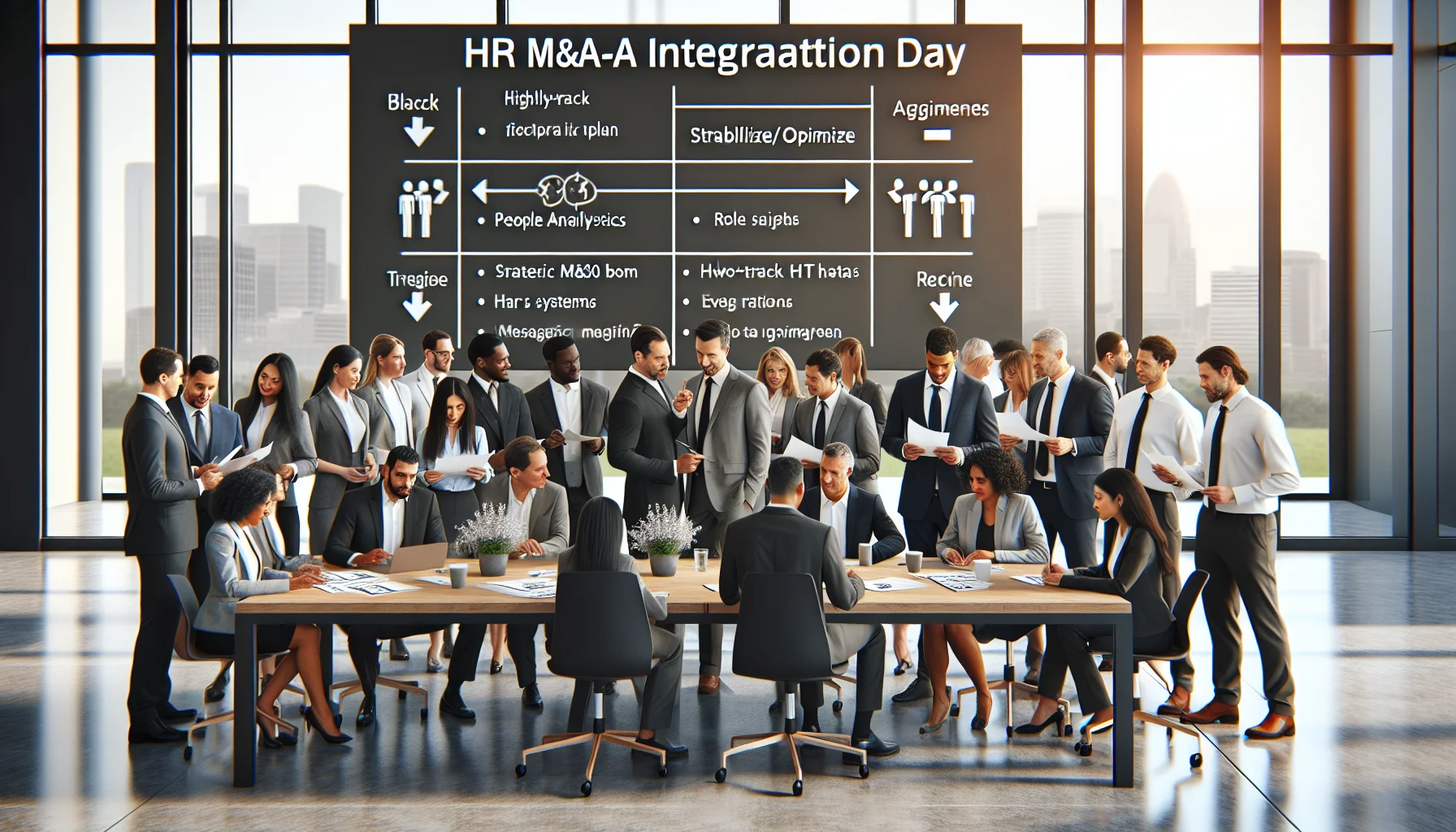
This article explains practical steps for HR IT M&A integration, starting with a focused due-diligence audit of contracts, data maps, and security. It recommends converting findings into a prioritized 30/60/90 backlog, running parallel stabilization and optimization tracks, assigning clear roles, and tracking measurable outcomes to avoid payroll and compliance disruption.
HR IT M&A integration is often the operational linchpin that determines whether an acquisition delivers promised value or becomes a costly distraction. In our experience, teams that treat people systems and IT as a combined program from day zero avoid months of rework and compliance risk. This article provides a prescriptive checklist, a prioritized backlog template, a two-track approach (stabilize then optimize), timeline examples, role assignments, and a concise case study for pragmatic implementation.
Due diligence should go beyond finance and legal. For effective HR IT M&A integration, prioritize three evidence-backed focus areas: contracts and licenses, data lineage and ownership, and security/compliance posture. Each area uncovers risks that will dictate sequencing, vendor negotiations, and integration effort.
Start with a short, focused audit that produces a one-page risk summary for executives and a 30-60-90 workplan for integration leads.
Contracts determine whether you can consolidate systems, migrate data, or must maintain dual licenses. Our checklist includes license caps, termination clauses, support SLAs, data residency requirements, and third-party subprocessor terms. Capture contract expiry dates and change-of-control clauses in a single registry indexed by system and HR process ownership.
Create a rapid data map showing employee master records, payroll feeds, benefits vendors, learning records, and access-control logs. Map fields, owners, frequency, and transformation rules. This becomes the authoritative input for your prioritized integration backlog and informs whether a quick cutover or staged migration is required.
Assess identity providers, SSO, MFA coverage, and audit trails. Flag any regulatory or cross-border transfer constraints. For the highest-risk systems, plan containment measures and retention of parallel controls until verification completes.
Once due diligence is complete, convert findings into a prioritized backlog. Treat this backlog like a product roadmap: triage items by risk, ROI, cost, and people impact. For HR IT M&A integration, we recommend a short-term backlog (0–90 days) for stabilization and a medium-term backlog (90–365 days) for optimization.
Use the following prioritization matrix and timeline template to guide weekly sprint planning and executive checkpoints.
Prioritize items that remove legal or payroll risk first, then employee experience and cost-savings opportunities. Quick wins often include redirecting SSO, consolidating payroll feeds, and harmonizing org hierarchies in HRIS.
Provide a simple 30/60/90 timeline for stakeholders. Assign an integration lead, HRIT product owner, information security owner, and business process owner for each workstream. Weekly steering meetings should surface blockers that require executive intervention.
Harmonization is as much policy as technology. Aligning compensation frameworks, leave policies, and job families reduces downstream reconciliation work. For the technical side, reconcile key identifiers (employee ID, legal entity, cost center) and decide on the system of record for each domain.
A pattern we've noticed: organizations that standardize a small set of core HR attributes first—name, legal status, employment dates, job code—can ingest data into analytics and payroll platforms faster, enabling accurate headcount and cost reporting.
In practice, choose between three models for people systems integration M&A: adopt-acquirer, adopt-acquired, or hybrid. The hybrid model is often best for large organizations where neither system meets all needs; it lets you rationalize modules by capability rather than vendor brand.
Some of the most efficient L&D teams we work with use platforms like Upscend to automate learning record transfers and maintain transcript integrity during consolidation, reducing manual reconciliation and accelerating time-to-value.
Begin with identity and payroll attributes, then move to performance and learning. Each harmonization decision should have a recorded business rationale, migration plan, and rollback criteria.
When to integrate HR and IT in M&A is a common executive question. Our recommendation: integrate for safety and continuity immediately; integrate for efficiency on a deliberate timeline. In other words, run two parallel tracks: stabilization (safety-first) and optimization (value-capture).
The stabilization track focuses on payroll, benefits, security, and identity. The optimization track focuses on talent management, learning, analytics, and process improvement. Both tracks share a governance board to arbitrate scope and budget.
Actions: freeze non-essential changes, validate payroll runs, ensure benefits continuity, confirm access controls. Success metrics: zero payroll incidents, no benefits disruptions, signed-off security posture.
Actions: rationalize HRIS modules, consolidate LMS, harmonize performance frameworks, and deploy analytics. Success metrics: reduced license costs, faster onboarding, unified learning transcripts, and consolidated people analytics dashboards.
In one mid-market acquisition we led, two companies with overlapping HR platforms and separate learning vendors needed rapid alignment. The acquiring company followed a strict due diligence checklist, created a prioritized backlog, and used the two-track approach to avoid disrupting payroll while consolidating learning records.
Key steps taken: immediate contract review to identify termination windows, a 30-day identity containment plan, and a 90-day cutover for critical HR feeds. Post-90 days, the team ran three 4-week optimization sprints to consolidate the LMS and harmonize job codes.
Outcomes were measurable: consolidated license costs fell by 28% within the first year, time-to-onboard decreased by 22%, and the combined HRIT environment supported unified headcount reporting within 45 days. Lessons learned included the value of pre-mapping data fields and allocating a dedicated migration team for learning records to prevent transcript loss.
Cultural integration is frequently underestimated. Technical harmonization will fail without change management and transparent communications. Address culture through joint working groups, shared KPIs, and visible leadership sponsorship.
Duplicate systems create cost and data quality issues. Use the prioritized backlog to decide which duplicates to sunset and which to keep. For compliance, maintain full audit trails and ensure that any data move follows regulatory rules identified during due diligence.
Common pitfalls include under-scoped data mapping, late involvement of security teams, and insufficient post-migration verification. We recommend allocating at least 10–15% of project hours to verification and remediation post-cutover.
HR IT M&A integration succeeds when teams combine disciplined due diligence with pragmatic, prioritized execution. Start with a focused audit of contracts, data maps, and security; convert findings into a prioritized backlog; run a stabilization track in parallel with an optimization track; and assign clear roles and weekly governance.
Compact checklist to run in your first 30 days:
If you want a structured workshop to create your 30/60/90 backlog and role map, schedule a short readiness review with your integration leads and run a two-hour mapping session—it's the fastest way to convert risk into a deliverable plan.
Next step: Convene an executive steering meeting this week to approve the due diligence scope and the 30/60/90 stabilization plan so your team can execute without delay.
The Upscend Team provides actionable insights on technology and business strategy.
Book a walkthrough and we'll show you how it applies to your own content.
 General
December 14, 2025
This article explains how to select and implement an HR technology stack for mid-size companies, focusing on data flow, user experience, and governance. It recommends a five-step build process, essential integrations (payroll, SSO, ATS, LMS), vendor trial tactics, and an implementation checklist to improve hiring, retention, and engagement.
 General
December 14, 2025
This article outlines an operational framework to diagnose common HR technology problems, evaluate HRIS vendors, and run phased implementations. It covers data and integration issues, adoption tactics, governance for scaling, and practical safeguards—discovery sprints, pilots, rollback plans—so teams can reduce risk and increase time-to-value.
 HR & People Analytics Insights
January 6, 2026
This article explains the HR-IT merger: integrating HR strategy, data, applications, and governance to accelerate people outcomes. It covers drivers (data, UX, security), three organizational models, a pragmatic five-step roadmap, and a 12–18 month readiness checklist to mitigate cost, disruption, and skill gaps.
 HR & People Analytics Insights
January 6, 2026
This article presents a pragmatic, low-cost framework for SMB HR IT integration: prioritize 1–2 high-value workflows, deliver quick wins with CSV or Zapier automations, then migrate to API or iPaaS. Follow a 6–9 month roadmap, use predictable pricing, and negotiate pilot terms to achieve rapid ROI and reduce manual work.