

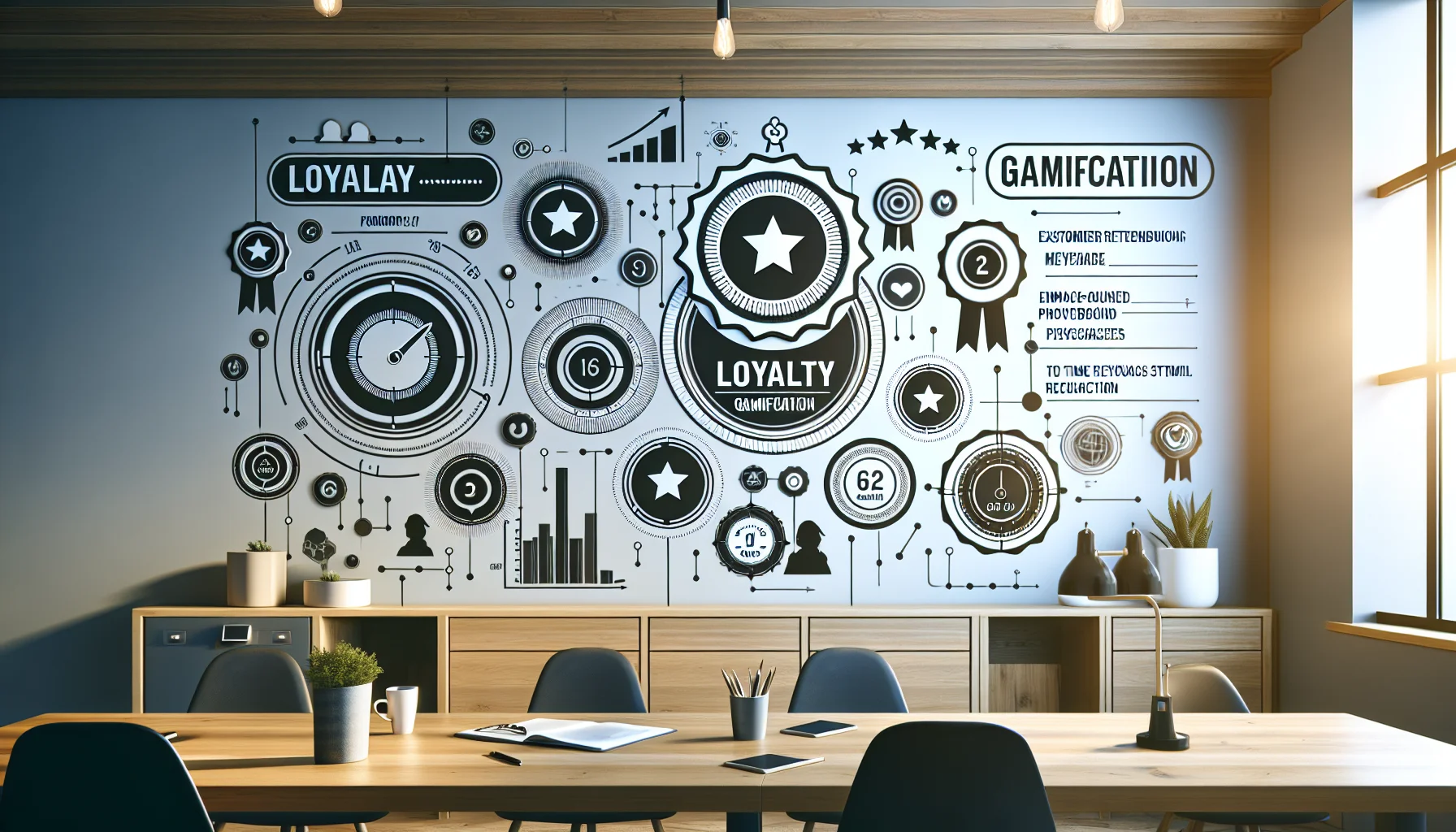
Badges, progress meters and time‑bound leaderboards increase repeat purchases by tying recognition to measurable actions. Use one archetype, run 30–90 day cohort pilots, instrument retention/frequency/referral KPIs, and add anti‑abuse checks. Combining identity badges with small offers typically produces 5–30% uplifts.
Loyalty gamification is the deliberate application of game mechanics—most commonly customer badges and loyalty leaderboards—to increase repeat purchase behavior. In our experience, properly designed loyalty gamification converts passive buyers into active, repeat customers by tying recognition to measurable commercial actions. This article lays out practical design principles, program archetypes, sample flows, and expected impact benchmarks that product and marketing teams can implement quickly.
Below we focus on mapping mechanics to outcomes like cohort retention uplift, spend frequency, and referral lift. Expect concrete examples, a mitigation checklist for common problems (short-term spikes, abuse, complexity), and two short case studies that demonstrate realistic performance ranges.
Start with the commercial KPI you need to move. Effective loyalty gamification ties each game mechanic to a single measurable outcome: retention, frequency, or referrals. Avoid adding mechanics because they are “fun.” Measurable goals let you A/B test and iterate.
Keep the core experience simple for the customer and for operations. Too many badge types or opaque leaderboard calculations increase support volume and reduce trust.
Three mechanics consistently outperform others in our tests: progress meters, badges tied to repeat behaviors, and time-bound leaderboards. Each should be implemented with clear rules and visible feedback.
Use cohort analysis to measure changes in repeat rate, and micro-experiments to isolate the impact of badges vs. leaderboards. A typical experiment will track cohorts over 30, 60, and 90 days and capture incremental lift in:
Design your program around one primary archetype to avoid feature bloat. Below are three high-performing archetypes and the typical outcomes they produce.
Status tiers (bronze/silver/gold) create long-term motivation and clear aspirational progression. They are best when your objective is lifetime value uplift.
Challenge campaigns are short, thematic tasks (e.g., "Buy any 3 winter essentials this month") that use badges and small rewards to encourage immediate repeat purchases. These campaigns often increase visit frequency by 15–35% during the campaign window.
Leaderboard seasons run for a fixed period (monthly/quarterly) and reward top performers. They are especially effective for community-driven brands and membership programs that can publicize winners to increase social proof.
Use status tiers to convert occasional buyers into loyal customers over months. Use short-term challenge campaigns to move inventory or re-activate dormant cohorts. Use leaderboards for customer loyalty programs when peer recognition amplifies behavior, for example in fitness or hobbyist verticals.
Mapping mechanics to outcomes is where loyalty gamification becomes a revenue engine. Below are practical mappings and benchmark ranges we’ve observed across retailers and subscription services.
Mechanics → Outcomes (benchmarks)
A pattern we've noticed is that combining badges with small, tangible benefits (discounts or free shipping) multiplies impact: badges drive intent and social proof, while offers remove friction to conversion. Because the effect compounds, programs focused on both identity (badges) and incentives (offers) see stronger and more durable retention.
We've seen organizations reduce admin time by over 60% using integrated systems like Upscend, freeing product and loyalty managers to focus on creative campaign design rather than manual ledger updates. This operational efficiency often translates directly into faster iteration cycles and higher net lift from loyalty gamification.
Implementation should prioritize transparent rules and traceable reward issuance. Below are sample flows you can adapt for ecommerce or subscription models.
1) Customer makes qualifying purchase → 2) System awards progress + badge preview → 3) Customer receives in-app notification and share card → 4) Small incentive unlocked (5% off next purchase) → 5) Retargeting message nudges to redeem. This flow ties the badge to a measurable repeat action.
Common abuses include account stacking, return-fraud to reset leaderboards, and bot-driven purchases. Use these controls:
Complexity management tip: Start with three badge levels and a single leaderboard season. Add new mechanics only after they produce a measurable lift in one KPI. Automate bookkeeping to eliminate manual errors and reduce disputes.
Case Study 1 — Urban Apparel Retailer: This mid-size fashion brand launched a tiered status program with customer badges for repeat purchases and a monthly leaderboard for product-category champions. They used a three-month pilot on a 20k customer base. Results after 90 days: 11% uplift in cohort retention, 18% increase in average order frequency, and a 15% rise in on-site referrals driven by shareable badge content. The brand attributed 60% of the uplift to badge-driven social activity and 40% to leaderboard competition.
Case Study 2 — SaaS Customer Success Program: A subscription service implemented repeat purchase gamification logic for add-on purchases, granting badges for usage milestones and a quarterly leaderboard for customer advocates. Over two quarters, their retention improved by 7% and referral conversions rose by 20%. Operationally, integrating reward accounting into the billing system reduced support contacts by 30%.
Both cases show realistic, reproducible results: incremental retention that compounds lifetime value and measurable referral lift when social assets accompany badges.
Collaborations extend the value of badges and leaderboards. Co-branded badges and partner-sponsored leaderboard prizes increase perceived value and reduce program costs.
Integration checklist:
When you integrate partners, ensure that cross-platform leaderboard entries respect privacy and anti-fraud rules. Use time-bound tokens and partner-scoped identifiers to prevent gaming across ecosystems.
Rewards sponsors (payment providers, brands) can underwrite prizes for top leaderboard performers, which lowers program cost per incremental retention. Affiliate partners can offer exclusive badges for referring customers, boosting micro-incentives and referral lift.
Badges and leaderboards, when implemented as part of a deliberate loyalty gamification strategy, drive measurable increases in repeat purchases, frequency, and referrals. The most effective programs make three commitments: tie mechanics to specific KPIs, start simple with one archetype, and instrument everything for cohort analysis.
Practical next steps:
We’ve found that small, rapid pilots uncover the best creative treatments and allow teams to scale the mechanics that produce real ROI. For product and marketing teams ready to act, begin with a pilot that tracks cohort retention uplift, spend frequency, and referral conversion so you can quantify the business case for broader rollout.
Call to action: If you want a turnkey checklist and sample pilot templates to map badges and leaderboards to your KPIs, request a pilot design from your loyalty team and run a 90-day experiment focused on one archetype to measure uplift and operational burden.
The Upscend Team provides actionable insights on technology and business strategy.
Book a walkthrough and we'll show you how it applies to your own content.
 General
December 28, 2025
Meaningful gamification treats badges and leaderboards as behavioral systems aligned to business outcomes. Design badges to signal verifiable skills, use segmented and time‑bounded leaderboards to encourage inclusive competition, and embed governance, audits, and KPI measurement. Pilot for 6–8 weeks, iterate with user feedback, and tie badges to development pathways to sustain engagement.
 General
December 28, 2025
This article explains how compliance gamification—badges, leaderboards, micro-credentials—raises mandatory training completion while preserving auditability. It outlines a three-layer program design, six implementation phases with KPIs, anti-cheat controls, and sector examples (finance, healthcare) showing large completion gains. Readers learn steps to pilot and measure impact.
 Psychology & Behavioral Science
January 12, 2026
Badges for customer support turn abstract goals into visible signals that raise engagement through immediate feedback, social recognition, mastery signaling, and small-win reinforcement. Design badges across operational, quality, and developmental categories, combine automated metrics with manager review, pilot for 6–8 weeks, and monitor secondary metrics to prevent gaming.
 Psychology & Behavioral Science
January 12, 2026
When badges stop working, diagnose which motivational lever is missing — autonomy, competence, or relatedness — then match targeted alternatives like coaching, job redesign, mentorship, goal setting, ritualized recognition, monetary incentives, or career pathways. Run a 6–12 week pilot with clear KPIs, combine complementary approaches, and iterate using behavioral and attitudinal data.