


This article defines hyper-personalization employee learning and explains how AI personalized learning techniques—NLP, collaborative filtering, and reinforcement learning—enable unique employee learning paths. It presents a three-part Data–Models–Delivery framework, architecture patterns, case studies with measured uplift, and practical steps for a 90-day pilot to reduce ramp time.
hyper-personalization employee learning is the practice of tailoring training at the individual level using data, algorithms, and dynamic content delivery. In our experience, teams that move beyond one-size-fits-all approaches produce measurable gains in engagement and skill uplift. This article explains what is hyper-personalization in employee training, outlines the technical components, and shows how AI personalized learning and adaptive learning systems combine to produce unique employee learning paths.
The goal here is practical: explain core concepts, present an implementable three-part framework, compare adaptive learning and hyper-personalized approaches, and give real-world case studies that demonstrate outcomes. Expect concrete guidance you can use when evaluating vendors or designing a pilot.
hyper-personalization employee learning is more than recommending a course — it's about delivering the right content, in the right format, at the right time for each individual. We've found that teams confuse personalization with simple segmentation; true hyper-personalization operates at the individual learner level and continuously adapts based on behavioral signals.
Key distinctions: adaptive learning systems adjust content based on performance; hyper-personalization employee learning uses broader signals (roles, projects, behavioral data, career goals, sentiment) to create unique learning pathways. This results in more relevant microlearning, better retention, and faster application on the job.
Why it matters: Research shows personalized experiences increase engagement. Studies show learners exposed to tailored content complete training at higher rates and report greater transfer of learning to work. That drives ROI through reduced time-to-competency and improved performance.
Personalization often refers to simple rules: assign a course based on role. Hyper-personalization combines many signals and real-time adaptation. It answers: who is this learner now, what do they need, and what sequence will maximize learning transfer?
Outcomes-focused: Hyper-personalization optimizes for business outcomes (skill uplift, productivity) rather than just completion metrics.
Implementing hyper-personalization employee learning requires five core components that must work together: learner profiling, content tagging, recommendation engines, feedback loops, and governance. Each piece is essential; weak content tagging or poor feedback loops will limit effectiveness.
Below are the components in actionable terms and what to prioritize when building or buying:
Practical checklist for initial deployment:
Profiles pull from structured HR systems, LMS logs, skills assessments, project assignments, communication patterns (with consent), and explicit learner preferences. The richer the signals, the more precise the resulting employee learning paths.
Note: Data quality is a primary limiter — focus on high-value signals first (role, recent performance, active projects), then expand to behavioral telemetries.
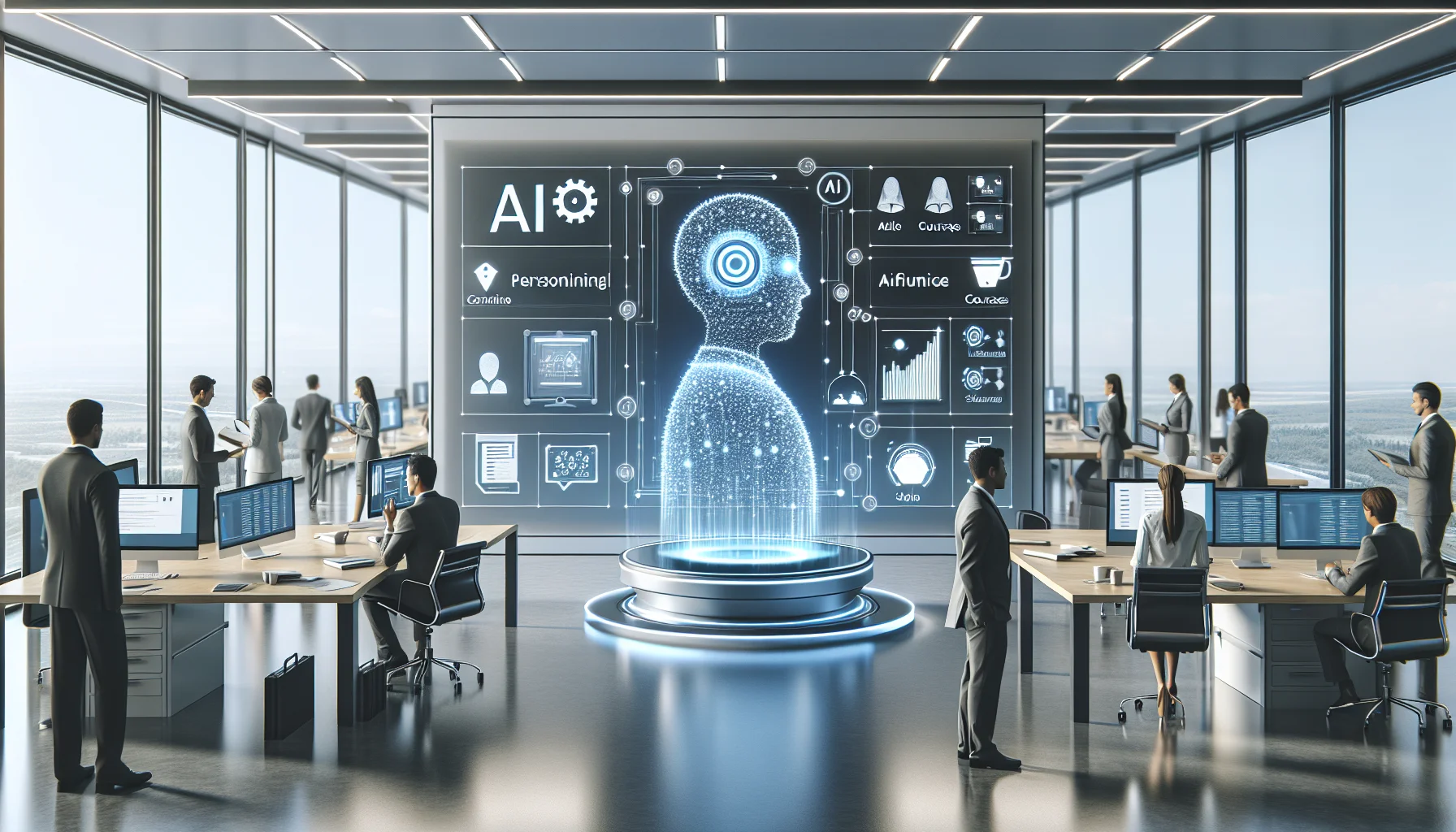
Understanding what is hyper-personalization in employee training includes knowing the AI building blocks. AI personalized learning is powered by a mix of algorithms that interpret profiles, tag content, predict outcomes, and sequence learning paths.
Common techniques used in production:
Each technique addresses different technical challenges: collaborative filtering helps when behavioral data is abundant; NLP is essential for scaling content tagging; reinforcement learning helps orchestrate long-tail learning journeys where sequential decisions matter.
NLP pipelines extract topics, skills, difficulty estimates, and learning objectives from content descriptions, transcripts, and captions. In practice, combining rule-based taxonomies with BERT-style embeddings provides high-precision skill mappings.
Tip: Start with semi-automated tagging: use AI to suggest tags and human experts to validate, improving both accuracy and scale.
To operationalize hyper-personalization employee learning, apply a simple three-part framework: Data, Models, and Delivery. In our experience, treating these as separate workstreams accelerates pilots and reduces integration friction.
Here’s how to structure each part and key deliverables for a first 90-day sprint:
Deliverables: learner profile schema, consent model, content metadata baseline, data pipeline for LMS and HR feeds. Focus on reliable, high-value signals first.
Actions:
Deliverables: baseline recommendation engine, outcome prediction model (completion, skill uplift), evaluation metrics. Start with interpretable models for stakeholder buy-in then iterate to more complex approaches.
Actions:
Deliverables: integrated LMS UI for personalized feeds, nudges and microlearning delivery, automated feedback capture. Delivery is where AI meets the learner; real-time usability is critical.
Actions:
Scaling hyper-personalization employee learning requires a modular architecture that separates data ingestion, modeling, and delivery. Common patterns include event-driven pipelines, model-serving microservices, and secure API layers to connect with LMS platforms.
Patterns to consider:
Integration with existing LMSs is often the practical barrier. Use a thin integration layer that syncs profiles and pushes personalized course lists while keeping the LMS as the authoritative completion record.
A turning point for most teams isn’t just creating more content — it’s removing friction. Tools like Upscend help by making analytics and personalization part of the core process, turning model outputs into actionable dashboards and prioritized interventions.
Cold start is resolved by mixing strategies: use role-based defaults, content-based recommendations (NLP tag matching), and lightweight onboarding assessments. Bootstrapping with explicit preferences accelerates personalization while behavioral data accumulates.
Practical step: Deploy a five-question onboarding micro-assessment to quickly map the learner to an initial learning path.
Many teams ask whether they need adaptive learning systems or full hyper-personalization. The short answer: adaptive learning systems are often a subset of hyper-personalized approaches. Adaptive systems typically react to assessment performance, while hyper-personalization employee learning integrates many more contextual signals and business outcomes.
| Feature | Adaptive Learning Systems | Hyper-personalized Learning |
|---|---|---|
| Scope | Performance-driven within course | End-to-end learner journeys tied to work outcomes |
| Signals | Assessment scores, interaction data | HR data, project assignments, manager input, behavior, assessments |
| Recommendation | Sequence adjustments inside modules | Content selection, format, timing, nudges across the lifecycle |
| Goal | Adaptive mastery within curriculum | Faster time-to-competency and business impact |
| Complexity | Lower | Higher (requires governance and multi-system integration) |
Which to choose? If your goal is better course completion and mastery, start with adaptive systems. If you need measurable business outcomes and cross-course orchestration, invest in hyper-personalization employee learning.
It does so by delivering content that aligns to immediate needs and preferred modalities, reducing friction and cognitive load. Learners are more likely to complete material that feels directly relevant and time-efficient.
Below are two concise case studies that show measurable outcomes from implementing hyper-personalization employee learning approaches.
Challenge: A bank with 60,000 employees needed to upskill relationship managers on digital advisory tools. Historic completion rates for voluntary training were 22% and time-to-competency averaged 14 weeks.
Solution: The team built a hyper-personalization employee learning pilot using profile data (region, client segment, product exposure), NLP-tagged microlearning modules, and a reinforcement learning engine to sequence content. Manager feedback and on-the-job KPIs were fed back into models.
Results (6 months):
Key takeaway: Combining business signals (product assignment) with model-driven sequences produced faster, measurable impact.
Challenge: A 700-person SaaS company struggled to onboard new customer success managers (CSMs). Onboarding churn was high and ramp time was 10 weeks.
Solution: The company implemented an AI personalized learning path that combined initial skill checks, content-based recommendations, and manager-specified learning objectives. They used lightweight A/B testing to refine recommendations and built a dashboard for managers to see progress.
Results (90 days):
Key lesson: For mid-market teams, rapid iteration and manager transparency deliver outsized benefits; simple ML with strong measurement beats complex models that take months to deploy.
Organizations attempting hyper-personalization employee learning face recurring technical and organizational problems. Below we address the most common and give practical mitigations.
Mitigation: Use hybrid recommendations that combine role-based defaults, content-based matching via NLP, and short onboarding assessments. Leverage transfer learning from larger datasets where privacy and governance allow.
Mitigation: Monitor model outcomes across demographics and job families. Use fairness-aware algorithms, and perform regular audits. Include human oversight in recommendations that affect career progression.
Mitigation: Implement a model-as-a-service layer with standard APIs. Keep the LMS as the system of record while pushing personalization decisions through APIs to the LMS UI.
Mitigation: Adopt data minimization, consent-first flows, and anonymized feature stores where possible. Work with legal to map regulations (GDPR, CCPA) to your data collection and retention policies.
Good governance prevents technical debt. Building privacy and explainability into your design saves rework and protects learners.
Other pragmatic tips we've found effective:
hyper-personalization employee learning is a practical, measurable evolution of L&D that combines AI personalized learning techniques with robust data, models, and delivery mechanisms. When done right, it reduces ramp time, increases completion and engagement, and ties learning directly to business outcomes.
To get started:
We've found that incremental pilots, transparent recommendations, and close collaboration between L&D, data teams, and managers create the fastest path to success for hyper-personalization employee learning. If you'd like a practical next step, start by mapping existing data sources and designing a five-question onboarding assessment to resolve cold start quickly.
Call to action: Pick one role and one measurable outcome, then design a 90-day pilot that applies the three-part Data–Models–Delivery framework described above — use the pilot to validate assumptions before scaling.
The Upscend Team provides actionable insights on technology and business strategy.
Book a walkthrough and we'll show you how it applies to your own content.
 General
December 22, 2025
This article explains how AI in LMS delivers personalized training through recommendation engines, adaptive pathways, and learning analytics. It outlines the enabling technologies, design and implementation steps, a vendor decision framework (transparency, data needs, ROI), and a mini case showing higher completion and faster time-to-competency.
 Lms
LmsDecember 23, 2025
This article explains how to create personalized learning paths using a skills baseline, role-based milestones, and multi-modal learning. It gives a step-by-step framework, reusable IDP and journey templates, LMS automation tactics, two sample employee journeys, and a KPI set to run a 90-day pilot and measure time-to-competency.
 General
December 24, 2025
AI personalization tailors content, pacing, and assessment to individual learners, reducing wasted time and improving retention. Organizations that treat personalization as a strategic capability report 30–50% reduced training hours and faster time-to-competency. The article outlines technologies, an implementation roadmap, KPIs, and common pitfalls to avoid.
 Ai
AiDecember 28, 2025
This article explains the architecture and algorithms behind AI tutoring platforms, covering data ingestion, student modeling (IRT/BKT/hybrids), personalization engines, conversational NLP, and operational concerns like latency and observability. Readers will learn how platforms analyze answers, recommend content, and mitigate integration and explainability challenges.