


This article shows which psychological safety innovation metrics to track—idea submission rate, idea velocity, experiment throughput, cycle time, and learning coverage—and gives formulas, baselines, dashboards, and pitfalls. It explains measuring idea velocity, linking metrics to revenue, and practical steps (90-day baselines, interventions) with two product-team case studies.
psychological safety innovation metrics are the quantitative and qualitative signals that show teams feel safe to experiment, speak up, and iterate. In our experience, tracking the right mix of activity, outcome, and learning metrics reveals whether product team safety is improving and whether innovation efforts are accelerating.
This article explains the core innovation KPIs, how to measure idea velocity, formulas and baseline comparisons, practical dashboards, common pitfalls like noisy signals, and two product-team case studies that demonstrate measurable change.
Which metrics show psychological safety improvements in product teams? Start with a balanced set across participation, throughput, learning, and sentiment. Relying on a single number creates blind spots; combining indicators reduces noise.
Key metrics to collect:
Measurement formulas (simple):
Use these metrics together to detect signals of psychological safety—rising idea submission rate with increasing idea velocity and shorter cycle times usually indicates safer, more effective ideation.
How to measure idea velocity as a sign of psychological safety is crucial because idea flow reflects both willingness to share and the team's ability to act. Idea velocity is not just counts; it must be normalized by team size and time, and paired with quality signals.
Step-by-step measurement:
Baselines and comparison logic:
Idea velocity is powerful when correlated with survey-based psychological safety scores, retro sentiment, and the proportion of contributors (is the same 2–3 people generating most ideas?). A growing contributor base with rising idea velocity strongly signals better product team safety.
Experimentation metrics reveal whether teams feel safe to fail quickly and extract value from failure. We’ve found teams that document learnings see faster downstream impact even when raw revenue changes lag.
Important experimentation metrics and formulas:
Baselines:
Link these to product outcomes: frequent, documented learning reduces rework and shortens cycle time, increasing long-term feature success even if short-term revenue impact is delayed.
One common pain point is noisy signals. High idea counts can be vanity metrics if ideas are low quality or concentrated among a few contributors. Our pattern recognition shows three common noise sources:
To link metrics to revenue reliably:
Avoid interpreting raw increases in idea submission as immediate revenue success; instead, map experiments to downstream metrics and use control groups where possible.
Practical steps to operationalize psychological safety innovation metrics center on consistent definitions, automated collection, and leader visibility. Start with a 90-day pilot where you capture baseline and set measurable targets.
Dashboard essentials:
Tools and workflows: centralize idea intake, automate timestamps, and require a short learning artifact for every experiment. While traditional systems require constant manual setup for learning paths, some modern tools like Upscend are built with dynamic, role-based sequencing in mind. That contrast highlights how choosing systems that reduce admin burden increases the signal-to-noise ratio in your metrics.
Best practices:
Real examples help translate metrics into action. Below are two concise product-team case studies showing metric changes after focused interventions.
Context: A 12-person product team had low idea submission (0.2 ideas/person/month) and long cycle times (median 45 days). Intervention: weekly ideation slots, rotating facilitation, and mandatory learning docs for experiments.
Metrics before vs. after (3 months):
Outcome: Product releases with prior learnings reduced post-launch defects by 40% and improved retention signals within two quarters, illustrating how psychological safety innovation metrics can precede product impact.
Context: A 20-person B2B team had moderate idea flow but low contributor diversity: 70% of ideas came from 3 senior members. Intervention: anonymized idea intake, peer review rotations, and manager commitment to surface dissent in demos.
Metrics before vs. after (4 months):
Outcome: The team converted more customer-facing experiments into feature launches, and quarterly ARR influenced by these features grew 6%—showing a measurable revenue link after accounting for attribution lag.
Tracking psychological safety innovation metrics requires a deliberate mix of participation, throughput, learning, and sentiment signals. We've found that combining idea submission rate, idea velocity, experiment throughput, cycle time, and % failed experiments with documented learnings gives a robust portrait of team safety and innovation health.
Start with clear definitions, a 90-day baseline, and small interventions that prioritize contributor diversity and learning documentation. Watch for noisy signals, use quality gates, and map experiments to downstream customer metrics to build the causal case to revenue.
Next step: pick three metrics from this article, set baselines for the next 90 days, and run one small intervention (anonymized intake, structured retros, or weekly ideation) to measure change. Tracking those three will give you a focused, reliable read on whether product team safety—and therefore innovation—are improving.
The Upscend Team provides actionable insights on technology and business strategy.
Book a walkthrough and we'll show you how it applies to your own content.
 Workplace Culture&Soft Skills
January 5, 2026
This article shows how to embed psychological safety into performance reviews through behavior-based competencies, calibrated feedback, paired outcome+process KPIs, and targeted recognition. It provides sample competency descriptors, calibration rules, two brief case studies, and a six-month implementation checklist so L&D and HR can pilot and scale evidenced alignment.
 Workplace Culture&Soft Skills
January 5, 2026
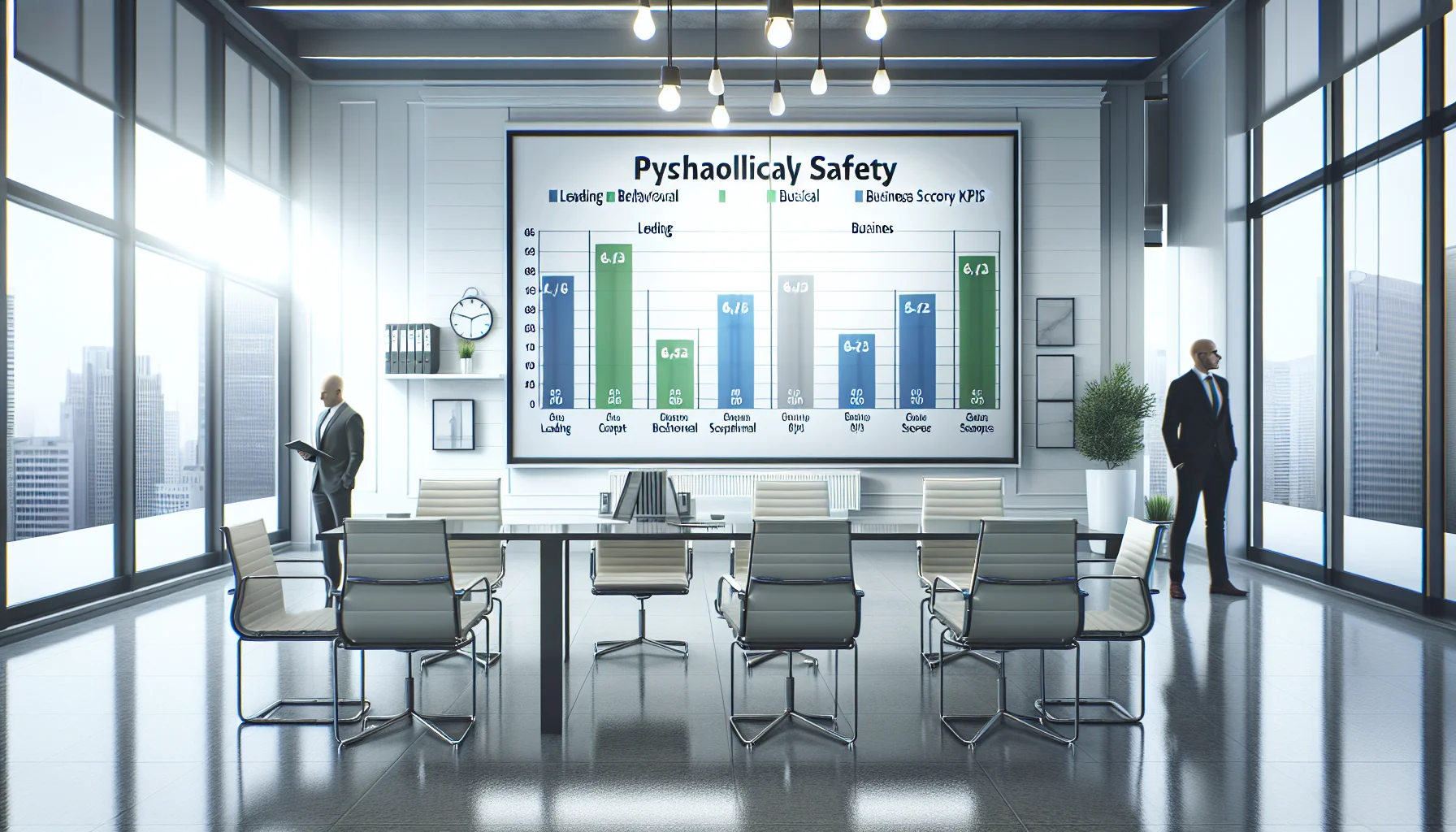
This article presents a balanced scorecard of psychological safety KPIs—leading, behavioral, and business outcomes—and gives operational formulas, baselines, and a sample quarterly dashboard. It explains converting changes into dollar impacts, handling attribution (difference‑in‑differences, staged rollouts), and an implementation checklist to run a 90‑day pilot and measure L&D ROI.
 Workplace Culture&Soft Skills
January 5, 2026
The article explains how integrating psychological safety in hybrid teams reduces digital misunderstandings by combining leadership modeling, HR systems, and short measurement cycles. It gives a repeatable six-week pilot, sample pulse questions, and metrics to track behavioral and outcome improvements.
Ai-Future-TechnologyFebruary 4, 2026
Practical methods to measure psychological safety in virtual discussions using behavioral KPIs, short pulse surveys, and leader dashboards. The article defines voice, inclusion, and feedback-loop metrics, recommends a weekly/biweekly/monthly cadence, offers a survey question bank, and outlines dashboard visuals and action triggers for leaders running a 90-day pilot.