

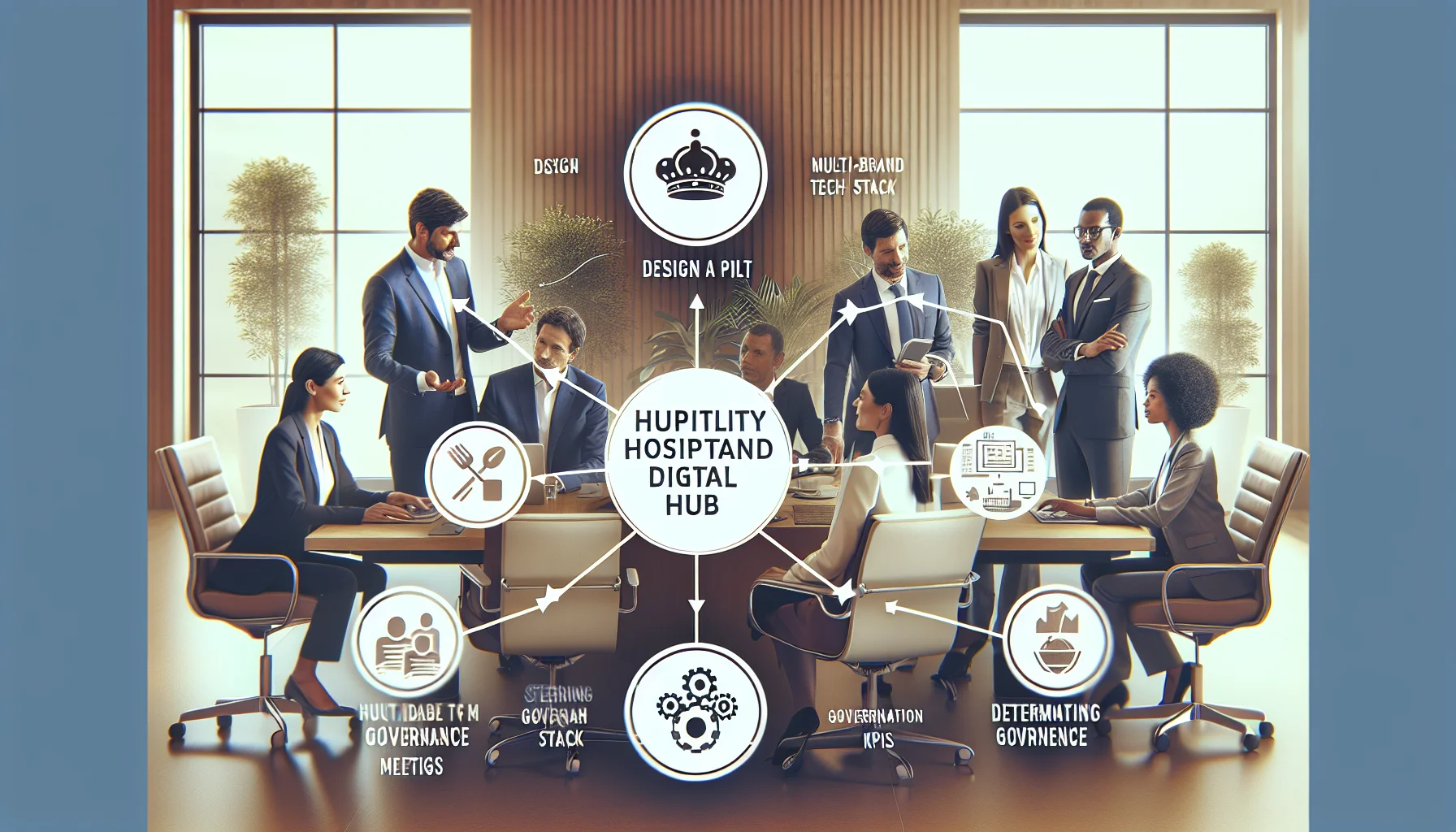
This blueprint guides hotel groups through a 90–120 day pilot to deploy a hospitality digital hub across multiple brands. It covers objectives, stakeholder RACI, pilot MVS, canonical data models, integration patterns, KPIs and training tactics. Readers will learn measurable targets, governance checkpoints and a repeatable rollout plan to scale with minimal brand disruption.
In our experience, a successful rollout of a hospitality digital hub starts with clarity: explicit objectives, mapped stakeholders and repeatable governance. This practical, repeatable digital hub case study blueprint helps decision-makers plan multi-brand implementation across portfolios. It covers objectives, stakeholder maps, pilot scope, tech stack choices, change management and a results-reporting template—framed by real-world constraints of brand standards, integration complexity and governance. Early alignment on the hub’s role prevents costly rework and protects brand integrity.
A concise purpose statement is the first deliverable when documenting a case study implementing a digital hub for hotel groups. Use a three-point objective structure: uplift guest experience, increase operational efficiency and unify brand communication. Framing the initiative as a centralized program to deliver consistent experiences across brands reduces cross-team friction and creates measurable targets for a hospitality digital hub.
Primary objectives typically include:
When drafting the objective statement, include baseline metrics and targets—for example, increase mobile direct bookings by 12–20% in year one, reduce campaign rollout from 10 days to 48 hours, and reduce content maintenance FTE effort per 100 properties. A formal objective might read:
"Deliver a centralized digital content and mobile presentation layer to increase direct mobile conversion by 15% within 12 months, reduce campaign deployment time to under 48 hours for approved templates, and cut content maintenance effort by one FTE per 100 properties."
Record current mobile conversion, average order value, ancillary revenue per stay, and content update cycle times. Typical baselines: mobile conversion 1.2–2.5%, ancillary revenue $8–$25 per stay, and content update cycles 7–14 days. Phase targets: quick wins in months 1–6, optimization in months 6–12, and scaling in months 12–24. This phased approach aligns a digital hub case study to executive tolerance for change and budget phasing.
Use-case examples clarify objectives: a lifestyle brand might prioritize personalization and local events to boost ancillary spend, while a business brand prioritizes frictionless check-in and loyalty integration. The hub’s architecture should support both without bespoke rewrites. Defining these brand use cases—e.g., "urban lifestyle: promote local experiences; suburban business: accelerate mobile check-in"—drives scope discipline and ensures the pilot validates meaningful variation.
A robust stakeholder map prevents the 'too many cooks' problem in multi-brand implementation. The governance model must be explicit: who approves brand creative, who owns local offers, and which team resolves technical debt. For hotel group digital transformation, a RACI matrix is indispensable.
Core stakeholders: corporate digital, brand marketing leads, property operations, IT/integration, revenue management and legal/compliance. External partners—PMS, CRS and payment vendors—are critical. Assign a centralized program lead to arbitrate trade-offs between brand autonomy and platform standardization. Map responsibilities at three levels:
Brand standards conflict is predictable. Create a three-tier style guide: global must-haves, brand-level flexible elements and local customization zones. Tie governance checkpoints to release gates so the hospitality digital hub enforces shared rules without immobilizing brands.
Practical mechanisms:
Include objective decision criteria in governance artifacts: revenue impact thresholds, compliance risk scores and effort estimates. For example, changes under a $10k revenue impact and low compliance risk can be approved by brand leads; larger changes go to the steering committee. This reduces subjective debate and keeps delivery moving.
RACI examples (abbreviated): content template approval (Responsible = Brand Manager; Accountable = Head of Brand), PMS integration mapping (Responsible = Integration Team; Accountable = IT Architect), and campaign rollout schedule (Responsible = Central Campaign Ops; Accountable = Marketing Ops Lead). Treat governance as a living process and record decisions in a governance backlog.
A focused pilot reduces risk and produces repeatable templates. We recommend a 90–120 day pilot limited to 2–4 properties across 2 adjacent brands that represent contrasting operations (e.g., a city hotel and a resort). The pilot should validate the centralized content model, booking flow integration and localized offers.
Key pilot components:
Define an MVS with surgical focus. Typical MVS elements for a hospitality digital hub pilot include a centralized CMS with brand-scoped templates, headless presentation for mobile and web with a single booking widget, basic PMS/CRS integration for availability and reservation CRUD, simple personalization rules (e.g., loyalty-tier messaging), and analytics with session and conversion tracking.
Measure adoption and business impact. Adoption KPIs: mobile activation rate, staff platform usage and content update turnaround. Business KPIs: direct bookings, ancillary revenue per guest and NPS uplift. Combine analytics with staff interviews and guest surveys to discover friction points. Example thresholds:
Testing tips: run A/B tests for messaging and flows; use a holdout property to control for seasonality; and test privacy/consent flows if personalizing. A well-executed pilot that produced +15% mobile bookings and 30% faster campaign deployment provided clear ROI to justify phased rollout. Document the pilot playbook so regions can reuse checklists, runbooks and deployment pipelines—this is how multi-brand implementation scales predictably.
Choosing the right tech stack is a make-or-break decision. A multi-brand implementation needs modular, API-first layers: centralized content management, headless presentation, identity and access, analytics, and an integration layer to PMS/CRS. The goal is a single source of truth while enabling brand-specific front-ends.
Essential stack elements for a hospitality digital hub:
Integration complexity is often underestimated. Plan for canonical data models and an enterprise service bus or iPaaS to handle transformations. Starting with a canonical reservation object eliminates dozens of one-off mappings later.
Implementation details:
Security, compliance and resilience:
Vendors and approach: many teams use a hybrid model—commercial headless CMS, cloud iPaaS and hospitality middleware. Evaluate vendors on integration footprint, SLAs, change velocity and roadmaps to avoid lock-in. The turning point for teams is removing friction: integrating analytics and personalization into core workflows speeds decisions and increases per-guest revenue.
| Layer | Primary Function | Notes |
|---|---|---|
| Content | Centralized asset and copy management | Brand scoping, approval workflows |
| Integration | PMS/CRS, payments, loyalty | iPaaS or ESB recommended |
| Presentation | Brand front-ends (mobile/web) | Headless approach for flexibility |
People adoption is the biggest risk after technology choices. A formal change program aligns property teams, corporate teams and vendors. Short, role-based learning paths and playbooks drive operational adoption faster than long manuals.
Training plan essentials:
Gamify early adoption: track usage metrics and celebrate properties that hit milestones. Provide a clear escalation path and a central change inbox to aggregate feedback. Emphasize time savings from the hospitality digital hub—for example, show frontline teams how centralized offers reduce manual tasks by 20–40%.
Effective tactics:
Measure training by behavior change: reduction in email requests, percent of campaigns launched via the hub, and time saved per task. If average time to create and publish a localized offer drops from 8 hours to 2 hours, that’s tangible adoption. Maintain communication cadence: weekly pilot standups, bi-weekly roll-up reviews during rollout and a quarterly steering committee to align on ROI. Include a regular "voice of the property" update so operations inform the roadmap.
Decision-makers need realistic, defensible KPIs. Present leading and lagging metrics split into engagement, revenue and operational efficiency.
Suggested KPI targets for a 12-month rollout of a hospitality digital hub (realistic):
How to measure lift credibly:
Example timeline and budget ranges for phased rollout:
| Phase | Duration | Estimated Budget (USD) |
|---|---|---|
| Pilot (2–4 properties) | 3–4 months | $150k–$300k |
| Regional roll-out (20–50 properties) | 6–9 months | $800k–$1.5M |
| Global scale (remaining properties) | 12–24 months | $2M–$5M |
These ranges assume core platform licenses, integration services, one-time implementation and ongoing managed services. Expect multi-year cadence for full ROI; most groups see payback within 18–30 months. For conservative modeling, use a 3-year NPV with sensitivity around conversion uplift (±3 points) and integration cost overruns (+20%).
Operational metrics to track monthly include content publish frequency and approval SLAs, average session duration and bounce rate, booking flow error rates and API success rate, and manual interventions per 1,000 bookings.
Successful hotel group digital transformation programs follow repeatable patterns. Key lessons:
Common pitfalls: underestimating integration effort, assuming one-size-fits-all templates will work, and neglecting property-level operational realities.
A concise report for executives must be data-driven and actionable. Use this template for monthly/quarterly reporting:
Present impact in dollars and staff-hours saved; executives respond to quantified trade-offs more than feature lists.
Include monthly trend charts with annotations showing campaign rollouts or integration changes that drove movement, property-level variance for top and bottom performers with hypotheses, an incident log summary and resolution times, and forecast adjustments based on observed conversion uplift and seasonality. Use anonymized property-level scorecards to surface drivers and accelerate troubleshooting. Provide a "Lessons for next region" section so each roll-out benefits from documented learnings and reduces rework.
Documented learning example: one roll-out missed localized tax fields in the canonical reservation model, causing pricing mismatches. The fix was to add a standardized tax_bucket to the canonical object and update integration tests—preventing repeats in subsequent regions.
Implementing a centralized mobile and content layer is more about disciplined execution than technology alone: a repeatable hospitality digital hub deployment balances centralized control with brand flexibility, a pragmatic pilot approach and clear KPIs. The most successful transformations couple a compact pilot with strong governance and automated integrations that scale.
Summary checklist for decision-makers:
Next steps: assemble a 6–8 week discovery to validate assumptions, cost integration points and finalize the MVS. Discovery deliverables should include an inventory of integration endpoints with estimated effort, a canonical data model draft with sample payloads, pilot property selection rationale and traffic modeling, and a high-level security and compliance assessment (PCI, privacy).
Call to action: If you’re preparing a pilot or building a business case for a hotel group digital transformation, assemble a compact discovery team for an 8-week assessment that yields a validated pilot plan, KPI baseline and budget you can act on. For teams wondering how multi-brand hotels deploy a centralized mobile hub, start with an MVS that demonstrates measurable guest and operational lifts within 90 days—this is the proof point executives need to fund scale.
Finally, when documenting a digital hub case study or case study implementing a digital hub for hotel groups, ensure it covers both technical architecture and human-centered outcomes. Decision-makers value concrete examples of time saved, revenue uplift and reduced complexity. A robust case study that includes these elements becomes the cornerstone of your organization's broader hotel group digital transformation.
The Upscend Team provides actionable insights on technology and business strategy.
Book a walkthrough and we'll show you how it applies to your own content.
 Business Strategy&Lms Tech
January 22, 2026
This article outlines how to design and deploy a hospitality excellence hub to standardize service across 10,000+ staff. It covers business case, governance, modular mobile-first architecture, training and pilot-to-scale timelines, plus KPIs and procurement checklist to measure ROI and operational impact.
 Business Strategy&Lms Tech
January 22, 2026
This 90-day playbook shows enterprise hotel teams how to deploy a centralized mobile hub with minimal IT overhead. It covers a 10-day audit, a 30-day pilot across three property types, content migration, provisioning options, training cadence, RACI, KPIs and post-launch optimization to deliver measurable operational ROI within three months.
 Business Strategy&Lms Tech
January 22, 2026
This article provides a prioritized 15-item hospitality vendor checklist to evaluate enterprise hospitality hubs. It covers core functionality, integrations (PMS/CRM/HRIS), security and offline behavior, implementation, SLA/pricing, a weighted scoring model and an RFP question bank. Use standardized demos and pilots to validate vendors and reduce time-to-value.
 Business Strategy&Lms Tech
January 22, 2026
This playbook gives a four-phase approach—Prepare, Pilot, Scale, Sustain—to drive adoption of a centralized staff mobile hub across 10,000+ hotel employees. It includes sponsor alignment templates, champion training tactics, regional scaling plans, KPIs, and a risk register, with targets like 70–85% weekly active usage within three months.