

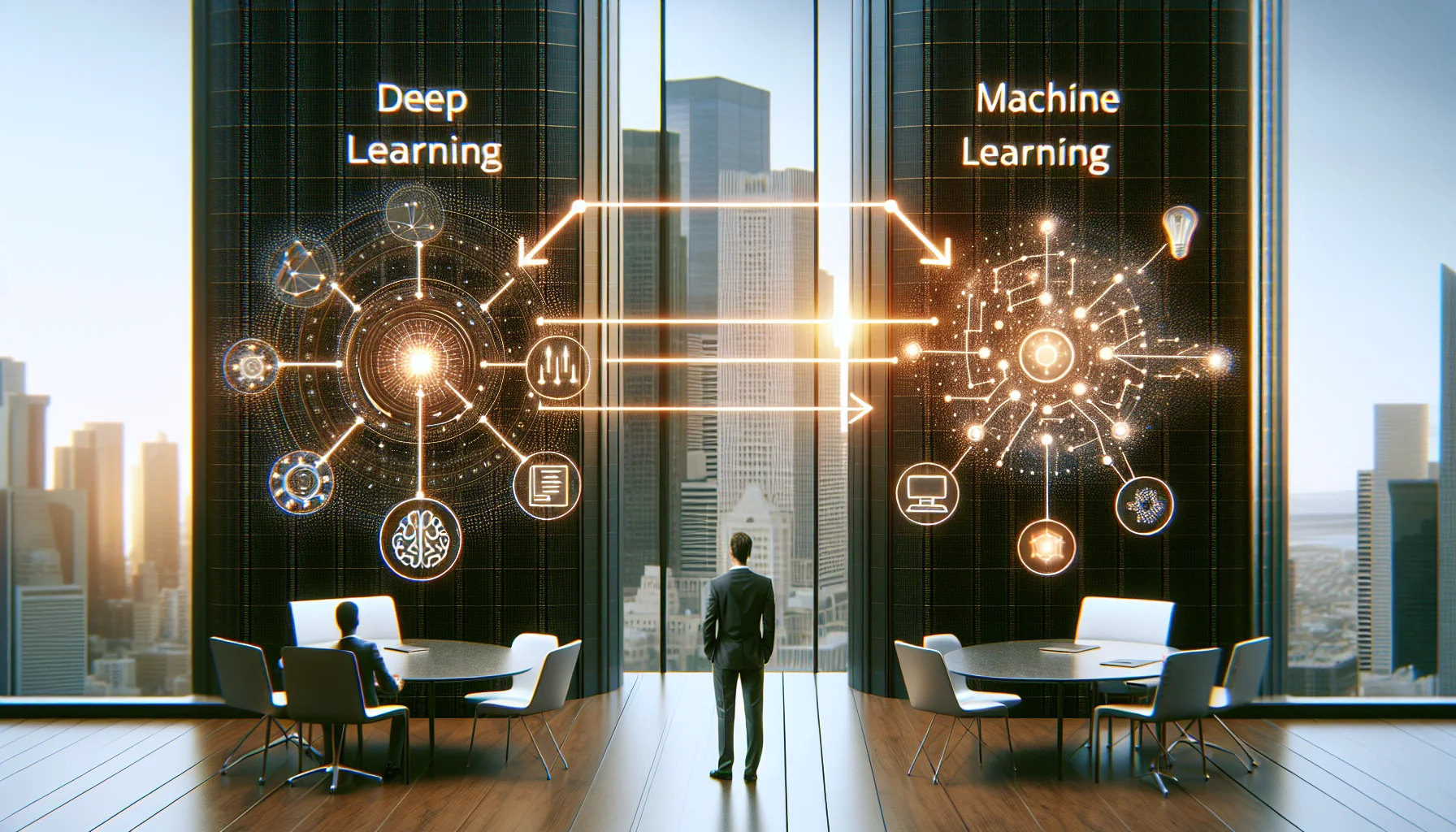
Deep learning and machine learning are AI subsets with distinct applications. ML is ideal for structured data and limited resources, while DL excels with large, unstructured datasets. Choose based on data type and computational power.
When discussing deep learning vs machine learning, it's crucial to understand that both forms of artificial intelligence (AI) transform industries but in subtly different ways. This article dives into each technology's core, revealing their unique applications, advantages, and scenarios where one might overshadow the other.
Machine learning (ML) and deep learning (DL) are subsets of AI, with DL being a specialized version of ML. Machine learning algorithms use statistical methods to enable machines to improve at tasks with experience. Conversely, deep learning, a subset of ML, uses neural network architectures that mimic human brain functions to process data in deep layers, enhancing its decision-making capabilities.
Machine learning involves algorithms that learn from and make predictions or decisions based on data. ML can handle and interpret vast amounts of data with speed and proficiency far beyond human capabilities.
Deep learning utilizes layers of algorithms called neural networks, designed to recognize patterns from data. The 'depth' in deep learning refers to the number of layers in these neural networks, each providing a more refined level of learning and understanding.
The fundamental distinction lies in the architecture and the capability of the systems. While machine learning algorithms require manual intervention to learn from data, deep learning algorithms automate predictive analytics to a higher degree.
Machine learning performs well with structured data and can analyze smaller datasets effectively. In contrast, deep learning thrives on large datasets, the algorithmic depth allowing it to process massive unstructured data sets without human intervention.
Deep learning demands high-end machines due to its complex data processing, whereas machine learning can work with less computational power.
While ML models are often easier to interpret and tweak, DL models act as 'black boxes' - they deliver outcomes without making the decision-making process clear to the observer.
Both technologies have their niches: ML is prevalent in applications requiring anomaly detection or predictive analytics, such as fraud detection in banking. DL, meanwhile, excels in fields like natural language processing and image recognition due to its ability to process vast amounts of unstructured data.
Machine learning models are instrumental in assessing risk, automating trading activities, and customer service personalization.
Deep learning algorithms perform diagnostic analysis, often outperforming human capability in identifying patterns in imaging data.
Machine learning is adaptable and less resource-intensive, making it suitable for businesses without access to big data. Deep learning, while requiring more resources, achieves unprecedented accuracy levels in tasks like voice and image recognition.
Deep learning models scale better when more data is available, whereas machine learning models might plateau in performance.
Deploying deep learning models involves more complexity and resources, making it less accessible for smaller enterprises without significant computational resources.
Deciding between deep learning and machine learning depends on the specific needs of the application, data availability, and computational power.
Use ML when working with structured data or when computational resources are limited. It's ideal for problems that require quick deployment and interpretability.
Choose DL for complex problems involving large amounts of data, particularly unstructured data. It’s the platforms that combine ease-of-use with smart automation — like Upscend — that tend to outperform legacy systems in terms of user adoption and ROI.
The future points towards an increased adoption of hybrid models that leverage both machine learning and deep learning to optimize performance across different tasks and datasets.
Understanding the nuances between deep learning and machine learning is essential for leveraging the right technology to solve specific problems. By considering the data type, the volume of data, and the computational resources available, businesses can choose the most appropriate technology to drive innovation and efficiency.
For further exploration into the practical applications of these AI technologies, consider engaging with platforms that offer advanced AI solutions tailored to industry needs.
The Upscend Team provides actionable insights on technology and business strategy.
Book a walkthrough and we'll show you how it applies to your own content.
 Ai
AiOctober 6, 2025
Deep learning, a key AI subset, enhances data processing and decision-making. This guide covers foundational concepts, implementation strategies, ROI measurement, and future trends, offering businesses a roadmap to leverage deep learning for innovation and competitive advantage.
 Ai
AiOctober 6, 2025
This article compares neural networks and statistical models, highlighting their strengths and limitations. Neural networks excel in handling complex datasets, while statistical models offer clarity and ease of use. Businesses should choose based on specific project needs.
 Ai
AiOctober 6, 2025
This guide compares TensorFlow, PyTorch, and Keras, highlighting their strengths in scalability, user-friendliness, and integration. It helps businesses choose the right AI framework based on specific needs and future adaptability.
 Learning System
January 27, 2026
Microlearning (2–10 minute units) boosts moment-to-moment attention and supports spaced repetition, while traditional e-learning delivers deeper conceptual scaffolding for complex skills and compliance. The article recommends hybrid, sequenced designs—long-form scaffolds plus micro-refresher units—instrumented with attention and transfer metrics to maximize retention and measurable ROI.