


Poor LMS experiences cause measurable losses across ROI, retention, productivity and compliance. This article identifies signals (drop-offs, support spikes, manager workarounds), quantifies hidden costs with a simple model, and outlines a 90-day remediation plan of prioritized fixes, automation, KPIs and pilots to recover value.
In our experience, the costs of LMS dissatisfaction are rarely limited to unhappy learners — they ripple through productivity, compliance, and the bottom line. Many organizations treat a clunky learning management system as a nuisance rather than a strategic risk. That perspective under-estimates the real financial and operational impacts of poor platform decisions.
This article breaks down how dissatisfaction manifests, quantifies the hidden drains on value, and offers a practical framework L&D leaders can use to measure and mitigate pain points. We'll cover training retention risks, the LMS ROI impact, lost time, and compliance exposures with concrete steps you can deploy immediately.
A pattern we've noticed is that the costs of LMS dissatisfaction are not always visible in budget spreadsheets. Instead, they appear as friction: longer onboarding, repeated manager interventions, and repeated course failures. These operational symptoms compound over time.
Common signals include slow course completion rates, frequent support tickets, and managers who bypass the LMS. Each of these is a leading indicator of deeper issues with content relevance, usability, or system performance.
These signals are measurable. Track them monthly, and you can calculate direct time lost to manual work and remediation — the first layer of the lost productivity lms problem.
When leaders ask about LMS ROI impact, they're usually thinking of license fees versus usage. But ROI is more complex: it must account for opportunity cost, reduced learner performance, and the expense of compensating for a poor user experience.
Two concrete pathways reduce ROI: increased administrative overhead and diminished learning transfer. For example, when trainers spend hours troubleshooting access, that time is not spent on curriculum improvement or coaching. That incremental overhead is often hidden in general admin budgets.
Estimating the LMS ROI impact means combining these costs into a simple model: (time lost × average hourly rate) + (decrease in performance × revenue per FTE). This yields a pragmatic, defensible figure you can use in vendor or upgrade discussions.
Answering "what are the costs of a bad LMS" requires separating direct costs (licenses, service fees) from indirect costs (churn, low morale, and lost productivity). In our practice, indirect costs often exceed direct fees within 12 months.
For example, high learner frustration correlates with lower engagement in career-path training, which accelerates attrition among high performers. That escalation turns a learning tool problem into a talent management expense.
Quantify this by counting hours per employee spent on LMS-related problems each month. Multiply that by employee loaded cost and extrapolate across the active user base. This approach highlights the lost productivity lms creates and makes remedial investment easier to justify.
Training retention risks also increase the longer learners avoid or circumvent required activities. Retention drops impact competency pipelines and lengthen time-to-proficiency, reducing the return on every learning dollar spent.
Fixing the underlying issues requires both product and process interventions. Start with a prioritized backlog of usability fixes, data hygiene, and content re-mapping so learners find relevant material quickly. These changes directly reduce the costs of LMS dissatisfaction by improving completion rates and reducing support cases.
A pattern we've seen among efficient L&D teams is automation of routine workflows — enrollment, nudges, and credentialing — so people spend more time on coaching. Some forward-thinking organizations we work with use platforms like Upscend to automate this entire workflow without sacrificing quality. That approach demonstrates an industry best practice: automate repetitive tasks, then measure the performance delta.
Combine these steps with a pilot and clear KPIs (completion, time-to-proficiency, support tickets) to show rapid ROI improvement and shrink the ongoing costs of LMS dissatisfaction.
One of the least appreciated consequences of a poor LMS is regulatory risk. When compliance training is skipped or poorly tracked, organizations face fines, audit failures, and reputational damage. A clear example: incomplete mandatory training before high-risk tasks can lead to legal exposure.
To manage compliance risk LMS problems, you must ensure accurate, auditable reporting and robust credentialing workflows. Weak reporting often forces teams to create manual records — a practice that increases error rates and the chance of non-compliance findings.
These controls both lower the immediate compliance risk and reduce the labor cost of remediation — another way the costs of LMS dissatisfaction manifest in hidden legal exposure.
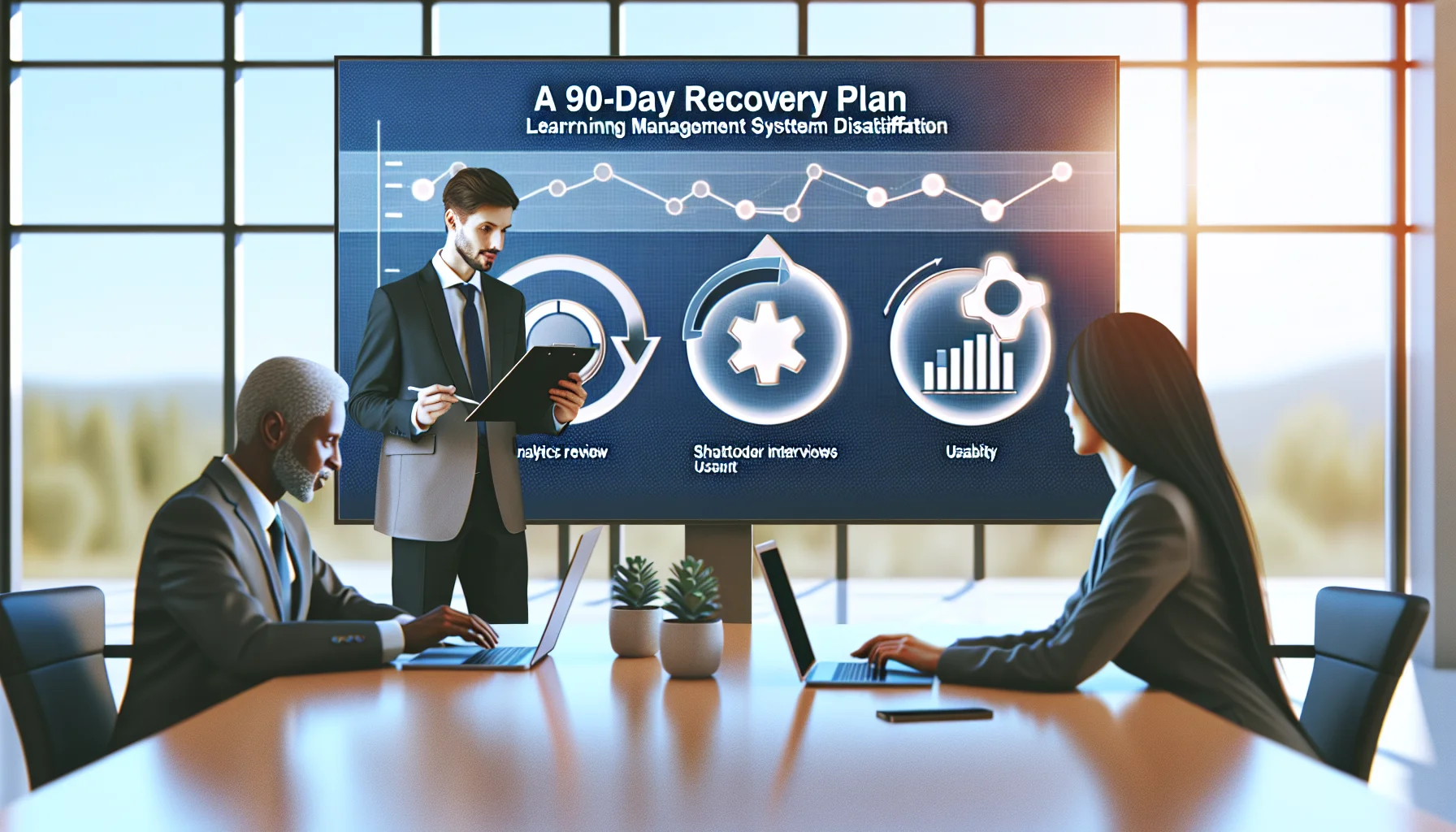
Recovery is a measurement problem. Build a simple dashboard that tracks a small number of high-impact metrics: completion time, support ticket volume, manager bypass events, and on-the-job performance. These metrics let you calculate reduced friction and the corresponding ROI uplift.
We recommend a 90-day scorecard: baseline, pilot changes, and post-implementation delta. Use these steps to quantify the how LMS dissatisfaction affects ROI and create a case for continued investment.
Practical implementation steps:
Key insight: Small, targeted fixes that reduce time-to-access and improve reporting often deliver outsized improvements in perceived value and measurable ROI.
Common pitfalls include chasing feature lists without fixing data, under-investing in UX, and treating training completion as the only success metric. Focus on outcomes: faster proficiency, fewer exceptions, and auditable compliance repeatability.
Finally, include stakeholders from Legal, HR, and the business early. Their involvement prevents scope creep and ensures the recovery plan addresses both operational and regulatory priorities.
The hidden costs of LMS dissatisfaction are real, measurable, and fixable. By reframing the issue as a cross-functional performance problem — not just a platform complaint — L&D teams can unlock latent value in lower churn, higher productivity, and stronger compliance posture.
Start with rapid diagnostics, prioritize fixes that reduce manual work, and run short, measurable pilots that demonstrate the LMS ROI impact. Use a simple scorecard to communicate results to executives and secure continued investment.
Next step: Run a 90-day LMS health audit with the stakeholders who own compliance, operations, and talent. Document time-savings and performance deltas, then present a concise ROI summary to decision-makers so you can convert dissatisfaction into measurable returns.
The Upscend Team provides actionable insights on technology and business strategy.
Book a walkthrough and we'll show you how it applies to your own content.
 General
December 14, 2025
This article outlines a three-stage diagnostic—analytics review, stakeholder interviews, and usability testing—to identify LMS dissatisfaction drivers. It prioritizes quick wins (0–30 days), medium fixes (30–120 days), a 90-day recovery plan, and governance practices to measure and sustain LMS user adoption.
 L&D
L&DDecember 14, 2025
This article explains why LMS dissatisfaction arises—from UX, content fit, integrations, and governance—and offers a three-step diagnostic and prioritized roadmap. It lists quick wins (simplify navigation, fix links, microlearning) and longer structural fixes (SSO, governance, curriculum redesign), plus metrics and a measurement cadence to track improvements.
 General
December 14, 2025
This article identifies common LMS dissatisfaction causes across technical, UX, and organizational domains. It presents a five-step diagnosis framework—telemetry, micro-surveys, task tests, stakeholder mapping, and impact-effort prioritization—and recommends short sprints, cross-functional squads, and governance to deliver measurable improvements within 8–12 weeks.
 L&D
L&DDecember 14, 2025
In this LMS dissatisfaction case study a mid-size services firm cut complaint volume 60% in six months by combining 60-day operational sprints with a 6–12 month remediation roadmap. Key actions included taxonomy and metadata standardization, UX simplification, automation, and governance, producing faster ticket resolution and higher completion rates.