


This article provides an actionable roadmap to build a human-AI partnership through readiness assessment, modular employee AI training, and lightweight governance. It recommends a 90-day pilot per role, KPIs to measure adoption and accuracy delta, and scaling patterns like role-based playbooks, hands-on labs, and executive dashboards.
Human-ai partnership is the linchpin for organizations moving from pilot projects to sustained productivity gains. In our experience, a clear ai workforce strategy combined with targeted employee ai training accelerates adoption and reduces resistance. This article outlines a practical, actionable roadmap for executives and L&D leaders: definitions, benefits and risks, a readiness checklist, five modular training frameworks, governance and KPIs, org charts, change management, resources, and short case studies to illustrate impact.
The human-ai partnership describes collaborative systems where human judgment and machine intelligence are paired to achieve outcomes neither could reliably produce alone. This includes decision support, automated workflows, augmented creativity, and real-time monitoring. In practical terms, the scope covers three layers: the interface layer (how humans interact), the model layer (how systems make recommendations), and the governance layer (how outcomes are validated and audited).
Defining scope early avoids scope creep and clarifies training goals. A focused scope statement should answer: Which roles will use the systems? What decisions remain human? Which outcomes are measured? Clear boundaries enable an effective ai integration roadmap and prioritize investments in the most valuable interfaces.
A partnership exists when systems routinely influence human decisions and humans routinely correct or refine system outputs. If a tool is strictly automation without human oversight, it’s automation—not a partnership. Treat partnership design as a socio-technical effort: people, processes, and tech must be designed together.
Include all systems that produce recommendations or automate analysis: large language models, predictive analytics, ML‑based routing, and augmented-reality decision aids. Explicitly list these in your intelligent systems adoption plan to align training and governance efforts.
Organizations that treat the human-ai partnership strategically unlock measurable gains and avoid common pitfalls. Benefits and risks must be weighed equally during planning.
Executive sponsors should quantify benefits using business metrics (revenue per employee, cycle time, error rates) and map them to a conservative ROI model. For risks, create mitigation plans tied to governance checkpoints and employee ai training milestones.
“A pattern we've noticed: teams that invest early in role‑specific training and governance move from skepticism to advocacy within two quarters.”
A practical assessment helps answer: Are you ready to implement a durable human-ai partnership? Use the checklist below to diagnose strengths and gaps.
Use a RAG (red/amber/green) scoring approach to prioritize investments. A lightweight scoring table speeds stakeholder conversations and informs the ai integration roadmap.
| Domain | Status | Next Action |
|---|---|---|
| Data Readiness | Amber | Implement lineage and sampling within 6 weeks |
| Training Capacity | Green | Begin pilot for three roles |
We recommend a modular approach to employee readiness that maps to roles, technology, ethics, practice, and blended delivery. Each module is a building block in the larger ai workforce strategy and can be combined based on maturity.
For practical design, start with a 6-week pilot per role: week 1 discovery, weeks 2–3 core training, week 4 labs, week 5 assessment, and week 6 feedback loop and iteration. This sequence forms the backbone of how to build a human-ai partnership strategy.
The turning point for most teams isn’t just creating more content — it’s removing friction. Tools like Upscend help by making analytics and personalization part of the core process; when integrated into the curriculum they reduce time-to-competency and make progress visible to managers and learners alike.
Replicate the pilot by converting role-based playbooks into templates and automating assessments. Use internal champions to run cohorts and embed learning in workflows with job aids and decision-support prompts.
Governance is the backbone of any sustainable human-ai partnership. Design governance to be lightweight but enforceable: policy guardrails, approval gates, and an audit trail for model changes and human overrides.
Recommended KPIs to track:
| KPI | Target | Frequency |
|---|---|---|
| Adoption | 65% of pilot roles within 3 months | Weekly |
| Accuracy delta | 10% reduction in errors | Monthly |
For pilot design: pick a bounded use case with measurable outcomes, enroll a small cross-functional team, and run a 90-day sprint with clear go/no-go criteria tied to KPIs. Use the pilot to iterate training content and refine governance before scaling.
Successful change management aligns sponsors, L&D, data science, and operations. Here are two before/after org chart concepts in words: before — siloed data team, disconnected L&D, and decentralised operations; after — a cross-functional AI enablement hub that includes a product owner, learning designer, data steward, and frontline champion per business unit.
Start small, measure fast, and scale what produces measurable business value — not what looks most advanced.
Three short case studies:
A deliberate human-ai partnership strategy turns intelligent systems into force multipliers rather than sources of disruption. Start with a readiness assessment, run tightly scoped pilots, and use modular training frameworks to build momentum. Prioritize governance, measurable KPIs, and clear role definitions to manage risk and maximize ROI.
Immediate next steps for leaders:
Key takeaways: Align people and tech from day one, measure early and often, and embed continuous learning into the workflow. When done well, the human-ai partnership becomes an enduring strategic advantage.
Call to action: Assemble a cross-functional pilot team this quarter and commit to a 90-day sprint that includes role-based training, governance gates, and measurable KPIs — use the checklist above to get started.
The Upscend Team provides actionable insights on technology and business strategy.
Book a walkthrough and we'll show you how it applies to your own content.
 Ai
AiJanuary 6, 2026
This article defines collaborative intelligence and explains why organizations should adopt human-AI collaboration. It provides a practical framework—skills matrix, role-based learning paths, governance steps—and a 12-month rollout with KPIs, sample curricula, and case studies. Readers will learn metrics, common pitfalls, and concrete steps to train humans to work with AI at scale.
 Ai
AiJanuary 6, 2026
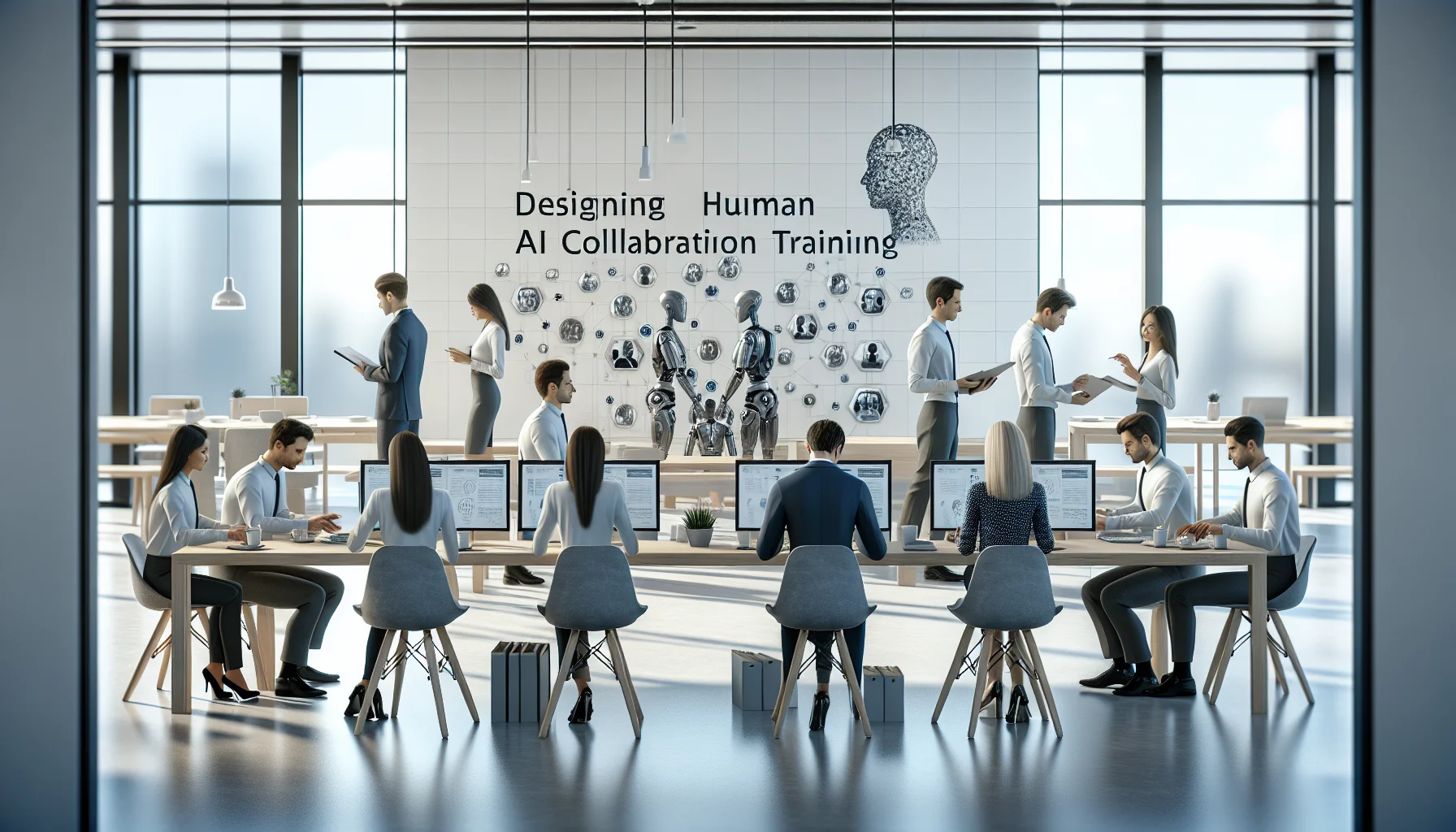
Step-by-step process to design human-AI collaboration training: assess needs, map personas, build role-specific competency maps, and deliver modular curricula with microlearning and simulations. Pilot, measure adoption and business KPIs, then scale via train-the-trainer and automated assessments. Includes templates and two case examples showing measurable impact.
 Ai
AiJanuary 6, 2026
This article compares human-AI training methods for collaboration skills, evaluating instructor-led, e‑learning/microlearning, experiential labs, and embedded on-the-job coaching. It provides cost and time-to-competency estimates, two concise pilot designs, and measurement tactics. Recommendation: use a blended stack—microlearning, VILT, labs, and embedded coaching—to maximize transfer and adoption.
 Ai
AiFebruary 3, 2026
This article outlines a tactical 90-day plan to implement AI co-pilot for employee training across six phases: discovery, pilot design, data connection, pilot launch, iteration, and scale. It includes LMS integration strategies, data privacy checklists, a sample RACI, pilot success criteria, common pitfalls and practical remediation steps.