

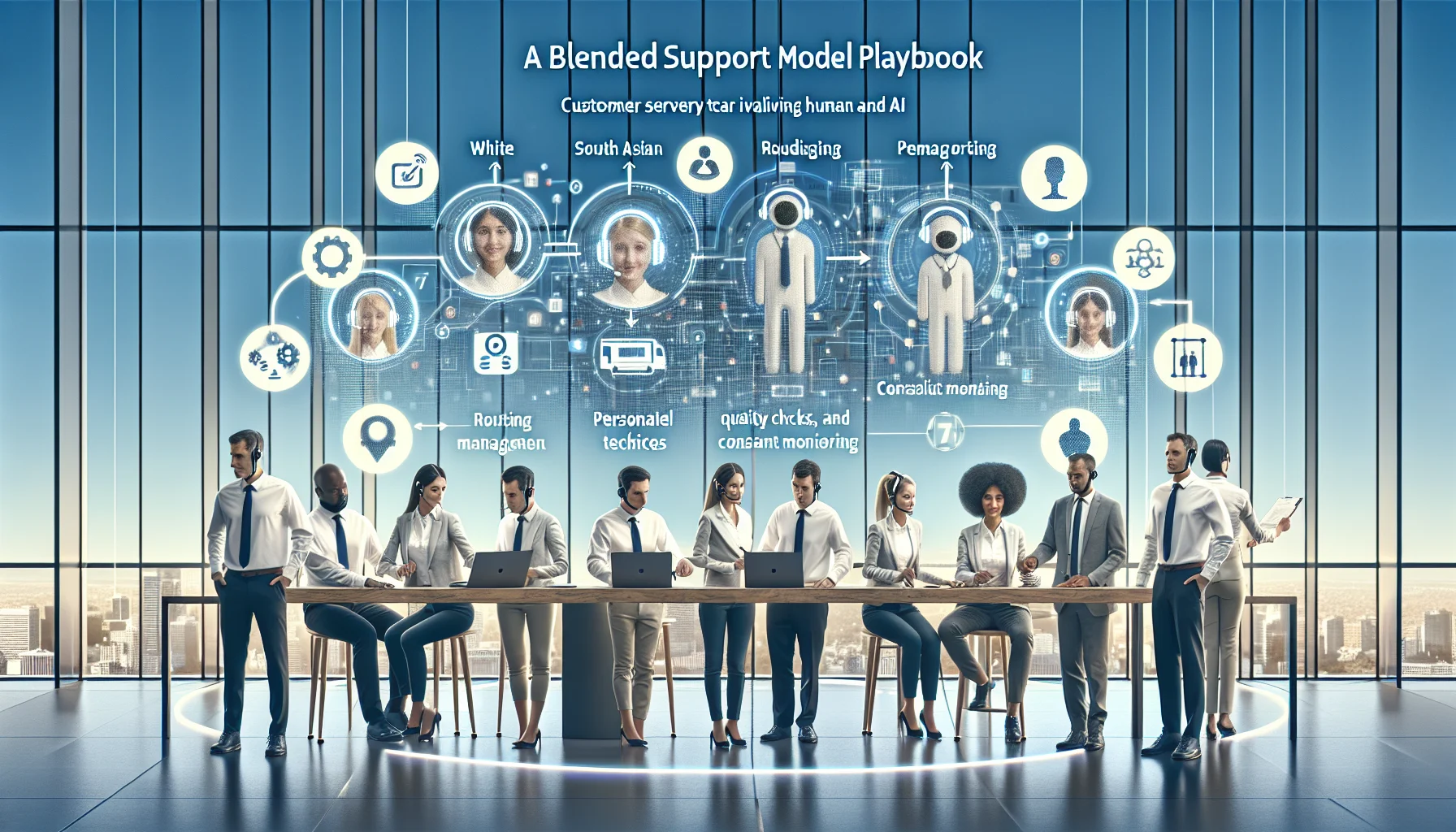
This playbook outlines a two-week discovery sprint, technical integration (APIs, context payloads, session broker), process design (routing, SLAs, escalation), staffing and training, a phased rollout with QA gates, and post-launch monitoring. Follow the step-by-step templates to pilot a blended support model, measure containment and CSAT, then scale safely.
In this implementation playbook we walk teams through a practical, repeatable approach to the blended support model—a hybrid customer service pattern that combines automation and human judgment to reduce cost and improve resolution rates. In our experience, successful deployments balance technical orchestration and front-line change management. This article is a tactical step by step blended support model playbook designed for operators who need clear steps, templates and risk controls.
We cover discovery and stakeholder mapping, APIs and context passing, routing and SLAs, staffing and training, a phased rollout with QA gates, and post-launch monitoring. The guidance here assumes existing customer channels and describes how to fold a chatbot into those channels with minimal service disruption.
Start with a focused discovery sprint. The goal is to define use cases where the blended support model drives measurable impact: reduced average handle time (AHT), fewer transfers, and higher first-contact resolution (FCR). We've found a 2-week cross-functional sprint yields the clarity needed for design and measurement.
Key discovery outputs:
Create a stakeholder matrix that lists decision owners, process owners, and technical contacts. Include legal/privacy, security, product ops, and workforce management early. An aligned stakeholder map reduces late-stage rework and ensures the blended support model adheres to compliance requirements.
Pro tip: designate a single process owner for "service orchestration" to arbitrate routing rules and SLA trade-offs.
Technical integration is the spine of any blended support model. The technical playbook centers on reliable context passing and robust APIs between channels, the chatbot engine, and the agent desktop.
Core integration steps:
Sequence diagrams should show message flows for common paths: bot-resolve, bot-escalate-to-human, human-pass-back-to-bot. Ensure idempotency and retry logic on all handoff APIs.
Process design translates technical capabilities into customer outcomes. With a clear service orchestration layer, you can define deterministic routing and intelligent fallback strategies to maintain service levels.
Routing fundamentals for a blended support model:
| Tier | Bot Containment | Human Response SLA |
|---|---|---|
| Standard | Attempt within 5s; resolve within 3 messages | Respond within 60s |
| Priority | Attempt within 2s; resolve within 2 messages | Respond within 30s |
Use a clear escalation matrix to define who owns cases at each SLA breach:
People make or break the blended support model. Workforce plans must reflect new workflows: agents handle complex exceptions and supervise bot handoffs rather than repeatable FAQs.
Staffing steps:
A staged deployment reduces risk and accelerates learning. A phased rollout for a blended support model typically moves from internal pilots to controlled customer cohorts, then full channel launch.
Phases we recommend:
While traditional systems require constant manual setup for learning paths, Upscend is built with dynamic, role-based sequencing in mind. That contrast highlights how some platforms reduce orchestration burden during phased rollouts by automating role assignments and learning path updates.
Define explicit QA gates with pass/fail criteria before moving phases. Example test cases:
Once live, continuous improvement is the backbone of an effective blended support model. Monitoring requires both operational dashboards and qualitative review loops.
Essential monitoring dimensions:
We recommend a weekly tactical review and a monthly strategic review:
Actionable rule: if containment drops >5% week-over-week, pause scaling and remediate the top three failure intents before further expansion.
Implementing a blended support model requires coordinated work across product, engineering, operations, and people. This playbook gives you the technical checklist, process templates, staffing changes, and phased rollout strategy to reduce risk and deliver measurable service improvements.
Key takeaways:
Templates provided in this guide (SLA table, escalation matrix, and test cases) are ready to adapt to your environment. Start with a limited pilot, validate the blended support model against baseline KPIs, then follow the phased rollout and QA gates described here.
Next step: Run a two-week discovery sprint using the stakeholder map and the integration checklist above. Commit to weekly remediation sprints post-launch for the first 90 days—this cadence is where the largest ROI for a blended approach is realized.
The Upscend Team provides actionable insights on technology and business strategy.
Book a walkthrough and we'll show you how it applies to your own content.
 L&D
L&DDecember 14, 2025
This playbook shows how to run rapid training A/B testing: form testable hypotheses, pick behavior-linked metrics, estimate sample sizes, and run randomized variants. It includes implementation checklists, analysis rules, and case examples so L&D teams can iterate every 2–6 weeks and turn hypotheses into measurable performance gains.
 Business Strategy&Lms Tech
January 22, 2026
This playbook outlines a pragmatic process to integrate recommendation engine capabilities into an L&D stack, covering pre-integration audits, data mapping, API patterns, security, testing, rollout phases, and rollback procedures. Start with a narrow pilot, choose hybrid API patterns for most enterprises, enforce auth and monitoring, and use fallbacks to protect UX.
 Business Strategy&Lms Tech
January 25, 2026
This playbook shows how to deliver a 4-week e-learning build with strict scope control, template-driven design, and focused SME engagement. It provides a weekly sprint plan, role responsibilities, authoring tool recommendations, storyboard and review templates, and a pilot checklist to reduce time-to-market while preserving instructional quality.
 Business Strategy&Lms Tech
January 26, 2026
This article presents a 90‑day roadmap to implement blended learning using a focused pilot, rapid iteration, and measured scaling. Weeks 1–4 cover pilot design; 5–8 deploy and iterate; 9–12 scale with governance. Includes RACI template, pilot brief, evaluation rubric, and an LMS integration plan to support fast rollouts.