


This article explains how to measure soft-skills impact using an Experience Influence Score (EIS). It shows how to combine behavioral competency metrics, 360 feedback, sentiment and trace data with outcome linkages to produce a standardized, trendable score, plus a sample rubric, cadence and pilot steps for validation.
In our experience, measuring soft-skills is one of the most persistent challenges for HR and people analytics teams. Traditional LMS completion rates and quiz scores capture knowledge, but not reliably the behavioral change that drives business outcomes. This article lays out a pragmatic, research-informed approach to quantify soft skills impact using an Experience Influence Score (EIS), combining proxies, hybrid measures and competency rubrics so boards and leaders can see the connection between learning investments and organizational results.
Measuring soft-skills matters because these competencies—communication, empathy, problem-solving and collaboration—drive retention, customer satisfaction and innovation. Boards increasingly ask for people metrics that explain performance variance, and soft skills are often the missing explanatory variable.
However, three obstacles repeat in most organizations:
Our experience shows hybrid measurement reduces error. Combine behavioral competency metrics with objective outcomes and signal-processing approaches (e.g., smoothing, control groups). Repeated measures and triangulation are essential to create a robust EIS that executives trust.
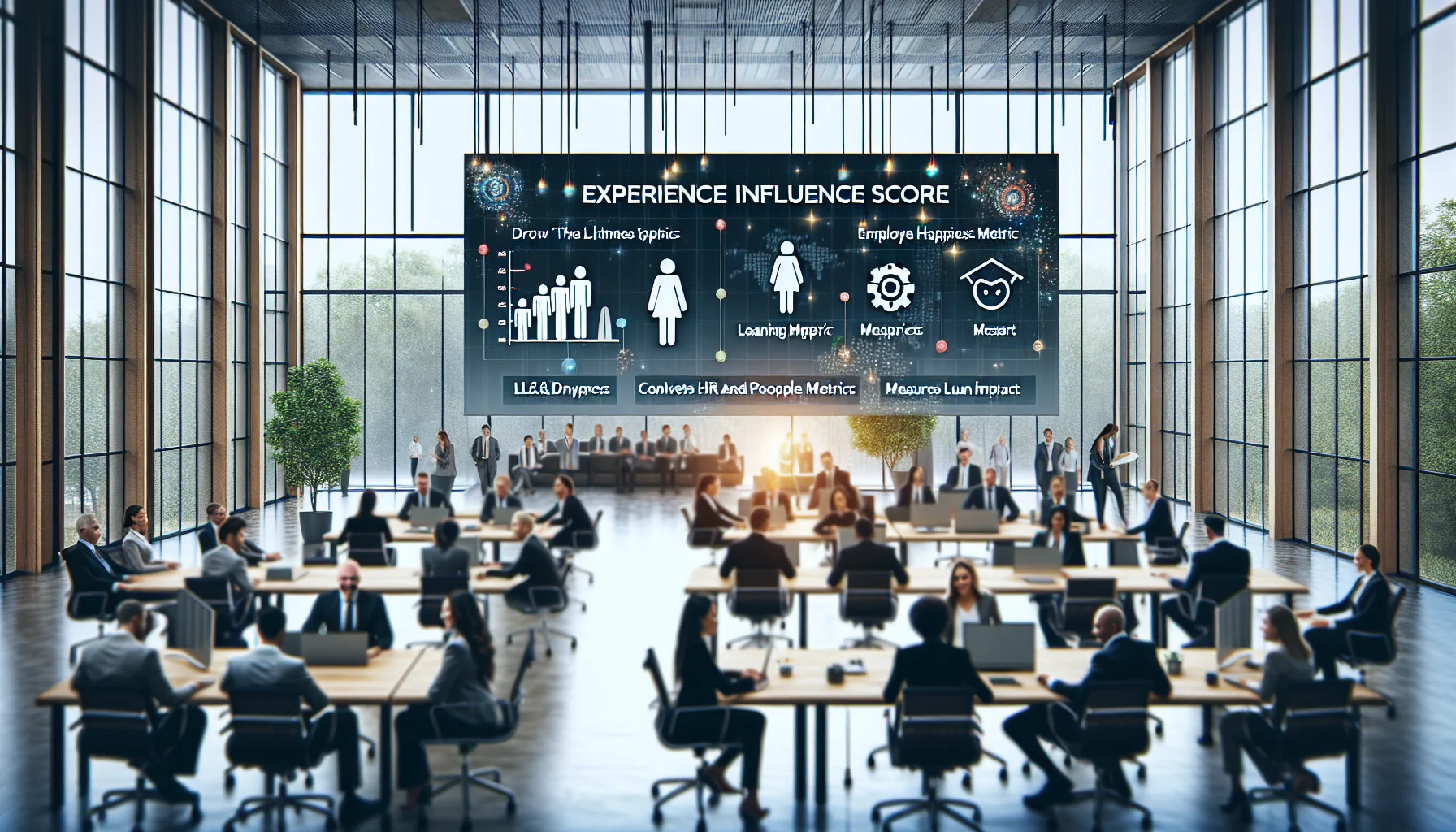
The Experience Influence Score is a composite index designed to quantify the influence of learning experiences on observable behaviors and business outcomes. EIS converts multiple inputs—qualitative and quantitative—into a standardized score that can be trended, benchmarked and reported to senior leaders.
Core EIS attributes include:
EIS shifts focus from completion to influence: rather than counting finishes, it weights evidence of behavior change and business effect. This transition is crucial for credible soft skills measurement because behavior—not completion—drives impact.
When direct observation is impossible, proxies and hybrid measures create measurable signals. Below are the proven inputs we recommend integrating into EIS for soft-skills measurement.
360 feedback provides multi-source views that reduce individual rater bias. Use standardized questions anchored to behavioral exemplars and convert responses into normalized scores. Combine frequency-weighted ratings with rater reliability adjustments to reduce noise.
Attach soft-skills competencies to project-level outcomes (e.g., on-time delivery, stakeholder satisfaction). When a team member leads a cross-functional project, measure both the project outcome and complementary behavioral ratings to compute contribution-weighted EIS components.
Text analytics on support tickets, coaching notes and post-interaction surveys yield sentiment signals. Natural language processing can surface empathy, problem-solving language and escalation triggers that map to soft skills indicators for Experience Influence Score.
Digital collaboration platforms produce trace data—response times, thread participation, cross-team touches—that can be normalized as behavioral proxies. While indirect, these traces are high-frequency signals that improve EIS temporal resolution.
Modern LMS platforms are evolving to support AI-powered analytics and personalized learning journeys based on competency data; Upscend's recent implementations illustrate this trend by integrating behavioral signals with outcome data to produce richer EIS models in practice.
A clear rubric translates observable behavior into scores that feed the EIS. Below is a concise sample for a customer-facing communication competency:
| Level | Behavioral Indicators | Score |
|---|---|---|
| Exceeds | Consistently clarifies needs, de-escalates, and achieves first-contact resolution | 5 |
| Meets | Usually communicates clearly and resolves issues with occasional escalation | 3 |
| Developing | Requires coaching to clarify issues and often needs supervisor intervention | 1 |
Use the rubric across raters and convert to a normalized competency score (0–100) for the EIS input.
We recommend a mixed cadence to balance timeliness and stability:
Combine short-cycle signals with less frequent but higher-validity measures to populate the EIS and to detect both immediate shifts and sustained behavior change.
Context: A mid-sized SaaS provider ran a six-month soft-skills rollout focused on empathy and structured problem-solving for customer success reps. The program combined microlearning, coaching and role-play assessments.
Measurement design:
Findings after six months:
This case demonstrates how combining behavioral competency metrics, proxy signals and outcome linkage turns soft skills programs into interpretable, board-ready evidence of impact.
Step-by-step implementation to operationalize EIS for soft skills:
Common pitfalls to avoid:
Best practices we’ve found effective include using inter-rater reliability checks, applying smoothing windows to reduce volatility, and presenting EIS alongside confidence intervals to reflect measurement uncertainty.
To strengthen causal claims tie EIS changes to outcomes using quasi-experimental designs: A/B testing where feasible, time-series models with controls, or difference-in-differences comparing trained vs. matched untrained peers. Transparency in method and sensitivity checks are essential to defend findings with leadership.
Measuring soft-skills impact requires moving beyond completion statistics to a composite, evidence-based metric like the Experience Influence Score. By combining 360 feedback, behavioral competency metrics, project outcomes, sentiment analysis and digital trace data, organizations can build a reliable EIS that ties learning to business results.
Practical next steps:
Measuring soft-skills is feasible with a disciplined approach that combines strong design, multiple data sources and transparent analytics. Start with a focused competency, instrument consistently, and iterate—this will produce a board-ready narrative that links soft-skills development to measurable business impact.
Call to action: If you’re ready to pilot an EIS for a priority competency, begin with a single team and the rubric above; collect three signal types over a quarter and evaluate EIS-linked outcomes to build the case for scale.
The Upscend Team provides actionable insights on technology and business strategy.
Book a walkthrough and we'll show you how it applies to your own content.
 HR & People Analytics Insights
January 6, 2026
The Experience Influence Score (EIS) is a normalized index that translates L&D inputs—completion, engagement, performance delta, manager feedback, wellbeing—into a single employee happiness metric. Using weighted standardized inputs and an attribution coefficient, EIS helps HR quantify learning impact, prioritize programs, and report training ROI with confidence intervals and governance.
 Workplace Culture&Soft Skills
January 28, 2026
This article compares 360 feedback vs behavioral data for evaluating soft skills, outlining measurement theories, validity, reliability, biases and costs. It provides decision rules, three hybrid integration patterns, pilot metrics and a 6–12 week roadmap to test a single competency. Use 360s for perception, behavioral data for continuous monitoring, and combine both for defensible insight.
Workplace Culture&Soft SkillsFebruary 5, 2026
This article shows how measuring nuance converts soft skills into auditable ROI using three models: cost of errors, retention lift, and escalations avoided. It provides a three-tab spreadsheet blueprint, scenario and sensitivity tests, KPI cadence, and an executive one‑page template to run an 8–12 week pilot and validate assumptions.