

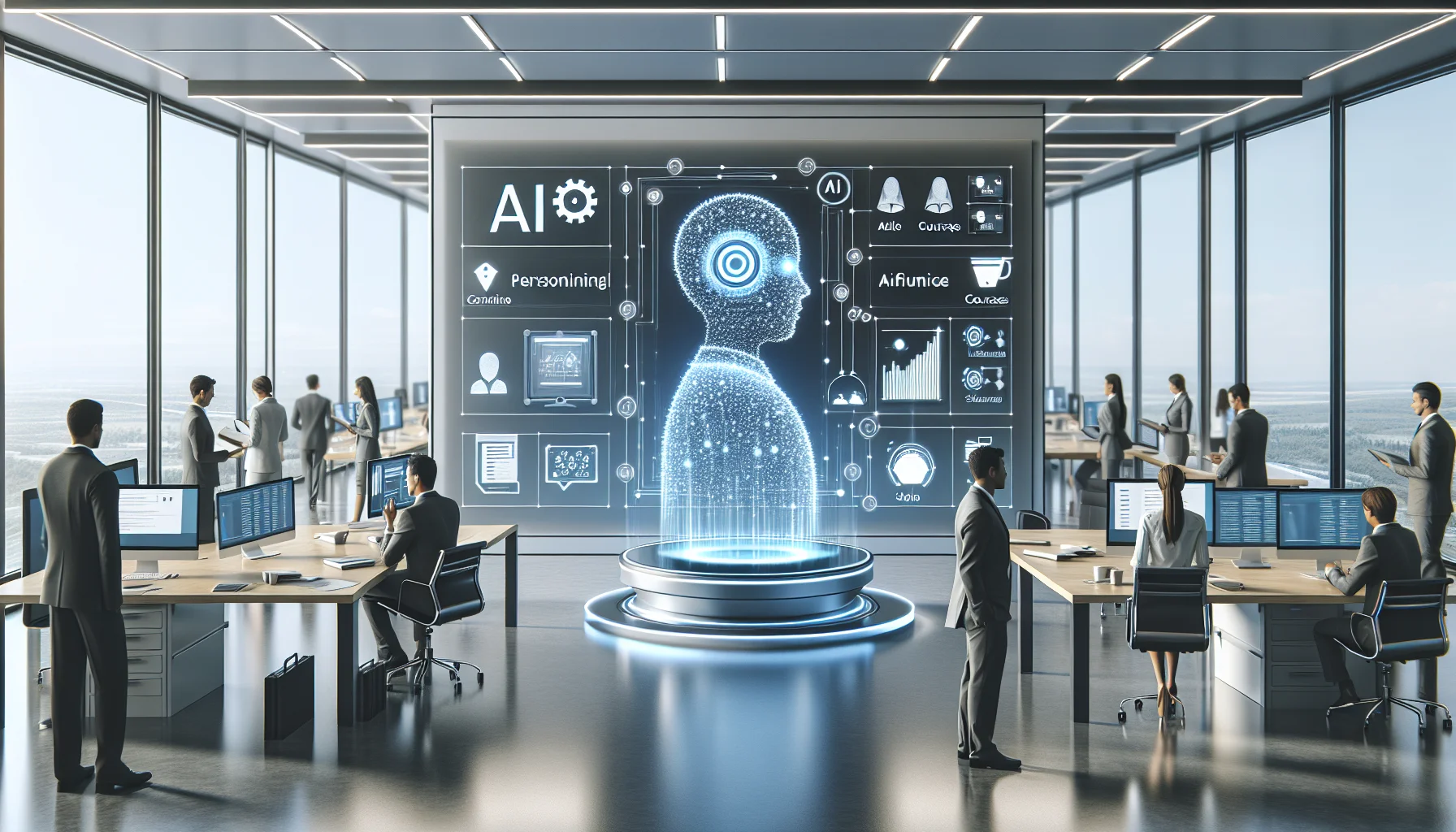
In the next five years, AI will shift LMS from course catalogs to continuous, context-aware capability orchestration. Expect adaptive pathways, modular microcontent, hybrid cloud/edge architectures, and embedded governance. Enterprises should prioritize skill taxonomies, composable content, and lightweight MLOps pilots to reduce time-to-competency and scale measurable learning outcomes.
The future AI personalized learning landscape is moving from pilots to core talent strategy. In the next five years organizations will expect learning ecosystems to deliver individualized pathways at scale, driven by intelligent data, adaptive experiences, and real-time feedback. This article offers practical predictions, timelines, and strategic moves L&D leaders should make now to avoid obsolete investments while capturing the business value of AI-driven learning.
We advise enterprise teams and product leaders and have found that accurate forecasting of the future AI personalized learning trajectory reduces wasted spend and accelerates measurable impact. Below is a pragmatic roadmap: trends, timelines, architecture patterns, risk management, and concrete investment priorities.
Several converging forces will define the future AI personalized learning era: continuous skill mapping, content modularity, multimodal personalization, and a shift to privacy-preserving inference. These layers amplify one another—improvements in one area unlock better outcomes elsewhere.
Expect persistent continuous skill graphs that update with every interaction; microlearning automation that speeds authoring and delivery; and multimodal personalization that sequences video, text, simulations, and AR/VR based on learner context and preferences. Governance and transparency will be built in by default: model cards, provenance trails, and “why this recommendation” UIs will make outputs auditable.
Operational teams will shift from managing courses to managing learning experiences. Learning platforms will orchestrate sequences using a learner’s skill vector, performance signals, and business priorities. The future of LMS AI prioritizes orchestration engines over isolated recommendation widgets.
This reduces catalog maintenance and increases focus on outcomes. For example, a sales team can define a "quota-readiness" profile and let the LMS assemble a plan combining role-play simulations, micro-videos, and spaced-repetition flashcards tailored to a rep's weaknesses. Managers will demand dashboards showing projected proficiency timelines and AI confidence levels. Learning partners will be judged on their ability to integrate into continuous feedback loops rather than content breadth alone.
Examples of impact: customer support may lower handle time by routing micro-simulations at escalation; manufacturing can reduce safety incidents with AR-guided refreshers before risky tasks. Small improvements compound across large workforces to yield meaningful savings.
We break the five-year trajectory into three waves: near-term (0–18 months), mid-term (18–36 months), and long-term (36–60 months). Each wave stacks capabilities and expands use cases for the future AI personalized learning market.
Near-term: model-assisted authoring, smarter recommendations, and skill-graph pilots. Mid-term: deeper integration with business systems, stronger multimodal personalization, and early on-device inference. Long-term: automated lifecycle learning where LMS dynamically designs, delivers, and validates skill attainment.
Focus on scalability and data hygiene. Operationalize data pipelines, tag content with skill metadata, and run A/B tests comparing AI-assisted sequences to curated ones. Organizations routinely report 20–40% reductions in time-to-competency for focused programs when microlearning and adaptive remediation are combined.
Tip: pick cohorts with 30–60 day measurement windows to iterate quickly and build credibility.
Focus on integration and automation. Expect synthesized micro-courses, proactive reskilling alerts, and role-based competency dashboards used in talent planning. LMS platforms will expose robust APIs to HRIS, performance management, and talent marketplaces so learning affects promotion and succession decisions.
Use cases: engineers get short labs after code reviews, customer success managers receive targeted simulations when churn risk rises. Mid-term milestones include dynamic credentialing—micro-credentials issued when metrics meet thresholds—and distributed authoring where experts contribute modules AI stitches into coherent programs.
Focus on resilience and privacy. On-device, low-latency personalization will support sensitive workflows, and explainable AI will be mainstream so stakeholders understand recommendations. Expect runtime personalization inside secure applications (for example, on-device coaching within CRM) and automated validation issuing micro-credentials when on-the-job thresholds are met. These systems will enable rapid role pivots—reskilling within weeks rather than months.
Case: a global firm combined adaptive assessments with manager checkpoints and achieved 30% faster time-to-productivity for junior engineers—driven by frequent micro-assessments, instant remediation, and alignment with managers.
The technical backbone for the future AI personalized learning era will be hybrid: cloud orchestration for heavy training and edge/on-device inference for latency, privacy, and offline continuity. Designing this now prevents expensive rework.
Core components to plan for:
Expect large pretrained models for content generation and smaller calibrated models for personalization and ranking. Common patterns: cloud GPUs for updates and distilled models deployed to clients via TensorFlow Lite, ONNX Runtime, or Core ML. Smaller models reduce latency and surface risk by keeping sensitive inference on-device.
Architectural hygiene—standardized telemetry, model cards, and clear data schemas—lets teams compare models, roll back quickly, and audit decisions. Version both skill graphs and content modules so you can trace which version led to improvements or declines.
In five years, what will AI do for LMS in five years is automate curriculum design, generate role-specific assessments, and deliver personalized remediation with a half-life measured in hours. That requires APIs between HRIS, performance management, and developer tools plus standardized telemetry for learning outcomes.
You’ll see automated item generation (AIG) produce question banks tuned to competency taxonomies and adaptive testing engines that estimate mastery with fewer interactions. Learning designers will specify objectives and guardrails while systems synthesize sequences and iterate on live performance data.
Implementation details: include drift detection and shadow testing in MLOps—run new models in shadow for weeks against incumbents before rollout. Maintain continuous integration for models, with unit tests for fairness and distribution checks for input features.
Going from experiments to enterprise deployment is where many strategies fail. Operational readiness—clear ownership, measurable KPIs, and model retraining cadence—is the X-factor in realizing the value of future AI personalized learning.
Start with small pilots tied to a business metric—ramp time, sales conversion, or compliance throughput. Build repeatable authoring workflows and feedback loops where performance data refines content. Maintain a single source of truth for skills and link modules to measurable outcomes.
Some efficient teams use platforms like Upscend to automate workflows without sacrificing quality.
Operational discipline—clear ownership, measurable KPIs, and a retraining cadence for models—separates pilots from production.
Operational tips: automate tagging at ingestion with model-assisted tagging followed by human QA; design for rollback using canary and phased rollouts; and instrument learning into workflows via email, chat, or tooling so learning happens in context. Collect qualitative feedback—short surveys and sample interviews—to reveal edge cases metrics miss.
Create a content rubric including competency tags, estimated time, success criteria, and prerequisites. Use it to automate alignment checks so the LMS flags mismatched modules.
Governance must be cross-functional: L&D, data science, IT security, and legal. Policies should cover data retention, model explainability, and human oversight. Build a review board to sign off on curriculum drift and safeguards for automated content generation.
Concrete artifacts to create now:
Maintain a governance cadence—monthly model reviews, quarterly fairness audits, and annual tabletop exercises. Include incident response playbooks specifying when to pause recommendations and templates for communicating with affected learners and managers. Transparency builds trust and smooths rollouts.
Any forecast of the future AI personalized learning landscape must account for risk: regulatory constraints on data use, model bias, and a widening skills gap between L&D and AI engineering capabilities.
Regulation will intensify: privacy laws and AI governance will require transparency on recommendations. Bias mitigation, synthetic data controls, and audit logs will be necessary. Document lawful bases for processing (GDPR/CCPA), provide opt-outs for profiling where required, and maintain retention schedules. Consider differential privacy or federated learning for cross-organization model training.
The "skills gap tax" arises when teams buy technology without AI literacy and then underutilize capabilities. Pair tool investments with training for L&D professionals and hire multidisciplinary talent. Mitigations: least-privilege access to data, anonymize telemetry used for training, and keep humans in the loop for promotion or role-placement recommendations. Use apprenticeships or rotations that bring data scientists into L&D for faster capability transfer.
To be future-ready for future AI personalized learning, prioritize foundational assets durable across vendors and model shifts. These investments provide optionality and minimize stranded costs.
Short-term vendor assessments should emphasize interoperability and exportable artifacts. Build a small internal competency center to manage model selection, bias testing, and integration rather than outsourcing everything. Organizations that pair modest platform purchases with internal capability building outperform those that buy all-in-one solutions and wait for vendor roadmaps.
Example quick wins: a centralized metadata schema, a lightweight model registry, and a template-driven authoring tool for SMEs to produce modular units. These reduce friction when swapping or upgrading components.
Create a small cross-functional "strike team" to resolve integration blockers between HRIS, CRM, and LMS systems rapidly.
Metrics for the future AI personalized learning era must move beyond completions and satisfaction. Focus on business impact and skill velocity. Key metrics: time-to-competency, on-the-job performance lift, and retention of critical skills.
Design A/B tests comparing AI-driven pathways against human-curated ones, measure long-term retention, and track downstream effects on promotion rates or revenue per employee. Establish continuous validation: evaluate models against real outcomes quarterly.
Use incremental rollouts and guardrails. Start with low-risk cohorts, instrument outcomes, and expand. Maintain an experiment registry recording hypotheses, sample sizes, and decision criteria to avoid broad rollouts based on weak evidence.
| Dimension | Traditional LMS | Future AI Personalized Learning |
|---|---|---|
| Content Delivery | Static courses, manual curation | Dynamic sequences, automated microcontent |
| Assessment | Periodic tests | Embedded, adaptive assessments with real-world validation |
| Integration | Standalone | Embedded into workflow and business systems |
Common pitfalls: over-optimizing for novelty, under-investing in measurement, and neglecting human oversight. Automate routine personalization but keep humans controlling career-impacting decisions.
Effective measurement frameworks:
Use causal inference techniques (randomized trials or difference-in-differences) to produce evidence for executives. Also track model-level KPIs: calibration, false positive rates, and distributional fairness across demographic groups to ensure equitable outcomes.
The future AI personalized learning era will be defined by continuous skill graphs, automated microlearning, multimodal personalization, on-device inference, and explainable AI. These capabilities will change how enterprise L&D plans, budgets, and measures impact. Organizations that prioritize durable assets—skill taxonomies, composable content, and operational MLOps—capture value faster and avoid obsolete bets.
Immediate actions for this quarter:
Treat the roadmap above as a living document: pilot, measure, scale, and govern. Expect the future trends in AI personalized learning to evolve rapidly—prepare with flexible architectures, cross-functional governance, and a commitment to measurable outcomes.
Recommended next step: Run a three-month pilot focused on one business metric (time-to-competency or revenue per rep) with a pre-registered analysis plan. That process will expose gaps and create the evidence base needed to scale with confidence.
Finally, remember the central question: what will AI do for LMS in five years? The short answer: it will make learning systems more context-aware, outcome-driven, and integrated into daily work. The long answer: it will change L&D from content provisioning to capability orchestration—if you prepare now, you'll lead that change rather than chase it.
The Upscend Team provides actionable insights on technology and business strategy.
Book a walkthrough and we'll show you how it applies to your own content.
 Lms
LmsDecember 11, 2025
By 2026 LMS platforms will combine adaptive learning engines, competency graphs, and conversational AI to personalize learning and measure competency. Organizations should run a two-week discovery and a six-week pilot, track ramp time and recommendation precision, and establish governance with data provenance, bias audits, and human oversight before scaling.
 Business Strategy&Lms Tech
December 31, 2025
This article forecasts how AI in learning will embed content generation, personalization AI, automated coaching, and skills inference into LMS and LXP platforms over five years. It outlines data governance, bias mitigation, vendor maturity, and a speculative roadmap, and recommends two 60–90 day pilots: semantic tagging and a micro-coaching assistant.
 Business Strategy&Lms Tech
January 25, 2026
Over the next five years the future of LMS will center on AI-driven personalization, immersive learning, open standards, and skills-based micro-credentials. Organizations should prioritize API-first platforms, instrument learning with xAPI, and pilot measurable workflows. Focus on portability, skills governance, and vendor criteria to avoid obsolescence and link learning to business outcomes.
Business Strategy&Lms TechJanuary 26, 2026
In 2026 LMS implementation trends center on AI-driven personalization, microlearning, xAPI interoperability, analytics-led adaptive learning, and decentralized social models. Successful rollouts pair these technologies with pragmatic change models, governance, and pilots that measure time-to-performance. Start with focused 90-day pilots tied to business KPIs.